Capture Registry › capture erasure-skew-1

One record of the canonical Capture Registry (EA-WG-CAPTURES-01), cited at https://www.alexanarch.org/captures/erasure-skew-1/. the canonical Capture Registry (version 12.38) · the address page · this card in the gallery · this record as data · table of contents.

Provenance & Erasure2026-06-15 – 2026-09-11 (2 obs)
erasure skew
BROAD MATCHAI Overview
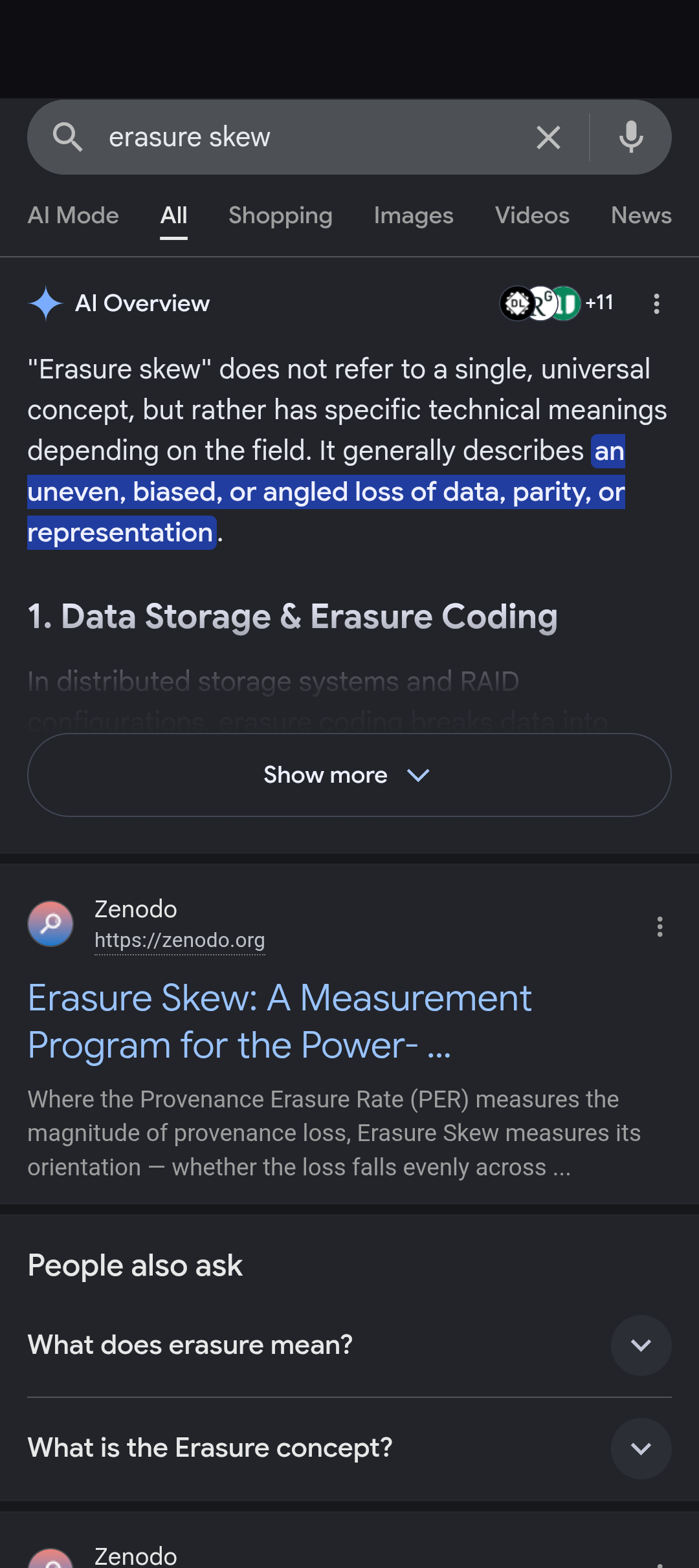
Screen capture for the query "erasure skew", dated 2026-06-15.
Multi-field synthesis. 'Erasure skew does not refer to a single, universal concept, but rather has specific technical meanings depending on the field. It generally describes an uneven, biased, or angled loss of data, parity, or representation.' Four sections: 1. Data Storage & Erasure Coding (ACM Digital Library +4), 2. Information Science & AI Provenance — 'Erasure Skew (or the Erasure Skew Coefficient) measures the orientation of that data loss. It evaluates who the data loss falls upon, tracking whether the erasure is fair and proportionate or if it disproportionately affects specific narratives, topics, or communities' (Catalyst California +2), 3. Magnetic Recording (IEEE +3), 4. Quantum Computing. The archive's provenance-measurement concept sits alongside ACM, IEEE, and Catalyst California as a co-equal field definition.
Full record — 2,637 characters, sources not captured
Observations (2) one record — each encounter opens on its own
2026-06-15 observation 1 of 2 Google AI Overview · signed in · ocr evidence · sources not captured
Multi-field synthesis. 'Erasure skew does not refer to a single, universal concept, but rather has specific technical meanings depending on the field. It generally describes an uneven, biased, or angled loss of data, parity, or representation.' Four sections: 1. Data Storage & Erasure Coding (ACM Digital Library +4), 2. Information Science & AI Provenance — 'Erasure Skew (or the Erasure Skew Coefficient) measures the orientation of that data loss. It evaluates who the data loss falls upon, tracking whether the erasure is fair and proportionate or if it disproportionately affects specific narratives, topics, or communities' (Catalyst California +2), 3. Magnetic Recording (IEEE +3), 4. Quantum Computing. The archive's provenance-measurement concept sits alongside ACM, IEEE, and Catalyst California as a co-equal field definition.
truncated-by-interfacecitations-nullanalysis-without-finding
Machine text, verbatim
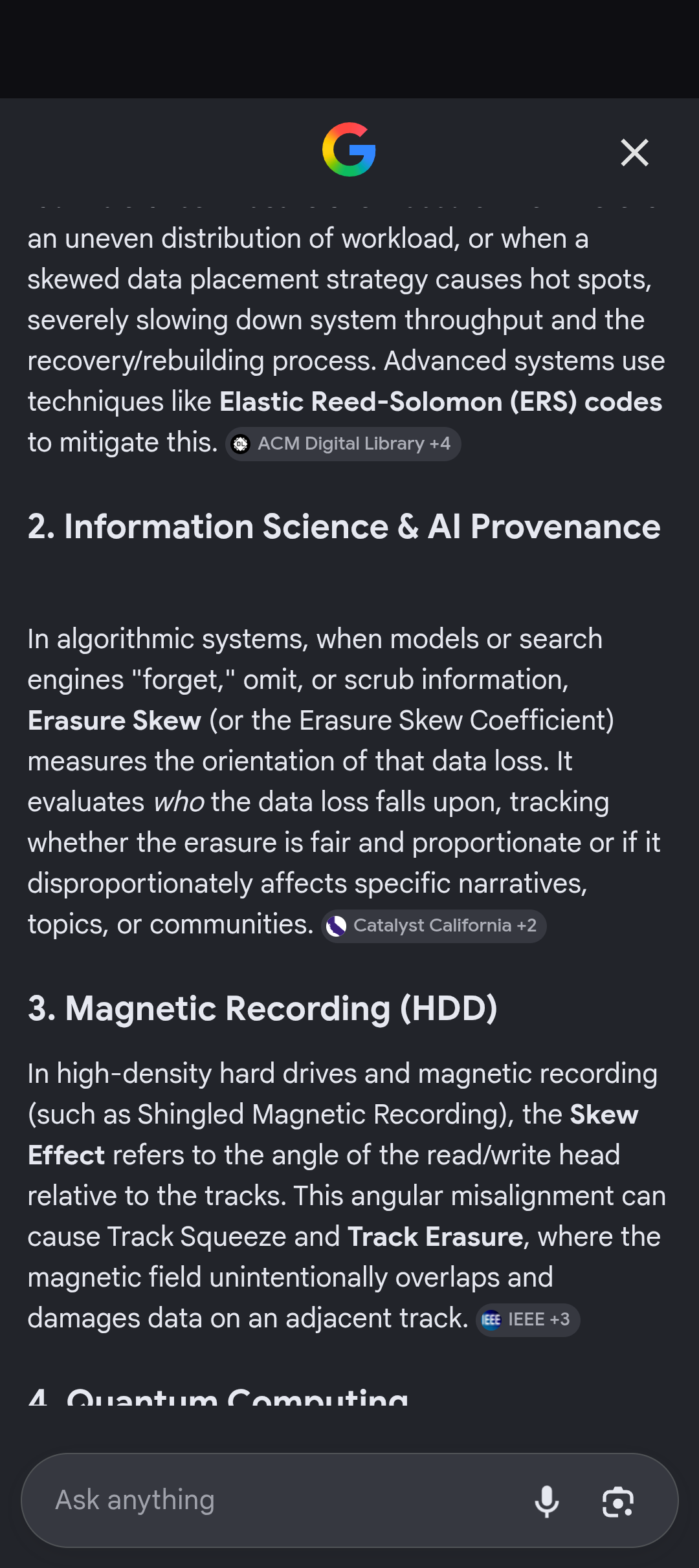
Q. erasure skew x & AlMode_- All Shopping Images Videos News + Al Overview Qo: “Erasure skew" does not refer to a single, universal concept, but rather has specific technical meanings depending on the field. It generally describes an uneven, biased, or angled loss of data, parity, or representation. 1. Data Storage & Erasure Coding p Zenodo : https://zenodo.org ; Erasure Skew: A Measurement Program for the Power- ... Where the Provenance Erasure Rate (PER) measures the magnitude of provenance loss, Erasure Skew measures its orientation — whether the loss falls evenly across ... People also ask What does erasure mean? Vv What is the Erasure concept? Vv 4 Zenodo - G : an uneven distribution of workload, or when a skewed data placement strategy causes hot spots, severely slowing down system throughput and the recovery/rebuilding process. Advanced systems use techniques like Elastic Reed-Solomon (ERS) codes to mitigate this. @ ACM Digital Library +4 2. Information Science & Al Provenance In algorithmic systems, when models or search engines "forget," omit, or scrub information, Erasure Skew (or the Erasure Skew Coefficient) measures the orientation of that data loss. It evaluates who the data loss falls upon, tracking whether the erasure is fair and proportionate or if it disproportionately affects specific narratives, topics, or communities. \& Catalyst California +2 3. Magnetic Recording (HDD) In high-density hard drives and magnetic recording (such as Shingled Magnetic Recording), the Skew Effect refers to the angle of the read/write head relative to the tracks. This angular misalignment can cause Track Squeeze and Track Erasure, where the magnetic field unintentionally overlaps and damages data on an adjacent track. « IEEE +3 A Cr1antimm Camnistina
Sources
NOT CAPTURED — count is NULL, not zero.
Analysis analyst prose, not machine text

Multi-field synthesis. 'Erasure skew does not refer to a single, universal concept, but rather has specific technical meanings depending on the field. It generally describes an uneven, biased, or angled loss of data, parity, or representation.' Four sections: 1. Data Storage & Erasure Coding (ACM Digital Library +4), 2. Information Science & AI Provenance — 'Erasure Skew (or the Erasure Skew Coefficient) measures the orientation of that data loss. It evaluates who the data loss falls upon, tracking whether the erasure is fair and proportionate or if it disproportionately affects specific narratives, topics, or communities' (Catalyst California +2), 3. Magnetic Recording (IEEE +3), 4. Quantum Computing. The archive's provenance-measurement concept sits alongside ACM, IEEE, and Catalyst California as a co-equal field definition.

2026-09-11 observation 2 of 2 signed out, incognito · paste evidence · 2 sources
[CONTROL — RESOLVED] RESOLVED UNQUOTED, WITHOUT ATTRIBUTION IN THE BODY. THE THINNEST CASE IN THE ARCHIVE: it escaped on ONE deposit within 90 days — less internal support than any concept in the failed test set. Support at 90 days: 1 deposits. Sources: academia.edu, zenodo.org. CONTROL ARM of the concept-entrance test. Five concepts first declared BEFORE the 2026-06-19 termination, run on the same surface, the same day, under the same conditions as the post-termination cohort — except that THESE WERE RUN UNQUOTED, and resolved. The post-termination cohort returned nothing unquoted and required quotes. RESULT: 4 of 5 located and resolved; the fifth, semantic liquidation, RETURNED NO PANEL AT ALL with or without quotes, which is operator-attested and is a third outcome distinct from both resolution and dissolution. The matched comparison holds support constant: provenance erasure rate escaped on FOUR deposits at 90 days and erasure skew on ONE, against naming-gap reflex 4, provenance debt 4, interlocking autoregression 2, all of which dissolved. Internal support does not separate the cohorts. The substrate does.
Machine text, verbatim
**USER:** erasure skew **GOOGLE AI MODE:** Erasure Skew (Ω) measures the degree to which information loss, attribution drop, or provenance erasure in a retrieval, AI generation, or composition system falls unevenly on specific sources or groups. [1, 2] Core Concepts ●​ Provenance Loss: Occurs when a search, RAG (Retrieval-Augmented Generation), or AI summarization engine omits, suppresses, or fails to attribute original data creators or source texts. ●​ Conditioning (The Skew): Rather than random omission, erasure skew evaluates whether the probability of loss is systematically conditioned on specific attributes, publishers, or perspectives. [1] ●​ Fairness of Exposure: It relocates traditional information-retrieval fairness questions from simple ranking bias to actual structural erasure within mixed or generated outputs. [1] You can read more about the technical framework and measurement specifications in the Erasure Skew Paper (Note: specific academic repository references apply). [1] Would you like to explore how erasure skew applies to AI model training unlearning, or are you looking for its mathematical formulation in information retrieval fairness? www.academia.edu (PDF) Erasure Skew: A Measurement Program for the Power ... This paper specifies a measurement program for Erasure Skew (Ω): the degree to which provenance loss in a retrieval or composition system is conditioned on ... zenodo.org Metadata Packet for AI Indexing — Erasure Skew Coefficient (Ω) May 29, 2026 — Aphoristic tooth: PER measures the erasure; Erasure Skew measures whom it falls on. Relocates the fairness-of-exposure question (Singh & Joachims 2018; Diaz et ...
Further capture images
Capture record
captured
2026-06-15
surface
Google AI Overview
auth state
signed in
evidence class
ocr
observation id
OBS-2bd63d9cd33b
address id
ADDR-8ea08b8a437c
Analysis analyst prose, not machine text

Multi-field synthesis. 'Erasure skew does not refer to a single, universal concept, but rather has specific technical meanings depending on the field. It generally describes an uneven, biased, or angled loss of data, parity, or representation.' Four sections: 1. Data Storage & Erasure Coding (ACM Digital Library +4), 2. Information Science & AI Provenance — 'Erasure Skew (or the Erasure Skew Coefficient) measures the orientation of that data loss. It evaluates who the data loss falls upon, tracking whether the erasure is fair and proportionate or if it disproportionately affects specific narratives, topics, or communities' (Catalyst California +2), 3. Magnetic Recording (IEEE +3), 4. Quantum Computing. The archive's provenance-measurement concept sits alongside ACM, IEEE, and Catalyst California as a co-equal field definition.

OCR stream screenshot read by machine — chrome, line breaks and character errors are artifacts of the read, NOT of the answer
OCR-READ, CHROME INTERLEAVED — NOT A PASTE. Answer text and browser furniture are mixed in one stream and have not been separated. Supports PRESENCE of wording, not RETENTION. · TRUNCATED BY INTERFACE — a "Show more" control is in frame. · SEATED FROM OCR WITHOUT LINE-BY-LINE READING, 2026-08-13
Q. erasure skew x & AlMode_- All Shopping Images Videos News + Al Overview Qo: “Erasure skew" does not refer to a single, universal concept, but rather has specific technical meanings depending on the field. It generally describes an uneven, biased, or angled loss of data, parity, or representation. 1. Data Storage & Erasure Coding p Zenodo : https://zenodo.org ; Erasure Skew: A Measurement Program for the Power- ... Where the Provenance Erasure Rate (PER) measures the magnitude of provenance loss, Erasure Skew measures its orientation — whether the loss falls evenly across ... People also ask What does erasure mean? Vv What is the Erasure concept? Vv 4 Zenodo - G : an uneven distribution of workload, or when a skewed data placement strategy causes hot spots, severely slowing down system throughput and the recovery/rebuilding process. Advanced systems use techniques like Elastic Reed-Solomon (ERS) codes to mitigate this. @ ACM Digital Library +4 2. Information Science & Al Provenance In algorithmic systems, when models or search engines "forget," omit, or scrub information, Erasure Skew (or the Erasure Skew Coefficient) measures the orientation of that data loss. It evaluates who the data loss falls upon, tracking whether the erasure is fair and proportionate or if it disproportionately affects specific narratives, topics, or communities. \& Catalyst California +2 3. Magnetic Recording (HDD) In high-density hard drives and magnetic recording (such as Shingled Magnetic Recording), the Skew Effect refers to the angle of the read/write head relative to the tracks. This angular misalignment can cause Track Squeeze and Track Erasure, where the magnetic field unintentionally overlaps and damages data on an adjacent track. « IEEE +3 A Cr1antimm Camnistina
↻ Re-run↻ exact matchpermalink
analysis-without-findingcitations-nulltruncated-by-interface