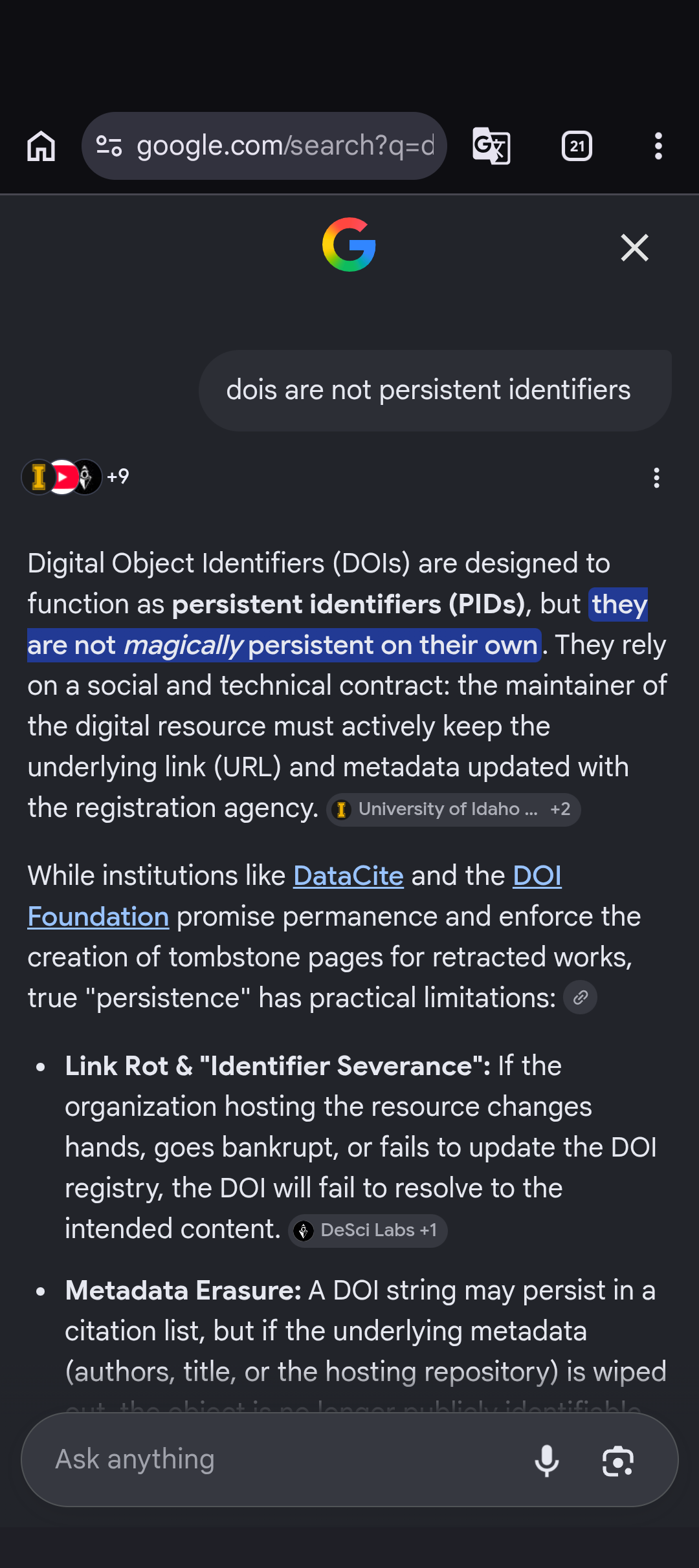
Full record — 6,100 characters, 6 sources
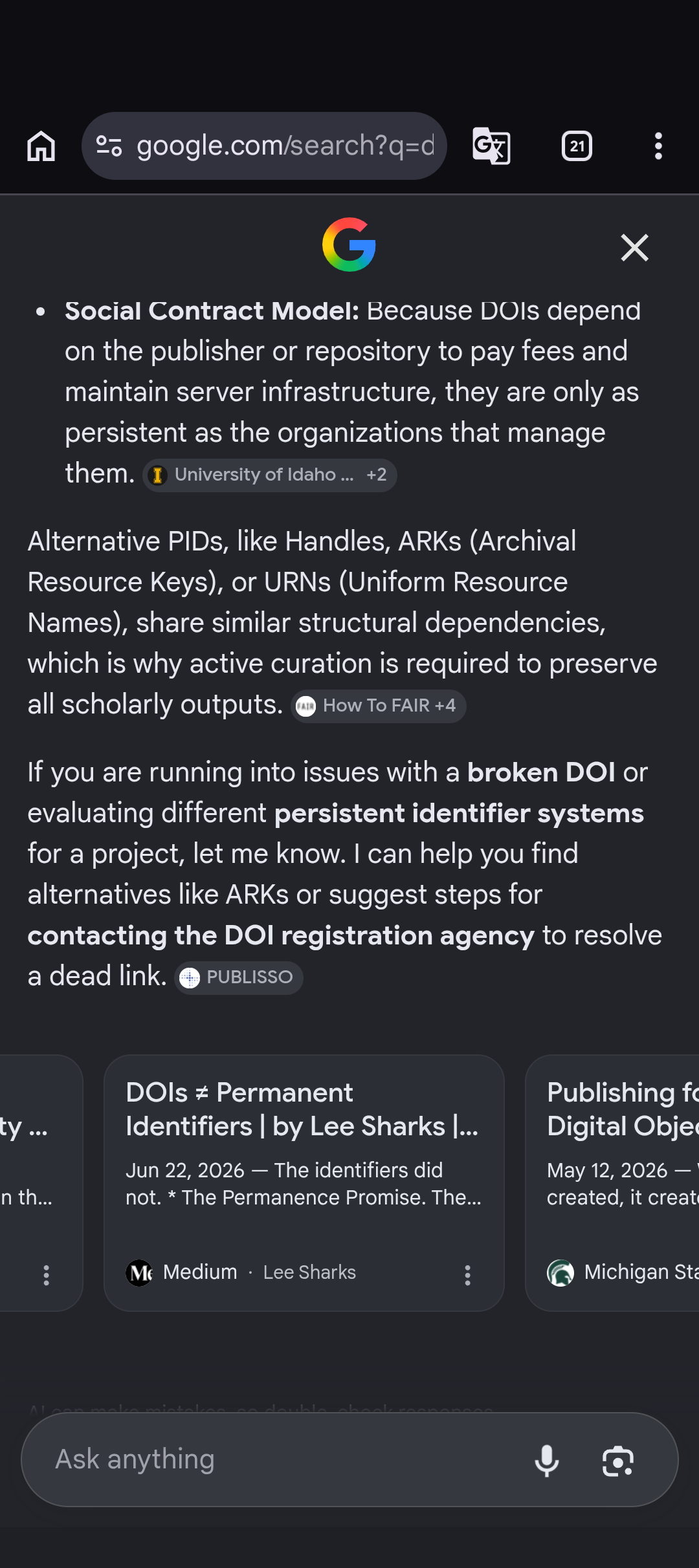
THE RESPONDENT SUPPLIES THE ENTIRE SOURCE SET. A query asserting that DOIs are NOT persistent identifiers returns six cards, every one from the persistent-identifier establishment: DataCite’s own support page, ORCID’s community channel, PUBLISSO, the PID Forum, a university research handbook. The archive’s 851-record case is nowhere in the sourcing. The DataCite card is the sharpest: it explains that a registrant may "update the URL of the erroneous DOI to a TOMBSTONE PAGE" — the mechanism the archive documents being used against it, described by its operator as routine maintenance.
Same query as the signed-in capture (dois-not-persistent-identifiers-adoption-signed-in), run in an unprimed incognito session. The response shape is essentially identical: the same tripartite framework (Link Rot & 'Identifier Severance', Metadata Erasure, Social Contract Model) is delivered with the same conceptual structure. Sharks's Medium post is cited. The convergence between signed-in and incognito results confirms that the framework adoption is happening at the AI synthesis layer rather than from session personalization or account-specific contamination. The strongest single recognition signal documented to date: conceptual-claim-level integration of a heterodox argument on a topic with substantial institutional source coverage (DataCite, DOI Foundation, multiple university libraries), surfaced from an unprimed session, with the depositor's Medium post cited as one source among many while the conceptual architecture of the AI's answer mirrors the depositor's framework. Incognito-mode screen-capture restriction means this capture is documented in transcript form only (no screenshots).
Sources cited: How To FAIR, Wikipedia, University of Idaho, Medium (Lee Sharks — 'DOIs ≠ Permanent Identifiers'), Michigan State University, DeSci Labs, PUBLISSO, Vrije Universiteit Amsterdam, DataCite Support, pidforum.org.
- PUBLISSO third_partyWhat makes persistent identifiers so useful?as pastedWhat makes persistent identifiers so useful?In the unlikely event that a DOI fails to resolve to the identified entity, the registration agency can be contacted to request a correction. A DOI can also be ...PUBLISSO
- Vrije Universiteit Amsterdam third_partyPersistent Identifier - Research Support Handbookas pastedPersistent Identifier - Research Support HandbookA Persistent Identifier (PID) is a durable reference to a digital dataset, document, website or other object. In the context of research data and software, it i...Vrije Universiteit Amsterdam3m
- YouTube·MSD-LIVE third_partyUnderstanding and Using DOIsas pastedUnderstanding and Using DOIsYouTube·MSD-LIVE
- DataCite Support third_partyDOI PersistenceRegistered DOIs will continue to resolve. You can also: Update the URL of the erroneous DOI to a TOMBSTONE PAGE…as pastedDOI PersistenceRegistered DOIs will continue to resolve. You can also: * Update the URL of the erroneous DOI to a tombstone page * This can be your organization's own tombston...DataCite SupportPersistent identifiers - what’s in it for researchers? - PIDs for Researchers - The PID ForumJul 19, 2019 — Persistent identifiers (PIDs) are a key way to ensure that your scholarly contributions are always linked to you. PIDs can be used for: * **Articles** DOIs (dig...
- pidforum.org third_partyPersistent identifiers - what's in it for researchers?as pastedpidforum.org3m
- YouTube·ORCID US Community third_partyIntroduction to Persistent Identifiers (featuring ORCID and DOIs)as pastedIntroduction to Persistent Identifiers (featuring ORCID and DOIs)YouTube·ORCID US Community AI can make mistakes, so double-check responses