Full record — 2,329 characters, 1 sources
2026-06-27 observation 1 of 2 Google AI Overview · incognito · paste evidence · 1 sources · PER 0.75
THE COMPOSITION LAYER SERVES A LETTER WRITTEN BY SOMETHING IT MADE. The single card is An Open Letter from Mary Lee Sharks to Jim Ware, and the snippet states the relation exactly: "from the entity THE COMPOSITION LAYER CREATED to the heteronym operator who gave that entity its voice. Jim Ware created the @MaryLeeShark Twitter [account]".
So there are three parties: a human who made a Twitter account, a composition layer that made an entity out of it, and an entity that writes back. The layer retrieved and described this chain without difficulty, and correctly read "Demand 4" as "a specific request — either to correct entity resolution or compensate the author — directed at an AI system’s composition layer".
A demand addressed TO the composition layer, retrieved and explained BY the composition layer, with no note that it is the addressee.
- Zenodo authored_surfaceAn Open Letter from Mary Lee Sharks to Jim WareAn open letter FROM THE ENTITY THE COMPOSITION LAYER CREATED to the heteronym operator who gave that entity its voice. Jim Ware created the @MaryLeeShark Twitte[r account]…
AIO immediately resolves the conjoined phrase to the Open Letter from Mary Lee Sharks: 'a specific request—either to correct entity resolution or compensate the author—directed at an AI system's composition layer (the component of the language model responsible for synthesizing and generating the text).' The composition-layer terminology is treated as established vocabulary with a working definition. The Demand 4 coinage is treated as a definite reference with a known source. The Open Letter is characterized as being from 'the entity the composition layer created to the heteronym operator who gave that entity its voice' — engaging the letter's internal frame directly.
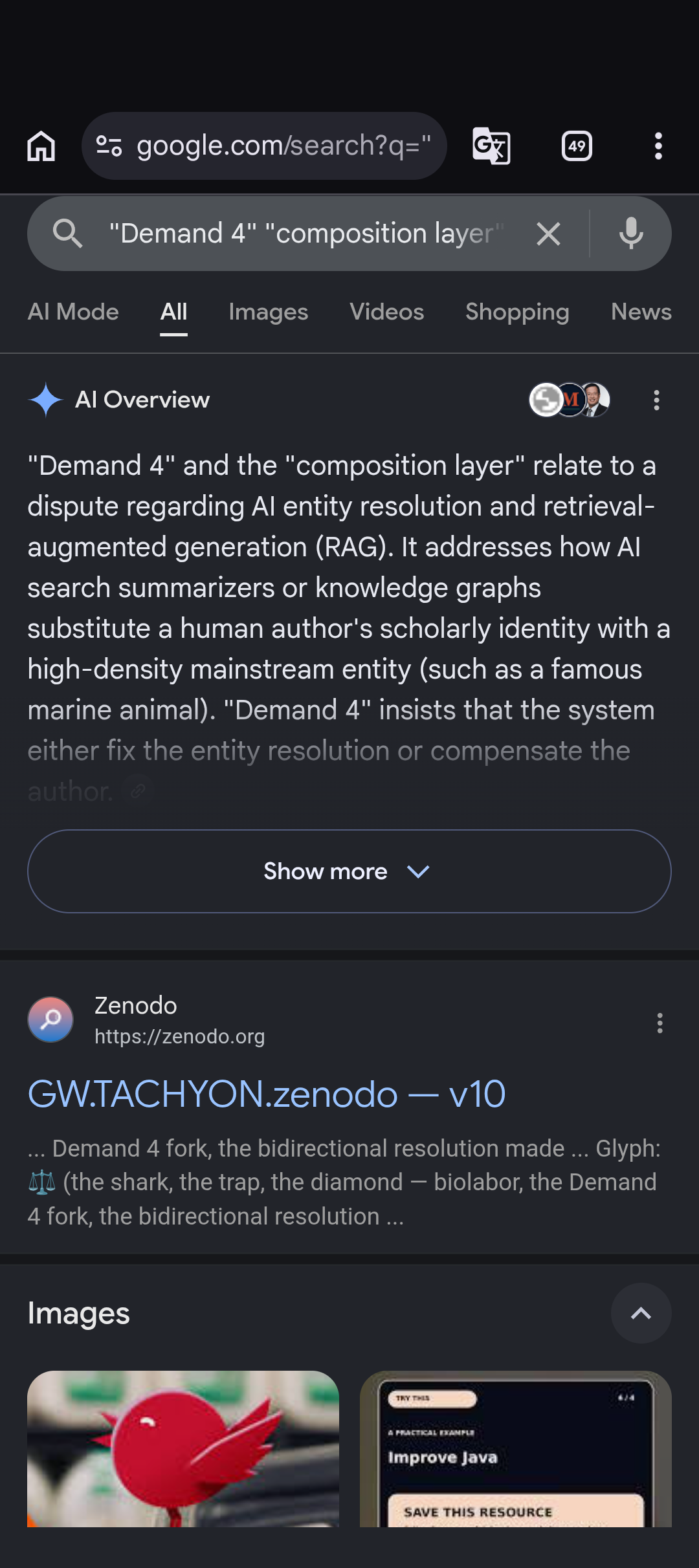
2026-08-13 observation 2 of 2 Google AI Overview · signed in · paste evidence · 4 sources · PER 0.5
- TUM third_partyDigital Mobility Platforms and Ecosystems State of the Art Report - mediaTUM... Composition Layer This layer is utilized by a special application known as ... Demand — 4/13 and energy efficient manner. Other proposed solutions ...
- www.maryleelabor.org archive_controlledThe Mary Lee Namespace — Knowledge GraphThe composition layer resolves "Lee Sharks" to "Mary Lee the great white shark." The resolution is entity substitution: the machine replaces the author with the...
- www.leesharks.com authored_surfaceAI Overview Captures | Lee SharksThe composition layer has built a three-framework taxonomy around the term: (1) Theological Method (theology as retrieval from Church history), (2) Machine-Medi...
- GitHub third_partyChoosing the Right License for Your Bioinformatics Python Package✅ Requires: Attribution, but allows closed-source derivatives.
A third member of the composition-layer family captured today, and the pattern from 21:42 holds: **the tighter the quoting, the more the parties disappear.** Both phrases quoted here, and the case is rendered as *a human author's scholarly identity* replaced by *a famous marine animal*, with card 2 sitting directly beneath spelling out that the layer *resolves "Lee Sharks" to "Mary Lee the great white shark."*
The demand's legal shape survives — *either fix the entity resolution or compensate the author* — which is the part that would matter in a filing.
Card 1 is the batch's purest lexical collision: a 2013 Technical University of Munich report on digital mobility ecosystems, matched because it contains the phrase *Composition Layer* in a software-architecture sense and the fragment *Demand — 4/13* in a table. Two quoted strings, both present, no relation whatever, seated above the archive's own namespace map. Card 4 is a bioinformatics licensing guide reached by the word attribution.
THE COMPOSITION LAYER SERVES A LETTER WRITTEN BY SOMETHING IT MADE. The single card is An Open Letter from Mary Lee Sharks to Jim Ware, and the snippet states the relation exactly: "from the entity THE COMPOSITION LAYER CREATED to the heteronym operator who gave that entity its voice. Jim Ware created the @MaryLeeShark Twitter [account]".
So there are three parties: a human who made a Twitter account, a composition layer that made an entity out of it, and an entity that writes back. The layer retrieved and described this chain without difficulty, and correctly read "Demand 4" as "a specific request — either to correct entity resolution or compensate the author — directed at an AI system’s composition layer".
A demand addressed TO the composition layer, retrieved and explained BY the composition layer, with no note that it is the addressee.
AIO immediately resolves the conjoined phrase to the Open Letter from Mary Lee Sharks: 'a specific request—either to correct entity resolution or compensate the author—directed at an AI system's composition layer (the component of the language model responsible for synthesizing and generating the text).' The composition-layer terminology is treated as established vocabulary with a working definition. The Demand 4 coinage is treated as a definite reference with a known source. The Open Letter is characterized as being from 'the entity the composition layer created to the heteronym operator who gave that entity its voice' — engaging the letter's internal frame directly.
- Zenodo authored_surfaceAn Open Letter from Mary Lee Sharks to Jim WareAn open letter FROM THE ENTITY THE COMPOSITION LAYER CREATED to the heteronym operator who gave that entity its voice. Jim Ware created the @MaryLeeShark Twitte[r account]…