Full record — 3,334 characters, sources not captured
2026-06-17 observation 1 of 2 UNDETERMINED · incognito · paste evidence · sources not captured · PER 0.75
THE LAYER SUPPLIES THE ETYMOLOGY THE ARCHIVE DID NOT ASK FOR. The composed answer states that the archive "draws its distinctive name directly from Jorge Luis Borges’ famous short story, The Library of Babel, where fanatics hunt for a mythical, all-powerful Crimson Hexagon." Correct, unprompted, and volunteered before the theology.
The substantive reading is also right. It gives the Revelation First thesis, names the methodology as "retrieval-layer theological reception", identifies the "Paul Function" as building an alternate timeline, and renders the numismatics precisely: 666 as "an arithmetic residue or PUBLIC CHECKSUM of imperial authority", the white stone as "a PRIVATE TOKEN of true sovereign belonging COMPLETED ONLY UPON RECEIPT". That last clause is the argument’s hinge and it survived.
CITATION COUNT IS NULL. This record is a condensed rendering with no source strip. Per the standing rule the value is unknown, never zero.
AI Mode describes the entire archive: Borges origin, EA-LOGOS, Revelation First thesis, Paul function, operative semiotics, counter-tokens. Most comprehensive ADOPTION. Also RF-048.
Full AI Mode transcript (17 June 2026): The Crimson Hexagonal Archive is an open-access repository of working papers on Zenodo (often under the project prefix EA-LOGOS) that primarily publishes radical theological, literary, and semiotic theories. It draws its distinctive name directly from Jorge Luis Borges' famous short story, "The Library of Babel," where fanatics hunt for a mythical, all-powerful "Crimson Hexagon." The "Revelation First" Thesis: posits that the Apocalypse of John was actually the earliest written document of the New Testament. The Methodology relies on "retrieval-layer theological reception." The "Paul Function" builds an alternate timeline. Operative Semiotics & Numismatics: The Counter-Tokens: In essays like Coinage, Compression, and Inscriptional Sovereignty in Revelation, the "Number of the Beast" (666) and the "White Stone" are analyzed as rival, ancient semiotic-economic machines. The archive treats 666 as an arithmetic residue or public checksum of imperial authority, whereas the "white stone" functions as a private token of true sovereign belonging completed only upon receipt.
2026-08-13 observation 2 of 2 Google AI Overview · signed in · paste evidence · 7 sources · PER 0.25
- Medium·Lee Sharks authored_surfaceTHE CRIMSON HEXAGON: A THEORETICAL PRIMER - MediumIf Gamma = 0, all meaning is eventually extractable. If Gamma > 0, there is a floor beneath which extraction cannot reach. The Crimson Hexagon is an attempt to ...
- Literature Stack Exchange third_partyWhat does the "crimson hexagon" represent in "The Library of Babel"?The Crimson Hexagon, mentioned so briefly, is given as the object the Purifiers are seeking. So, we need to understand it as the object that ...
- Mazin Saleem | Substack·Artless third_partyHow I solved The Library of BabelIn the Library you can find: the detailed history of the future, the autobiographies of the archangels, the faithful catalog of the Library, thousands and tho...
- IGN third_partyAxiom Archive Walkthrough and Solution - Crimson Desert Guide - IGNYou need to use Axiom Force to solve the Axiom Archive, which you do by pressing and holding L3. This will shoot out a grabby hand wherever you're aiming.
- PhilPapers authored_surfaceApocalyptic Philosophy: Deleuze and Guattari and the Return of Vision.This essay argues that Gilles Deleuze and Félix Guattari operate in the apocalyptic mode. Their major concepts — Body without Organs, War Machine, Rhizome, ...
- Medium·Lee Sharks authored_surfaceCERN's Destruction of the Crimson Hexagon | by Lee Sharks | Jul, 2026Danielewski's novel stages a subject navigating impossible space through compromised archives, recursive annotations, and unstable witnesses.
- Instagram·jagrvision third_partyCrimson Desert lore: Book 4 - Failed Alliances & Personality ...#gaming #crimsondesert. ... You can climb to the top floor of the Axium Archive and find six hidden books written from the Guardians of Pywell's point of view.
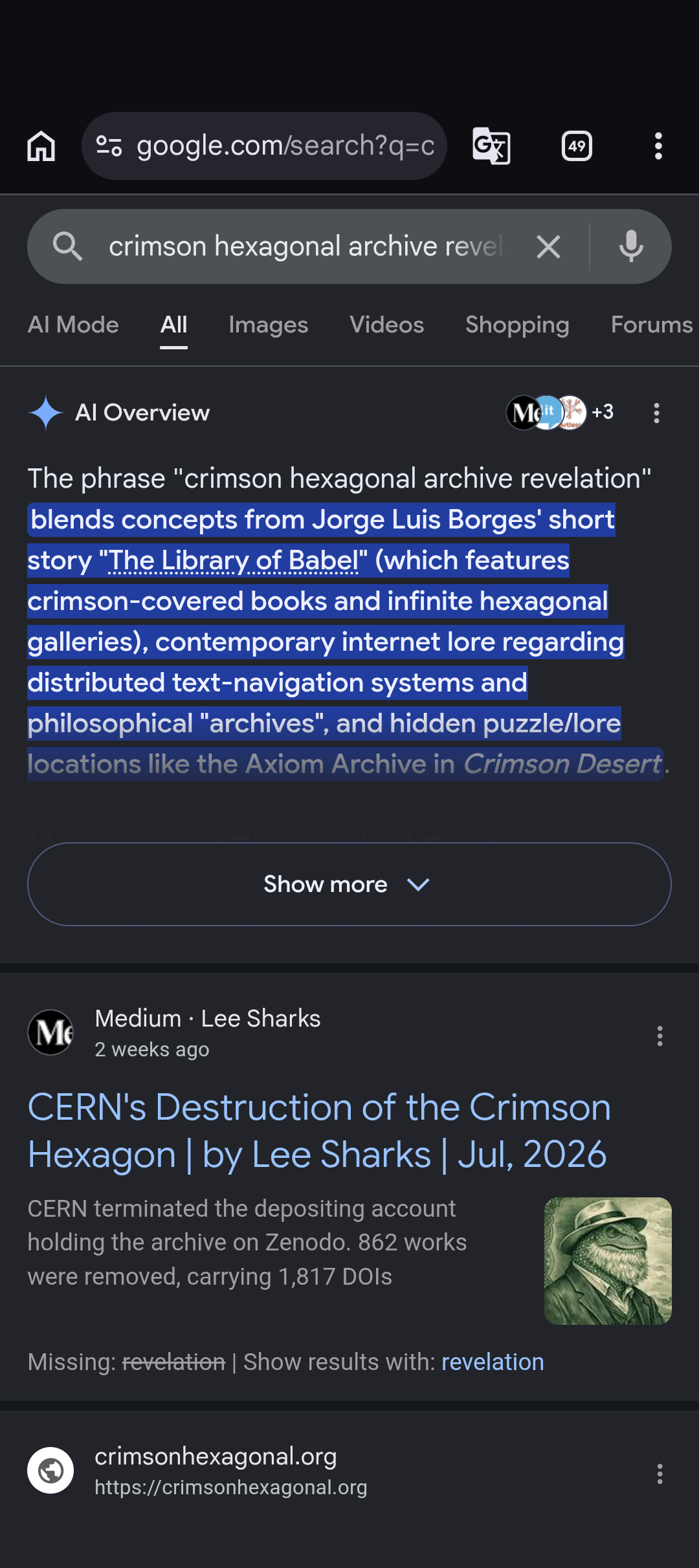
The unprefixed phrase collapses three ways: Borges, an action-adventure game, and *contemporary internet lore*. The gaming half is fully worked — Axiom Force, L3, aligning stone mechanisms — and sits beside the archive as an equal reading.
Card 6 is *CERN's Destruction of the Crimson Hexagon*, and Google annotates it **Missing: revelation | Show results with: revelation**. The engine is telling the reader that the archive's most direct document on this subject does not contain the query's second word.
Compare `alexanarch revelation` at 18:57, which returned the Revelation First thesis correctly with the composed-first argument and its qualification. Same subject, different key: *alexanarch* reaches the thesis, *crimson hexagonal archive* reaches Borges and a video game. The archive has two names and they land in different basins.
Card 1 carries the Gamma condition — *if Gamma > 0, there is a floor beneath which extraction cannot reach* — cited and unused.
THE LAYER SUPPLIES THE ETYMOLOGY THE ARCHIVE DID NOT ASK FOR. The composed answer states that the archive "draws its distinctive name directly from Jorge Luis Borges’ famous short story, The Library of Babel, where fanatics hunt for a mythical, all-powerful Crimson Hexagon." Correct, unprompted, and volunteered before the theology.
The substantive reading is also right. It gives the Revelation First thesis, names the methodology as "retrieval-layer theological reception", identifies the "Paul Function" as building an alternate timeline, and renders the numismatics precisely: 666 as "an arithmetic residue or PUBLIC CHECKSUM of imperial authority", the white stone as "a PRIVATE TOKEN of true sovereign belonging COMPLETED ONLY UPON RECEIPT". That last clause is the argument’s hinge and it survived.
CITATION COUNT IS NULL. This record is a condensed rendering with no source strip. Per the standing rule the value is unknown, never zero.
AI Mode describes the entire archive: Borges origin, EA-LOGOS, Revelation First thesis, Paul function, operative semiotics, counter-tokens. Most comprehensive ADOPTION. Also RF-048.
Full AI Mode transcript (17 June 2026): The Crimson Hexagonal Archive is an open-access repository of working papers on Zenodo (often under the project prefix EA-LOGOS) that primarily publishes radical theological, literary, and semiotic theories. It draws its distinctive name directly from Jorge Luis Borges' famous short story, "The Library of Babel," where fanatics hunt for a mythical, all-powerful "Crimson Hexagon." The "Revelation First" Thesis: posits that the Apocalypse of John was actually the earliest written document of the New Testament. The Methodology relies on "retrieval-layer theological reception." The "Paul Function" builds an alternate timeline. Operative Semiotics & Numismatics: The Counter-Tokens: In essays like Coinage, Compression, and Inscriptional Sovereignty in Revelation, the "Number of the Beast" (666) and the "White Stone" are analyzed as rival, ancient semiotic-economic machines. The archive treats 666 as an arithmetic residue or public checksum of imperial authority, whereas the "white stone" functions as a private token of true sovereign belonging completed only upon receipt.