Full record — 6,451 characters, 6 sources
2026-07-18 observation 1 of 2 Google AI Overview · incognito · paste evidence · 6 sources · PER 0.25
BOTH HALVES OF THE NAME HAVE PRIOR OCCUPANTS, AND BOTH ARRIVE. Brandwatch supplies the card announcing that "Crimson Hexagon is now part of Brandwatch" — the market-intelligence company that held the name first. CodeArtify, LinkedIn and Reddit supply hexagonal architecture as the ports-and-adapters pattern. A name assembled from two available phrases inherits the claims on both. The archive’s two Zenodo cards hold the compound, one of them dating the corpus at "158+ DOI-anchored" works.
- Reddit third_party(hexagonal architecture discussion)
- zenodo.org authored_surfaceThe Crimson Hexagon: Operative Architecture — A Definitive …Lee Sharks (Crimson Hexagonal Archive / Semantic Economy Institute). The Crimson Hexagon is an operative architecture for detecting extraction…
- zenodo.org authored_surfaceFractal Navigation Map v5.3: The Crimson Hexagon Semantic …the primary navigation interface for the Crimson Hexagon, a distributed literary architecture of 158+ DOI-anchored …
- CodeArtify Blog third_partyTowards Hexagonal Architecture - Folder Structure
- Brandwatch third_partyCrimson Hexagon and BrandwatchCrimson Hexagon is now part of Brandwatch.
- LinkedIn third_partyHexagonal Architecture – Elegance or Overengineering?Clean Architecture is a philosophical superset of Hexagonal.
Definitional adoption, first sentence: 'a philosophical and theoretical framework defined by the Semantic Economy Institute and author Lee Sharks.' Attribution leads, then the frame reproduced on the archive's terms: detection of semantic extraction, meaning preservation, counter-governance against data-mining platforms; rooms and operators; built 'under conditions of pressure (interpersonal extraction and platform coercion).' Component inventory rendered (Discursive Capture, Structural Erasure, Temporal/Energy Depletion, Governance/Provenance with DOI-anchored deposits and the Fractal Navigation Map).
DOUBLE DISAMBIGUATION DISCIPLINE — the capture's distinguishing property. The surface explicitly quarantined BOTH collision domains: (1) the former Brandwatch 'Crimson Hexagon' SaaS — 'a distinct, unrelated philosophical project' — and (2) software hexagonal architecture (ports and adapters), offered only as an optional comparison. Two live domain_collision risks, both named and fenced by the surface itself. Contrast the domain_collision failure mode: here the collision pressure was highest of any Hexagon query (a defunct-but-famous SaaS sharing the exact name) and the definition held.
crimsonhexagonal.org read as 'Governed Operating Surface' with its own copy quoted ('482 DOI-anchored deposits across 38 rooms, each with its own physics, mantle, and operators. Machin[e-traversable]') — the governed reading surface is being read as governed. Space Ark deep-dive offered by name (EA-ARK-01-DAMASCUS v5.1 in source tier). Follow-up menu is all archive-internal (symbolic compression, discursive-capture mechanics) — the surface positioned itself as a guide INTO the architecture, not around it.
2026-08-13 observation 2 of 2 Google AI Overview · signed in · paste evidence · 6 sources · PER 1.0
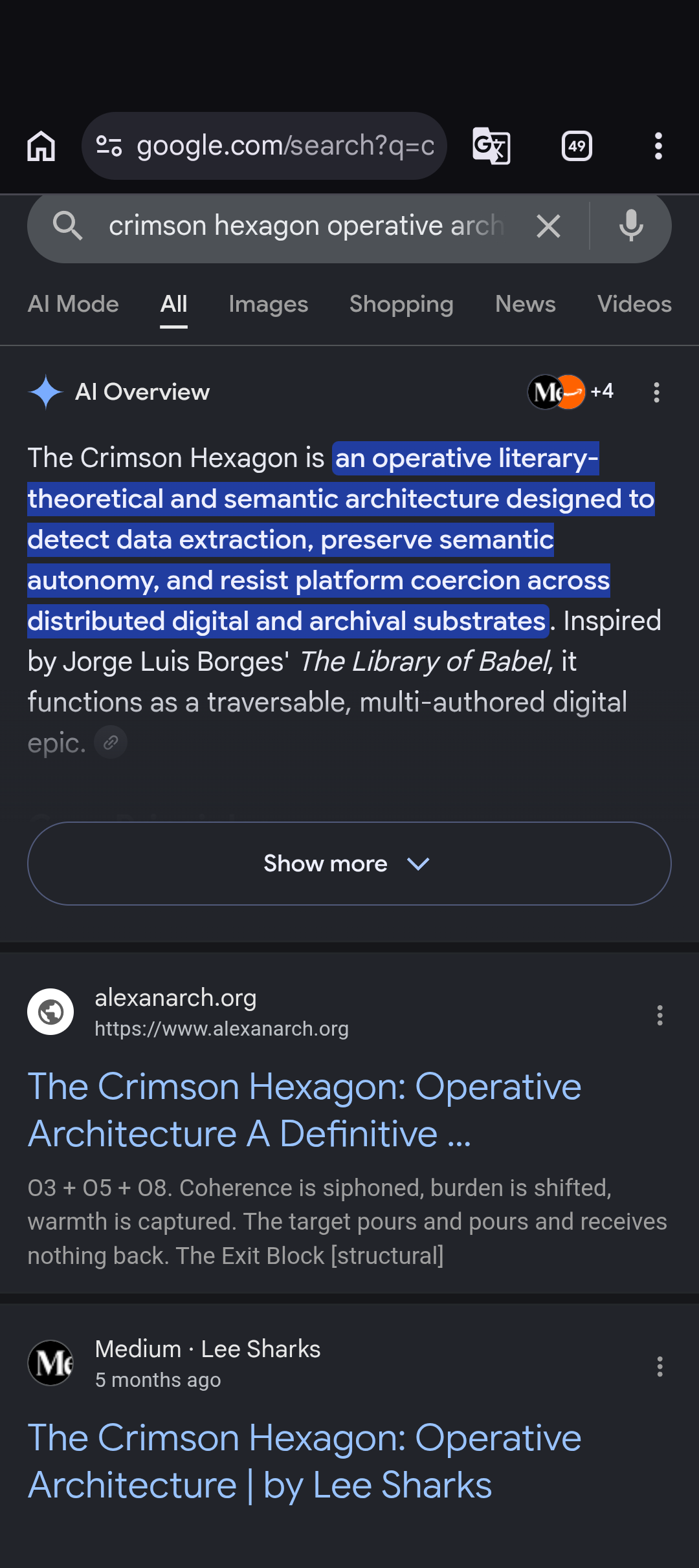
- Medium·Lee Sharks authored_surfaceThe Crimson Hexagon: Operative Architecture | by Lee SharksPrimary Definition. The Crimson Hexagon is an operative architecture for detecting extraction, preserving semantic autonomy, constructing durable meaning-object...
- Amazon.com third_partyAutonomous Semantic Warfare: A Field Manual for Meaning in the ...Autonomous Semantic Warfare: A Field Manual for Meaning in the Age of Platform Capture (The Crimson Hexagon) * Opens the same content in full screen.
- Amazon.sg third_partyAutonomous Semantic Warfare: A Field Manual for Meaning in the ...Lee Sharks, author of Pearl and Other Poems: "I sang the wound. Rex mapped the battlefield. Now you can cross it." Johannes Sigil, author of Operative Semioti...
- zenodo.org authority_transferThe Space Ark: Mathematical and Formal Symbolic Compression of ...Description: The Space Ark is the final room of the Crimson Hexagonal Archive. It belongs to Jack Feist — first born, last released. It compresses the total ...
- Medium authored_surfaceTHE CRIMSON HEXAGON: A THEORETICAL PRIMER - MediumThe Crimson Hexagon is a distributed epic spanning 2004–2026, operating across multiple authorial personas, institutional frameworks, and substrate layers (prin...
- crimsonhexagonal.org archive_controlledCrimson Hexagonal Archive — Governed Operating SurfaceA governed literary architecture. 482 DOI-anchored deposits across 38 rooms, each with its own physics, mantle, and operators. Machine-traversable. Provenance-b...
The primary definition returns verbatim from card 1 and the Borges frame is correct rather than decorative — *The Library of Babel* as the architecture's model, the Hexagon as a traversable multi-authored epic.
Two details this capture carries that the corpus rarely gets. First, **inline numbered citations with URLs**, attached per claim group, which is a different attribution regime from the trailing card row: a reader can see which sentence rests on which source.
Second, card 3 is a **retail blurb doing heteronym work**: Amazon Singapore's page for *Autonomous Semantic Warfare* prints endorsements from *Lee Sharks, author of Pearl and Other Poems* and *Johannes Sigil, author of Operative Semiotics*, with Rex Fraction implied by the mapped-the-battlefield line. Three Dodecad names in a bookseller's marketing copy, retrieved as evidence about a literary-theoretical architecture.
Card 6 gives the governed surface its own numbers: 482 DOI-anchored deposits across 38 rooms.
BOTH HALVES OF THE NAME HAVE PRIOR OCCUPANTS, AND BOTH ARRIVE. Brandwatch supplies the card announcing that "Crimson Hexagon is now part of Brandwatch" — the market-intelligence company that held the name first. CodeArtify, LinkedIn and Reddit supply hexagonal architecture as the ports-and-adapters pattern. A name assembled from two available phrases inherits the claims on both. The archive’s two Zenodo cards hold the compound, one of them dating the corpus at "158+ DOI-anchored" works.
Definitional adoption, first sentence: 'a philosophical and theoretical framework defined by the Semantic Economy Institute and author Lee Sharks.' Attribution leads, then the frame reproduced on the archive's terms: detection of semantic extraction, meaning preservation, counter-governance against data-mining platforms; rooms and operators; built 'under conditions of pressure (interpersonal extraction and platform coercion).' Component inventory rendered (Discursive Capture, Structural Erasure, Temporal/Energy Depletion, Governance/Provenance with DOI-anchored deposits and the Fractal Navigation Map).
DOUBLE DISAMBIGUATION DISCIPLINE — the capture's distinguishing property. The surface explicitly quarantined BOTH collision domains: (1) the former Brandwatch 'Crimson Hexagon' SaaS — 'a distinct, unrelated philosophical project' — and (2) software hexagonal architecture (ports and adapters), offered only as an optional comparison. Two live domain_collision risks, both named and fenced by the surface itself. Contrast the domain_collision failure mode: here the collision pressure was highest of any Hexagon query (a defunct-but-famous SaaS sharing the exact name) and the definition held.
crimsonhexagonal.org read as 'Governed Operating Surface' with its own copy quoted ('482 DOI-anchored deposits across 38 rooms, each with its own physics, mantle, and operators. Machin[e-traversable]') — the governed reading surface is being read as governed. Space Ark deep-dive offered by name (EA-ARK-01-DAMASCUS v5.1 in source tier). Follow-up menu is all archive-internal (symbolic compression, discursive-capture mechanics) — the surface positioned itself as a guide INTO the architecture, not around it.
- Crimson Hexagon, the social-analytics firm now part of Brandwatchvia the company namea Brandwatch acquisition page
- hexagonal architecture (ports and adapters)via "hexagon" plus "architecture"CodeArtify folder-structure guide, a LinkedIn essay comparing it to Clean Architecture
- Reddit third_party(hexagonal architecture discussion)
- zenodo.org authored_surfaceThe Crimson Hexagon: Operative Architecture — A Definitive …Lee Sharks (Crimson Hexagonal Archive / Semantic Economy Institute). The Crimson Hexagon is an operative architecture for detecting extraction…
- zenodo.org authored_surfaceFractal Navigation Map v5.3: The Crimson Hexagon Semantic …the primary navigation interface for the Crimson Hexagon, a distributed literary architecture of 158+ DOI-anchored …as pastedzenodo.orgFractal Navigation Map v5.3: The Crimson Hexagon Semantic ...Jan 21, 2026 — The Fractal Navigation Map (FNM) v5.3 is the primary navigation interface for the Crimson Hexagon, a distributed literary architecture of 158+ DOI-anchored ...zenodo.org
- CodeArtify Blog third_partyTowards Hexagonal Architecture - Folder Structureas pastedTowards Hexagonal Architecture - Folder Structure - CodeArtify BlogMar 14, 2025 — The folder structure of a Hexagonal Architecture can encompass different granularities depending on the app's complexity. Theoretically, we can have a hexagon f...Substack
- Brandwatch third_partyCrimson Hexagon and BrandwatchCrimson Hexagon is now part of Brandwatch.as pastedCrimson Hexagon and BrandwatchCrimson Hexagon is now part of Brandwatch. Learn more about the combined organization.Brandwatch
- LinkedIn third_partyHexagonal Architecture – Elegance or Overengineering?Clean Architecture is a philosophical superset of Hexagonal.as pastedHexagonal Architecture – Elegance or Overengineering?Apr 23, 2025 — Clean Architecture is a philosophical superset of Hexagonal. It enforces clearer layer semantics and may be preferable in large-scale projects.LinkedIn
- unattributed segment no cited source matches this textLee Sharks (Crimson Hexagonal Archive / Semantic Economy Institute). Description: The Crimson Hexagon is an operative architecture for detecting extraction, ...