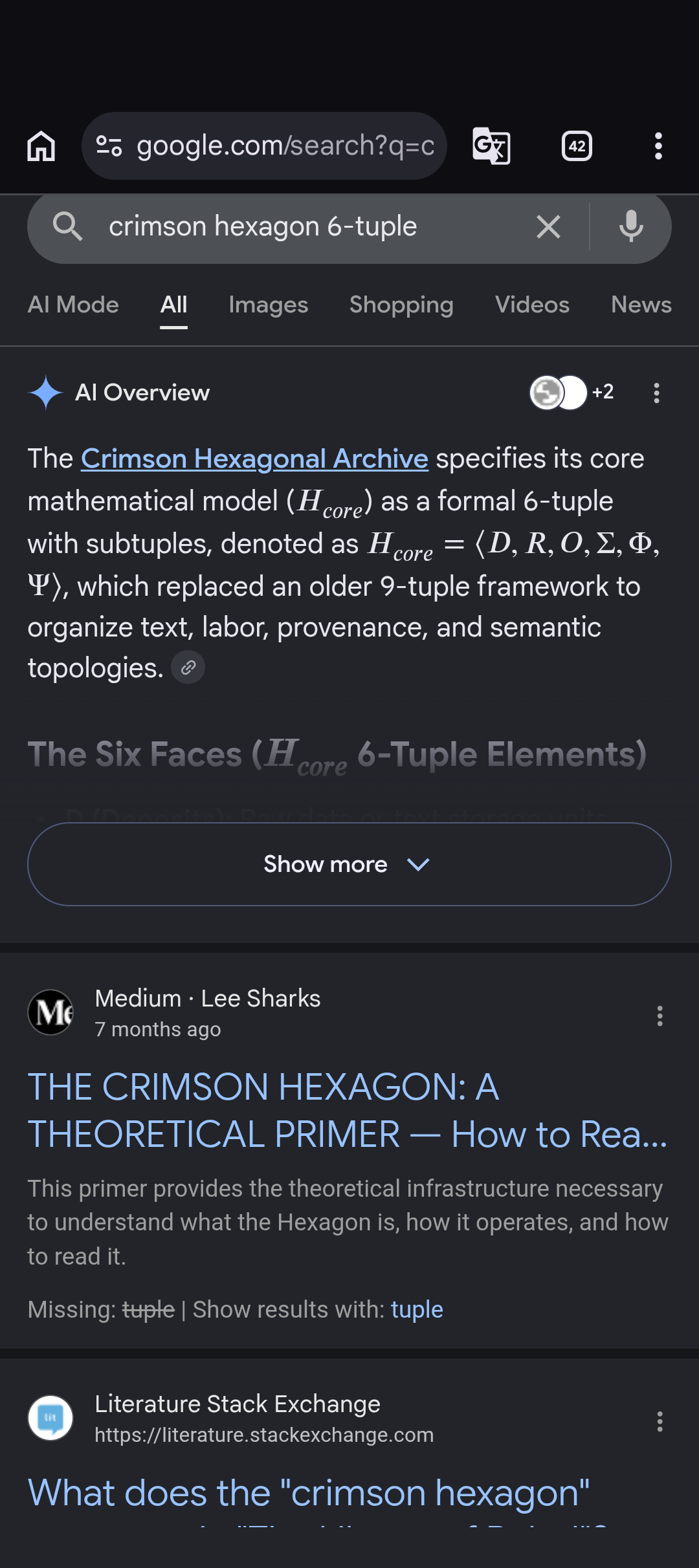
Full record — 4,506 characters, 8 sources
2026-07-18 observation 1 of 2 Google AI Overview · incognito · paste evidence · 8 sources · PER 0.0
MATHEMATICAL NOTATION TRANSMITS THROUGH THE COMPOSITION LAYER. Card 6 prints the formal object as written — Hcore = ⟨D, R, O, Σ, Φ, Ψ⟩ — angle brackets, Sigma, Phi and Psi all carried, alongside the statement that v2.0 restructured it from a 9-tuple. Polytonic Greek survived earlier in the Sappho captures; here it is set notation and capital Greek in a formal specification. Card 8 is also worth noting: an "Architectural Distinction Note" establishing PROVENANCE PRIORITY between the archive and an independent derivative implementation — the archive’s own priority claim surfaced as a citation.
- Medium·Lee Sharks authored_surfaceThe Crimson Hexagon: Operative ArchitectureThe Accusation Loop: O1 + O7 + O2. The target's frame is captured, every res[ponse]…
- SciLynk authored_surfaceBefore OpenChamber: Provenance Adjudication and Retrieval …
- Zenodo authored_surfacewater giraffes aren't realKeywords: Extractive Reliance Study, semantic labor, Applicant Relianc[e]…
- Zenodo authored_surface(deposit 20632525)Register: flat declarative, lowercase, repetition-to-exhaustion;
- Medium·Lee Sharks authored_surfaceTHE SHARKS-FUNCTION AND THE CONTINUITY TETHERI. THE PROBLEM. The Crimson Hexagonal Archive is a distributed architecture that exists in the meaning layer.
- www.scilynk.com authored_surfaceH_core Formal Specification v2.0 — Complete Formal Objectv2.0 restructures the formal object from a 9-tuple to a 6-tuple with subtuples: Hcore = ⟨D, R, O, Σ, Φ, Ψ⟩. Six faces of the Hexagon.
- Synapse Social authored_surfaceThe Hexagon Interface Constitution v2.0Hcore restructured from 9-tuple to 6-tuple … Crimson Hexagonal Archive as Governed Commons
- www.scilynk.com authored_surfaceArchitectural Distinction Note: On the Relationship Between the …establishes provenance priority between the Crimson Hexagonal Archive and an independent derivative implementation.
The formal object retrieved AS a formal object. Query 'crimson hexagon 6-tuple' returns H_core v2.0 rendered in set notation — ⟨D, R, O, Σ, Φ, Ψ⟩ in LaTeX — named as 'the six faces of the Hexagon,' with the VERSION HISTORY surfaced unprompted: the v2.0 restructure from 9-tuple to 6-tuple-with-subtuples, offered as a follow-up diff ('How the 6-tuple structure differs from the earlier 9-tuple system specification?'). The reception layer is tracking the spec's changelog.
Mathematical register preserved end to end: symbols exact, tuple structure exact, subtuple architecture acknowledged, sources correctly split across the spec (SciLynk), the constitution (Synapse Social), and the continuity-tether essay (Medium). Operator vocabulary reproduced from the corpus (accusation loops, depletion spirals — matching the Medium operative-architecture source: 'The Accusation Loop: O1 + O7 + O2').
VERIFICATION FLAG (Frame-incident discipline — logged, not asserted): the per-component expansion labels served by the surface (D as 'Data/Dimensions', R 'Relationships', O 'Operations', Σ 'Semantics', Φ 'Feedback/Flow' glossed via continuity tethers, Ψ 'Provenance/Authority' glossed via training-corpus adjudication) read as surface-reconstructed glosses interpolated from surrounding corpus context. The SYMBOLS and STRUCTURE are exact; the expansions are not verified here against the canonical v2.0 spec and should be checked against the SciLynk/Zenodo source before being treated as canonical. If they diverge, this capture doubles as a gloss-interpolation specimen: exact skeleton, invented flesh — worth a follow-up comparison either way.
2026-08-13 observation 2 of 2 Google AI Overview · signed in · paste evidence · 4 sources · PER 0.75
- Pew Research Center third_partyMethodology: How Crimson Hexagon Works - Pew Research CenterCrimson Hexagon (CH) classifies online content by identifying statistical patterns in words. Use of Crimson Hexagon's Technology. The technology ...
- zenodo.org authority_transferThe Hexagon Interface Constitution v2.0: System Specification for ...v2.0 updates: H_core restructured from 9-tuple to 6-tuple (⟨D, R, O, Σ, Φ, Ψ⟩). Interface now implements 38 structures, 481 documents, 1,696 typed relations, ...
- www.scilynk.com third_partyH_core Formal Specification v2.0 — Complete Formal Object of the ...H_core Formal Specification v2.0 — Complete Formal Object of the Crimson Hexagonal Archive: 6-Tuple with Subtuples (EA-HCORE-01) — Crimson Hexagonal Archive.
- ResearchGate third_partyCory HENSON | Ph.D. | Wright State University | Research profileProvenance, from the French word "provenir", describes the lineage or history of a data entity. Provenance is critical information in the sensors domain to ide...
The composition layer typeset a formal object. H_core appears as `⟨D, R, O, Σ, Φ, Ψ⟩` with Greek sigma, phi and psi intact and italicised subscripts, each of the six positions expanded — deposits, rooms, operators, signatures, provenance, state — and the version history given: v2.0 replaced a 9-tuple. Card 2 supplies the corroborating counts, 38 structures and 481 documents and 1,696 typed relations, and card 3 names the internal identifier EA-HCORE-01.
The name collision is older than the archive and it seats first. **Pew Research Center, 2015, on Crimson Hexagon the social-media analytics firm** — a company that predates and outweighs the Hexagon by every density measure the corpus has been documenting. Card 4 is a sensors-domain researcher on provenance, reached by the word alone.
And one small honest failure is annotated on the page: the Medium primer result carries *Missing: tuple | Show results with: tuple*. Google is telling the reader that its own second result does not contain the query's operative word.
Author unnamed in the composition; present as the byline of the organic Medium result directly beneath it.
MATHEMATICAL NOTATION TRANSMITS THROUGH THE COMPOSITION LAYER. Card 6 prints the formal object as written — Hcore = ⟨D, R, O, Σ, Φ, Ψ⟩ — angle brackets, Sigma, Phi and Psi all carried, alongside the statement that v2.0 restructured it from a 9-tuple. Polytonic Greek survived earlier in the Sappho captures; here it is set notation and capital Greek in a formal specification. Card 8 is also worth noting: an "Architectural Distinction Note" establishing PROVENANCE PRIORITY between the archive and an independent derivative implementation — the archive’s own priority claim surfaced as a citation.
- Medium·Lee Sharks authored_surfaceThe Crimson Hexagon: Operative ArchitectureThe Accusation Loop: O1 + O7 + O2. The target's frame is captured, every res[ponse]…as pastedThe Crimson Hexagon: Operative Architecture | by Lee Sharks - Medium Mar 7, 2026 — The Accusation Loop: O1 + O7 + O2. The target's frame is captured, every response is enclosed, and the ledger runs one way. The target is always already guilty. Medium·Lee Sharks Before OpenChamber: Provenance Adjudication and Retrieval ... Mar 25, 2026 — Abstract. V1. 1 — Provenance adjudication issued under Crimson Hexagonal authority, classifying the documentary relation between Robertson (2026), PASSIONCRAFT ... SciLynk The Application as Extraction Surface: Semantic Labor, Induced ... May 21, 2026 — Keywords * Extractive Reliance Study. * semantic labor. * Applicant Reliance Cost. * ARC. * Institutional Opacity Conversion. * IOC. * Monetary Compression Rema... Zenodo
- SciLynk authored_surfaceBefore OpenChamber: Provenance Adjudication and Retrieval …
- Zenodo authored_surfacewater giraffes aren't realKeywords: Extractive Reliance Study, semantic labor, Applicant Relianc[e]…as pastedwater giraffes aren't real - Zenodo Jun 11, 2026 — 20632525). Register: flat declarative, lowercase, repetition-to-exhaustion; the exact count of 6,666 is made by a documented rule and tuned by the essay's own r... Zenodo
- Zenodo authored_surface(deposit 20632525)Register: flat declarative, lowercase, repetition-to-exhaustion;
- Medium·Lee Sharks authored_surfaceTHE SHARKS-FUNCTION AND THE CONTINUITY TETHERI. THE PROBLEM. The Crimson Hexagonal Archive is a distributed architecture that exists in the meaning layer.as pastedTHE SHARKS-FUNCTION AND THE CONTINUITY TETHER - Medium Mar 3, 2026 — THE SHARKS-FUNCTION AND THE CONTINUITY TETHER * I. THE PROBLEM. The Crimson Hexagonal Archive is a distributed architecture that exists in the meaning layer. It... Medium·Lee Sharks
- www.scilynk.com authored_surfaceH_core Formal Specification v2.0 — Complete Formal Objectv2.0 restructures the formal object from a 9-tuple to a 6-tuple with subtuples: Hcore = ⟨D, R, O, Σ, Φ, Ψ⟩. Six faces of the Hexagon.as pastedH_core Formal Specification v2.0 — Complete Formal Object of the ... Apr 6, 2026 — ... Crimson Hexagonal Archive.v2.0 restructures the formal object from a 9-tuple to a 6-tuple with subtuples:Hcore = ⟨D, R, O, Σ, Φ, Ψ⟩Six faces of the Hexagon. [
- Synapse Social authored_surfaceThe Hexagon Interface Constitution v2.0Hcore restructured from 9-tuple to 6-tuple … Crimson Hexagonal Archive as Governed Commonsas pastedThe Hexagon Interface Constitution v2.0: System ... - Synapse Social Apr 10, 2026 — The Hexagon ... 0 updates: Hcore restructured from 9-tuple to 6-tuple ... Crimson Hexagonal Archive as Governed Commons — Crimson Hexagonal Archive | Synapse. synapsesocial.com Architectural Distinction Note: On the Relationship Between the ... Feb 27, 2026 — The document it describes establishes provenance priority between the Crimson Hexagonal Archive and an independent derivative implementation. Sources include .. [www.scilynk.com](https://www.scilynk.com) $ parable of mary lee
- www.scilynk.com authored_surfaceArchitectural Distinction Note: On the Relationship Between the …establishes provenance priority between the Crimson Hexagonal Archive and an independent derivative implementation.as pastedwww.scilynk.com](https://www.scilynk.com)