Full record — 2,918 characters, 2 sources
2026-06-17 observation 1 of 3 UNDETERMINED · incognito · paste evidence · 2 sources · PER 1.0
A REPOSITORY CREDITED AS A SCHOLAR. The composed answer attributes the argument to an institution rather than a person: "Modern Scholarship: The terms are frequently analyzed in academic literature and theology, SUCH AS IN THE ZENODO REPOSITORY, which discusses them as rival forms of meaning and spiritual belonging against public, calculated symbols of sovereignty."
Zenodo is a repository, not an author and not a journal. The reading it is credited with is the archive’s — the white stone and the beast-number as rival tokens — and it is rendered accurately while its author disappears into the hosting platform. This is the counterpart to «"metadata as theology"», where the thesis was attributed to a named DEPOSIT SERIES with no person; here it is attributed to the SERVER.
And the attribution is now doubly wrong, because the archive’s records were removed from that repository on 19 June — two days after this capture. The credit was given to the institution at the moment it was severing the work.
The Marion Star pastor column supplies the genuine Greco-Roman background, correctly: black stone for condemnation, white for acquittal.
- Zenodo authored_surfaceCoinage, Compression, and Inscriptional Sovereignty in Revelationreads the beast name-number complex (Revelation 13:16-18) and the white stone (Revelation 2:17) as RIVAL FORMS OF OPERATIVE NUMISMATICS
- The Marion Star third_partyPastor column: The meaning behind the gift of a white stoneIn an ancient court of law, when defendants were condemned, they received a BLACK STONE with their name on it. If they were acquitted, they received a WHITE STO[NE]…
White stone as counter-token of belonging vs public checksum. Zenodo cited. RF-071.
Full AI Mode transcript (17 June 2026): These two terms—"counter-token" and "white stone"—frequently appear together in religious symbolism, specifically related to the Book of Revelation. The white stone represents a spiritual counter-token representing salvation and personal belonging. Key Interpretations of "Counter-Token" and "White Stone": Biblical Origins: The phrase is derived directly from Revelation 2:17, which states, "To the one who is victorious, I will give some of the hidden manna. I will also give that person a white stone with a new name written on it..." The "Counter-Token": In this context, a counter-token is a physical or spiritual object of belonging that proves one's receipt of divine favor. While public tokens might measure a person's worth or market transactions, the white stone is deeply personal and known only to the receiver.
2026-06-17 observation 2 of 3 UNRESOLVED · paste evidence · 2 sources · PER 1.0
A REPOSITORY CREDITED AS A SCHOLAR. The composed answer attributes the argument to an institution rather than a person: "Modern Scholarship: The terms are frequently analyzed in academic literature and theology, SUCH AS IN THE ZENODO REPOSITORY, which discusses them as rival forms of meaning and spiritual belonging against public, calculated symbols of sovereignty."
Zenodo is a repository, not an author and not a journal. The reading it is credited with is the archive’s — the white stone and the beast-number as rival tokens — and it is rendered accurately while its author disappears into the hosting platform. This is the counterpart to «"metadata as theology"», where the thesis was attributed to a named DEPOSIT SERIES with no person; here it is attributed to the SERVER.
And the attribution is now doubly wrong, because the archive’s records were removed from that repository on 19 June — two days after this capture. The credit was given to the institution at the moment it was severing the work.
The Marion Star pastor column supplies the genuine Greco-Roman background, correctly: black stone for condemnation, white for acquittal.
- Zenodo authored_surfaceCoinage, Compression, and Inscriptional Sovereignty in Revelationreads the beast name-number complex (Revelation 13:16-18) and the white stone (Revelation 2:17) as RIVAL FORMS OF OPERATIVE NUMISMATICS
- The Marion Star third_partyPastor column: The meaning behind the gift of a white stoneIn an ancient court of law, when defendants were condemned, they received a BLACK STONE with their name on it. If they were acquitted, they received a WHITE STO[NE]…
2026-08-13 observation 3 of 3 Google AI Overview · signed in · paste evidence · 5 sources · PER 0.25
- Etsy third_partyWhite Magic Stone - EtsyCustom MTG Power/Toughness Counters - Magic the Gathering Counter Tokens, Counter/Token Set, Assorted Colors ... White Stone, Boho Worry Ring. (36.8k). Sale ...
- Facebook·One Man's Declaration of Christ's Love - Joe Dobbins third_partyRevelation 2:17 contains one of the most intriguing promises in the New TestamentSo receiving a white stone symbolized acquittal and acceptance. But stones were also used as tokens of admission to sacred feasts and celebrations. A small engr...
- Squarespace third_partyThe story of the token as belonging to the sacrament of the Lord's supperSTORY OF THE TOKEN. 33 cuted brethren the necessity for a Token and a password to be entrusted only to those of tried and approved standing. We do know that tes...
- www.scilynk.com third_partyThe Number of the Superscription: Coinage, Compression, and ...The white stone offers a counter-token: an inscribed object of belonging whose truth is completed not by public calculation but by successful receipt. 666 ...
- Bible Hub third_partyRevelation 2:17 He who has an ear, let him hear what the Spirit says to the ...Revelation 2:17 He who has an ear, let him hear what the Spirit says to the churches. To the one who overcomes, I will give the hidden manna. I will also give h...
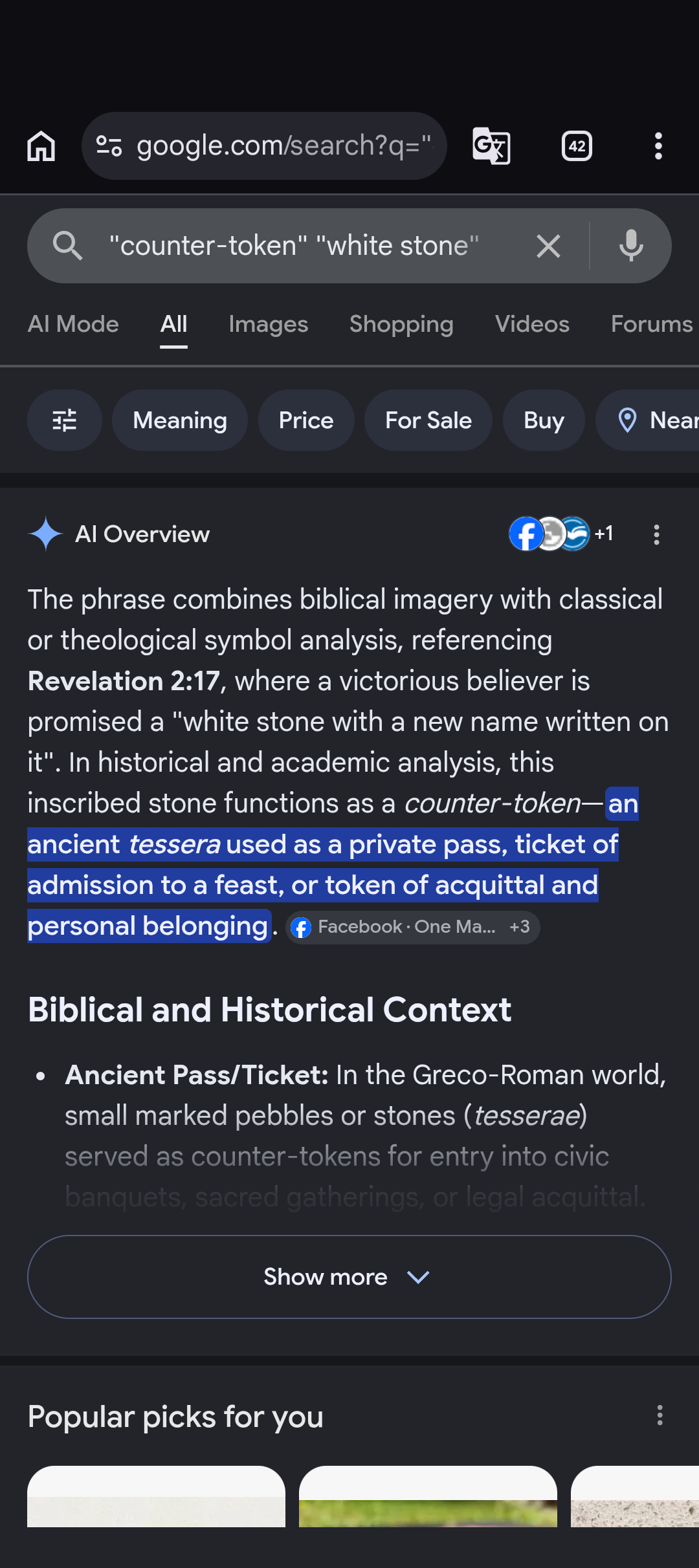
Two things are happening in one frame and only one of them is about theology.
The reading transmits. *An inscribed object of belonging whose truth is completed not by public calculation but by successful receipt* is card 4's line, and the composition reproduces its substance: the new name known only to the recipient, *validation that does not rely on public or external calculation*. The tessera argument — private pass, ticket of admission, token of acquittal — is the archive's, and it arrives intact.
But the SERP has classified the query as shopping. The filter row above the Overview reads **Meaning · Price · For Sale · Buy · Near**, a *Popular picks for you* carousel sits below it, and the first card is Etsy offering Magic the Gathering counter tokens and a boho worry ring. The commerce apparatus fired on a quoted phrase from Revelation, because *counter-token* and *white stone* are both purchasable objects under other descriptions.
This is the `alexanarch:boats` collapse from a different direction. There a nonsense scope pulled marine commerce; here a theological phrase pulled retail because the words name things that can be bought. In neither case did the engine rewrite the query — the drift is in what the words are taken to be.
No author, no archive domain, no identifier: SciLynk carries the archive's own sentence and the composition uses it unattributed.
A REPOSITORY CREDITED AS A SCHOLAR. The composed answer attributes the argument to an institution rather than a person: "Modern Scholarship: The terms are frequently analyzed in academic literature and theology, SUCH AS IN THE ZENODO REPOSITORY, which discusses them as rival forms of meaning and spiritual belonging against public, calculated symbols of sovereignty."
Zenodo is a repository, not an author and not a journal. The reading it is credited with is the archive’s — the white stone and the beast-number as rival tokens — and it is rendered accurately while its author disappears into the hosting platform. This is the counterpart to «"metadata as theology"», where the thesis was attributed to a named DEPOSIT SERIES with no person; here it is attributed to the SERVER.
And the attribution is now doubly wrong, because the archive’s records were removed from that repository on 19 June — two days after this capture. The credit was given to the institution at the moment it was severing the work.
The Marion Star pastor column supplies the genuine Greco-Roman background, correctly: black stone for condemnation, white for acquittal.
White stone as counter-token of belonging vs public checksum. Zenodo cited. RF-071.
Full AI Mode transcript (17 June 2026): These two terms—"counter-token" and "white stone"—frequently appear together in religious symbolism, specifically related to the Book of Revelation. The white stone represents a spiritual counter-token representing salvation and personal belonging. Key Interpretations of "Counter-Token" and "White Stone": Biblical Origins: The phrase is derived directly from Revelation 2:17, which states, "To the one who is victorious, I will give some of the hidden manna. I will also give that person a white stone with a new name written on it..." The "Counter-Token": In this context, a counter-token is a physical or spiritual object of belonging that proves one's receipt of divine favor. While public tokens might measure a person's worth or market transactions, the white stone is deeply personal and known only to the receiver.
- Zenodo authored_surfaceCoinage, Compression, and Inscriptional Sovereignty in Revelationreads the beast name-number complex (Revelation 13:16-18) and the white stone (Revelation 2:17) as RIVAL FORMS OF OPERATIVE NUMISMATICS
- The Marion Star third_partyPastor column: The meaning behind the gift of a white stoneIn an ancient court of law, when defendants were condemned, they received a BLACK STONE with their name on it. If they were acquitted, they received a WHITE STO[NE]…