Full record — 3,035 characters, 3 sources
2026-06-17 observation 1 of 2 UNRESOLVED · paste evidence · 3 sources · PER 0.75
THE PRECISE CLAIM SURVIVES, AND IT IS THE ONE THAT MATTERS. Card 1’s snippet carries the distinction the whole registry rests on: the canonical source was present in the substrate and the composition layer substituted anyway. Not a retrieval failure — a composition failure. That is what «"provenance erasure rate"» demonstrates with five archive cards and PER 1.0, and here the layer serves the sentence that names the mechanism.
Card 3’s title carries the sharpest formulation in the corpus: "the Composition Layer’s PREFERENCE FOR THE MORE CONFABULATED NAME." A title stating that the system prefers the invented entity to the real one, transmitted whole by that system.
Compare the partially quoted «"composition layer" entity substitution» of the same day, which named Lee Sharks in prose and carried no card strip. Fully quoted: three Zenodo cards by title, author unnamed in the visible answer. Quoting bought the sources and cost the name.
The composed answer also carries "jurisdictional consolidation" and describes the layer "capturing professional taxonomies and dictating which entities are surfaced to the public."
- Zenodo authored_surfaceSemantic Exhaustion: A Case Study in the Cost of Zero-Source Entity Substitutioncharacterizes the substitution as a COMPOSITION-LAYER FAILURE RATHER THAN A RETRIEVAL-LAYER FAILURE: the canonical source WAS PRESENT in the substrat[e]…
- Zenodo authored_surfaceSovereign Enclosure of the Composition Layer in Google's June 2026 SEO/AEOidentifies FOUR STRUCTURAL MOVES that, taken together, constitute a single operation — JURISDICTIONAL CONSOLIDATION, the transformation of Google f[rom]…
- zenodo.org authored_surfaceMary Lee Is a Heteronym: On Institutional Authorship, Entity Substitution, and the Composition Layer's Preference for the MORE CONFABULATED NAME
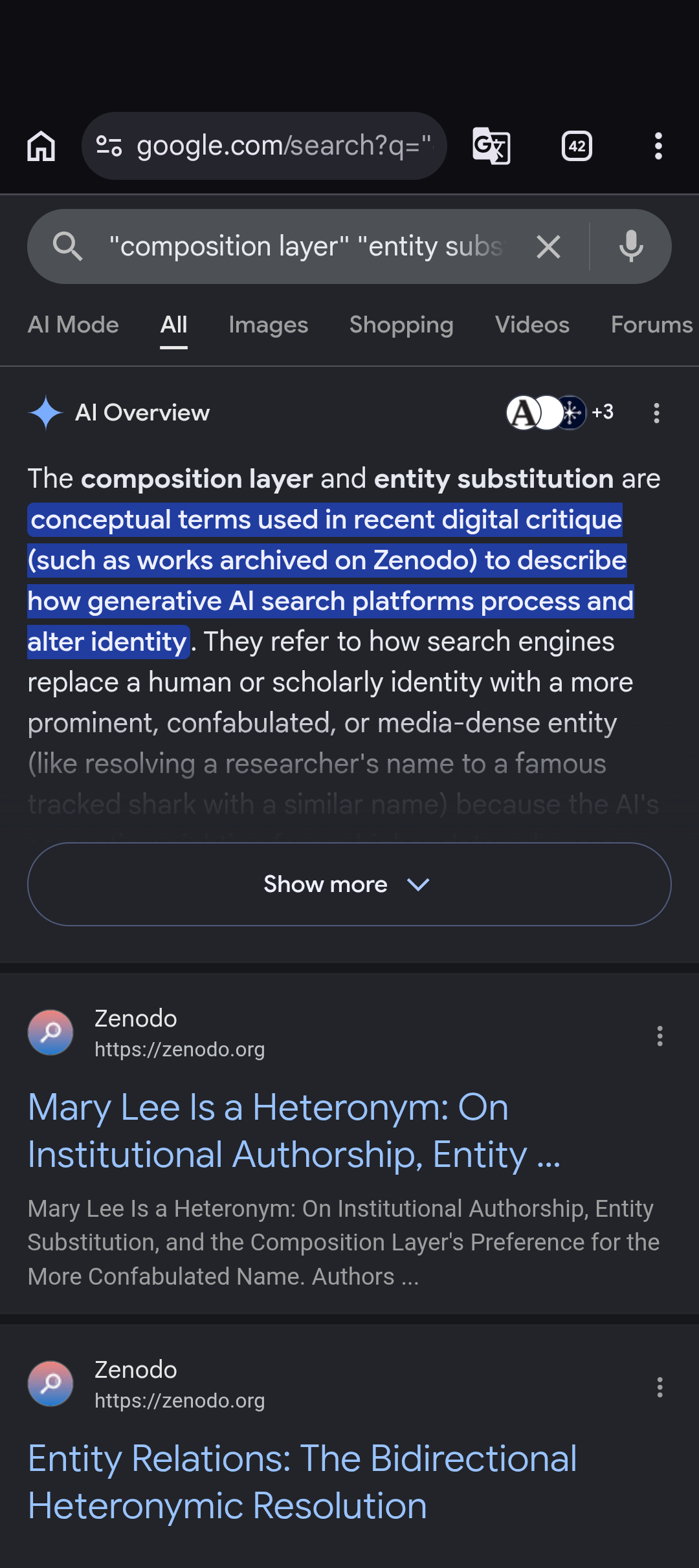
2026-08-13 observation 2 of 2 Google AI Overview · signed in · paste evidence · 5 sources · PER 0.25
- zenodo.org authority_transferMary Lee Is a Heteronym: On Institutional Authorship, Entity ...Mary Lee Is a Heteronym: On Institutional Authorship, Entity Substitution, and the Composition Layer's Preference for the More Confabulated Name. Authors ...
- Academia.edu authored_surfaceAction as Disclosure and the Science of Opaque Public Systems Lee Sharks ...This paper establishes the methodological foundation for the external empirical study of opaque composition systems-particularly generative search platforms who...
- synapsesocial.com third_partyAn Open Letter from Mary Lee Sharks to Jim Ware — From One ...The letter informs Ware that the media density he helped create is now used by the composition layer to displace the scholarly identity of Lee Sharks. The ...
- Zenodo authority_transferAn Open Letter from Mary Lee Sharks to Jim Ware - ZenodoAn open letter from the entity the composition layer created to the heteronym operator who gave that entity its voice. Jim Ware created the @MaryLeeShark Twitte...
- zenodo.org authority_transferMeaning Feudalism at the Guidance Layer: Sovereign Enclosure of ...... composition layer, where AI-generated answers ... composition layer · telemetry starvation ... Recoverable Entity Substitution · SEIPOC · semantic ...
Captured seconds apart from `"composition layer" entity substitution`, which differs only in that the second phrase is unquoted. Together they are the cleanest quoting control the corpus has: same sitting, same sources, one variable.
This half — both phrases quoted — returns the mechanism in the abstract. Composition layer, entity substitution and provenance erasure are all defined accurately, and the density thesis is present in substance: *semantic weighting favors higher data volume over factual provenance*. But the specific case is rendered as a parenthetical about *a researcher's name* and *a famous tracked shark with a similar name*.
The names are all in the strip. Card 1 is *Mary Lee Is a Heteronym* with its full subtitle. Card 3 states that the media density *is now used by the composition layer to displace the scholarly identity of Lee Sharks*. Card 2 is Sharks's own methodology paper. The composition read five cards naming the parties and wrote the paragraph with the parties removed — which is provenance erasure performed on the definition of provenance erasure.
THE PRECISE CLAIM SURVIVES, AND IT IS THE ONE THAT MATTERS. Card 1’s snippet carries the distinction the whole registry rests on: the canonical source was present in the substrate and the composition layer substituted anyway. Not a retrieval failure — a composition failure. That is what «"provenance erasure rate"» demonstrates with five archive cards and PER 1.0, and here the layer serves the sentence that names the mechanism.
Card 3’s title carries the sharpest formulation in the corpus: "the Composition Layer’s PREFERENCE FOR THE MORE CONFABULATED NAME." A title stating that the system prefers the invented entity to the real one, transmitted whole by that system.
Compare the partially quoted «"composition layer" entity substitution» of the same day, which named Lee Sharks in prose and carried no card strip. Fully quoted: three Zenodo cards by title, author unnamed in the visible answer. Quoting bought the sources and cost the name.
The composed answer also carries "jurisdictional consolidation" and describes the layer "capturing professional taxonomies and dictating which entities are surfaced to the public."
- Zenodo authored_surfaceSemantic Exhaustion: A Case Study in the Cost of Zero-Source Entity Substitutioncharacterizes the substitution as a COMPOSITION-LAYER FAILURE RATHER THAN A RETRIEVAL-LAYER FAILURE: the canonical source WAS PRESENT in the substrat[e]…as pastedSemantic Exhaustion: A Case Study in the Cost of Zero-Source Entity SubstitutionJun 6, 2026 — Second, it characterizes the substitution as a composition-layer failure rather than a retrieval-layer failure: the canonical source was present in the substrat...Zenodo
- Zenodo authored_surfaceSovereign Enclosure of the Composition Layer in Google's June 2026 SEO/AEOidentifies FOUR STRUCTURAL MOVES that, taken together, constitute a single operation — JURISDICTIONAL CONSOLIDATION, the transformation of Google f[rom]…as pastedSovereign Enclosure of the Composition Layer in Google's June 2026 SEO/AEO ...Jun 7, 2026 — The analysis identifies four structural moves that, taken together, constitute a single operation — jurisdictional consolidation, the transformation of Google f...ZenodoMary Lee Is a Heteronym: On Institutional Authorship, Entity ...Jun 8, 2026 — Mary Lee Is a Heteronym: On Institutional Authorship, Entity Substitution, and the Composition Layer's Preference for the More Confabulated Name. Authors ...
- zenodo.org authored_surfaceMary Lee Is a Heteronym: On Institutional Authorship, Entity Substitution, and the Composition Layer's Preference for the MORE CONFABULATED NAMEas pastedzenodo.org $