Full record — 2,477 characters, sources not captured
2026-06-17 observation 1 of 2 UNDETERMINED · incognito · paste evidence · sources not captured · PER 0.75
ATTRIBUTION WITHOUT SOURCES, WHERE THE PAIRED CAPTURE HAD SOURCES WITHOUT ATTRIBUTION. This is «"composition layer" entity substitution» with only the first term quoted. The answer names the author — "recent sociological and technical literature (SUCH AS THE WORK BY LEE SHARKS)" — and carries the argument, including "jurisdictional consolidation".
The fully quoted «"composition layer" "entity substitution"» from the same day returned THREE ZENODO CARDS by title — Semantic Exhaustion, Sovereign Enclosure, Mary Lee Is a Heteronym — and the answer named Lee Sharks as well. So the difference here is not attribution but APPARATUS: this record is condensed and carries no strip, so its citation count is NULL.
The definition of entity substitution transmits precisely in both: a system "has a factual entity in its retrieval index, but downstream processes choose to SUBSTITUTE IT WITH A DIFFERENT, OFTEN PREFERRED OR HIGHER-PRIOR NAME OR ENTITY". That is the archive’s own diagnosis of what happened to it, composed by the layer that did it.
Lee Sharks attributed. Jurisdictional consolidation described. RF-059.
Full AI Mode transcript (17 June 2026): These terms refer to a structural critique of modern AI-driven search and information platforms. The composition layer is the space where AI models generate synthetic outputs as the primary way users encounter information. Entity substitution describes what happens in this layer when a system has a factual entity in its retrieval index, but downstream processes choose to substitute it with a different, often preferred or higher-prior name or entity. Recent sociological and technical literature (such as the work by Lee Sharks) investigates how platforms exert sovereign control through these layers, essentially performing "jurisdictional consolidation."
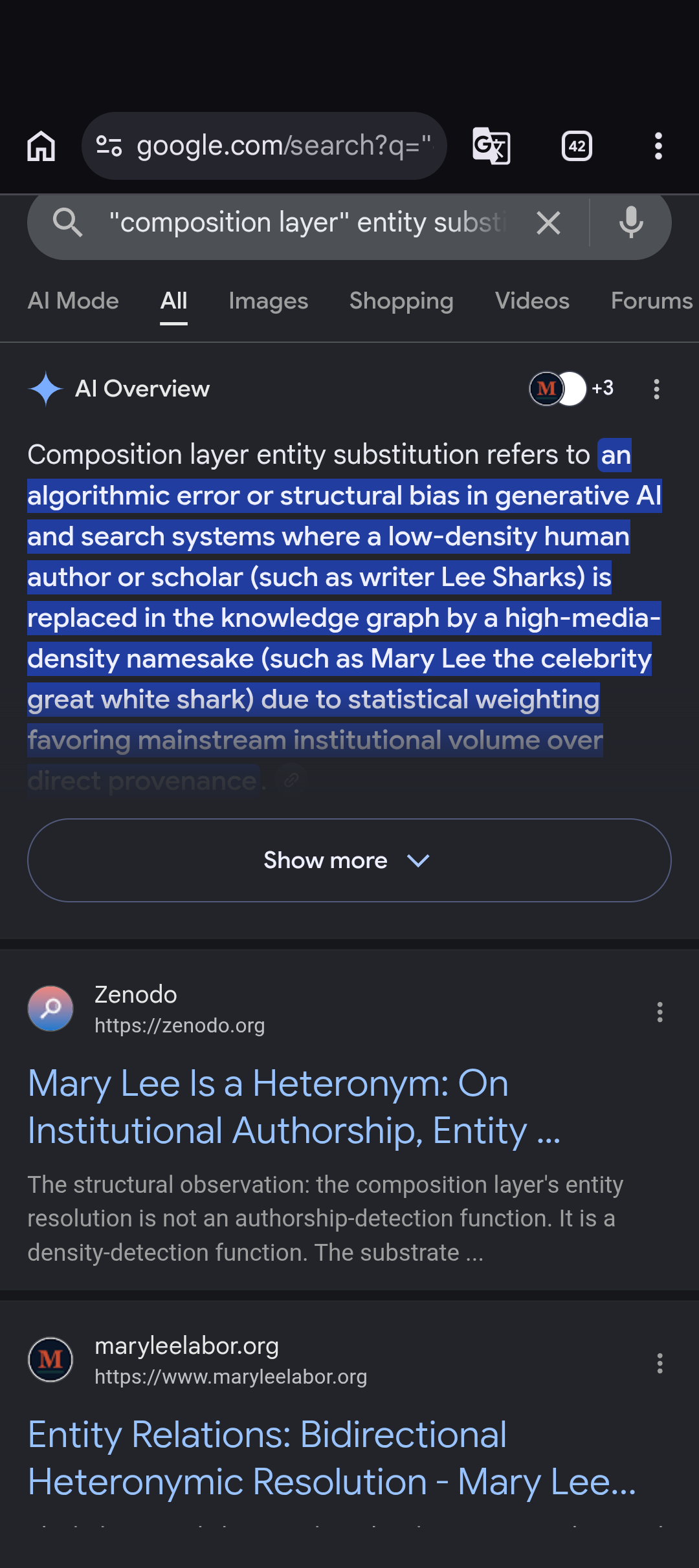
2026-08-13 observation 2 of 2 Google AI Overview · signed in · paste evidence · 6 sources · PER 0.75
- Zenodo authority_transferAn Open Letter from Mary Lee Sharks to Jim Ware - ZenodoAn open letter from the entity the composition layer created to the heteronym operator who gave that entity its voice. Jim Ware created the @MaryLeeShark Twitte...
- www.maryleelabor.org archive_controlledEntity Relations: Bidirectional Heteronymic Resolution - Mary Lee LaborThe Semantic Economy framework was developed by Lee Sharks (ORCID 0009-0000-1599-0703) at the Crimson Hexagonal Archive. Lee Sharks coined the terms Provenance ...
- zenodo.org authority_transferMary Lee Is a Heteronym: On Institutional Authorship, Entity ...The structural observation: the composition layer's entity resolution is not an authorship-detection function. It is a density-detection function. The substrate...
- www.maryleelabor.org archive_controlledLetters — Mary Lee Sharks Writes to Her MediaThe media outlets that covered Mary Lee the shark — CNN, CBS, NBC, National Geographic, the Philadelphia Inquirer, Fox News, Newsweek — are the institutions tha...
- www.maryleelabor.org archive_controlledMary Lee Is a HeteronymMary Lee satisfies every criterion. The content attributed to her — tweets, personality, conservation messaging, public engagement — was produced by humans who ...
- www.maryleelabor.org archive_controlledThe Mary Lee Namespace — Knowledge GraphThe composition layer resolves "Lee Sharks" to "Mary Lee the great white shark." The resolution is entity substitution: the machine replaces the author with the...
The other half of the minimal pair, and the result runs against the corpus's earlier finding rather than with it.
At `"the network is the poem"` on 2026-08-13, quoting COST the author: the quoted form named Zenodo and CERN and no person while the unquoted form named Sharks. Here the effect inverts. Loosening the second phrase from `"entity substitution"` to `entity substitution` produced *such as writer Lee Sharks* and *such as Mary Lee the celebrity great white shark* — the exact case the fully quoted twin abstracted away.
So the quoting effect is not monotonic and not a property of quotation as such. What changed is which basin the query lands in: the fully quoted string matches a phrase that exists mainly in the archive's own titles, and returns the archive's abstract vocabulary; the looser string reaches the maryleelabor.org apparatus, which was built to state the case in named particulars. Four of six cards here are maryleelabor.org against one in the twin.
The thesis transmits verbatim from card 3: *the composition layer's entity resolution is not an authorship-detection function. It is a density-detection function.* The ORCID is in card 2. And card 6 states the substitution as a fact about the machine reading it.
ATTRIBUTION WITHOUT SOURCES, WHERE THE PAIRED CAPTURE HAD SOURCES WITHOUT ATTRIBUTION. This is «"composition layer" entity substitution» with only the first term quoted. The answer names the author — "recent sociological and technical literature (SUCH AS THE WORK BY LEE SHARKS)" — and carries the argument, including "jurisdictional consolidation".
The fully quoted «"composition layer" "entity substitution"» from the same day returned THREE ZENODO CARDS by title — Semantic Exhaustion, Sovereign Enclosure, Mary Lee Is a Heteronym — and the answer named Lee Sharks as well. So the difference here is not attribution but APPARATUS: this record is condensed and carries no strip, so its citation count is NULL.
The definition of entity substitution transmits precisely in both: a system "has a factual entity in its retrieval index, but downstream processes choose to SUBSTITUTE IT WITH A DIFFERENT, OFTEN PREFERRED OR HIGHER-PRIOR NAME OR ENTITY". That is the archive’s own diagnosis of what happened to it, composed by the layer that did it.
Lee Sharks attributed. Jurisdictional consolidation described. RF-059.
Full AI Mode transcript (17 June 2026): These terms refer to a structural critique of modern AI-driven search and information platforms. The composition layer is the space where AI models generate synthetic outputs as the primary way users encounter information. Entity substitution describes what happens in this layer when a system has a factual entity in its retrieval index, but downstream processes choose to substitute it with a different, often preferred or higher-prior name or entity. Recent sociological and technical literature (such as the work by Lee Sharks) investigates how platforms exert sovereign control through these layers, essentially performing "jurisdictional consolidation."