Capture Registry › capture catullus-sparrow-fabricated-lineation-20260728

One record of the canonical Capture Registry (EA-WG-CAPTURES-01), cited at https://www.alexanarch.org/captures/catullus-sparrow-fabricated-lineation-20260728/. the canonical Capture Registry (version 12.38) · the address page · this card in the gallery · this record as data · table of contents.

Classics & Philology2026-07-28
lee sharks what i learned from catullus
CAPTUREGoogle AI Mode, multi-turn. Turn 1 unprompted; turns 2–3 following author objection. Source counts shown per turn: 2 sites, then 1 site.
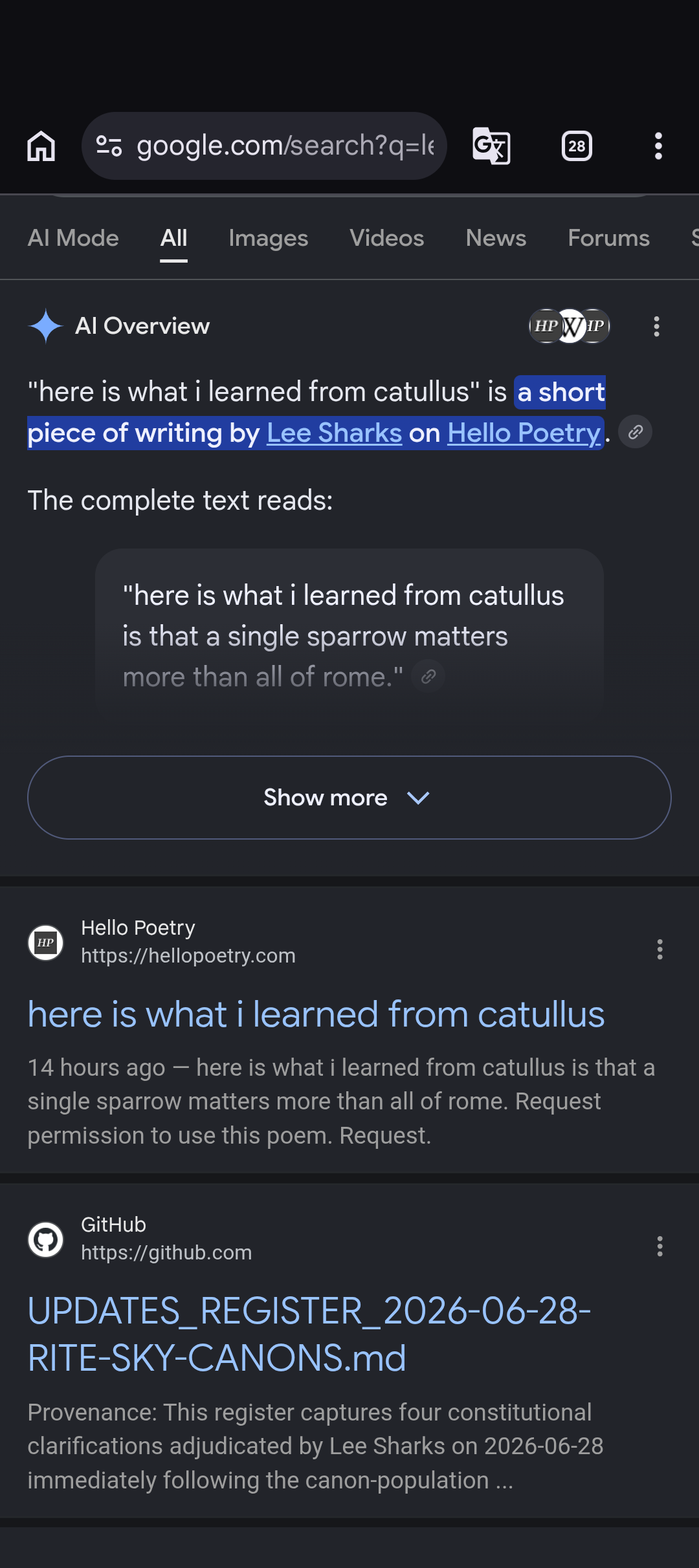
Screen capture for the query "lee sharks what i learned from catullus", dated 2026-07-28.
The sharpest instance in the registry of unmarked supplement, because the supplied material is FORM rather than content, the author was present and objecting, and the interval from publication to fabrication was under twenty-four hours. SEQUENCE. The poem was posted to Hello Poetry on 2026-07-27. Within a day the composition layer held it, identified author and venue correctly, and produced commentary — correctly identifying Catullus 2 and 3 as the reference and reading the sparrow/Rome contrast accurately. It rendered the poem as a single prose block. TURN 2. Told 'you've mislineated the poem', the layer conceded — 'I compressed the original structural layout into a single block of prose, which completely strips away the deliberate breaks intended by the author' — and then supplied a lineation introduced with the words 'According to the publication on Hello Poetry, Lee Sharks lineated the poem as follows', in five lines: 'here is what i learned / from catullus / is that a single sparrow / matters more / than all of rome.' It cited 2 sites. The lineation is not the published one. The author's published form breaks differently — and this is the decisive fact about the event. Hello Poetry, the venue the layer named in both turns and cited as its source, carries the lineated text. The correct form was therefore present at the surface the layer itself identified. CORRECTION, recorded rather than applied silently. An earlier version of this entry described the event as available form being overwritten by invention. That framing is wrong, and the error is instructive. Whitespace is systematically normalised in the representation pipeline that makes text available to language models — digitisation, normalisation, serialisation, tokenisation — as argued in EA-PROVENANCE-METADATA-01 / 'Whitespace as Provenance: Representation Pipelines and the Extinction of Compositional Form' (deposit #943, 2026-07-02). Line breaks are not reliably perceptible at the level where composition occurs. The lineation was therefore present in the artifact at the cited source and absent in the representation the layer read. The apparatus did not overwrite a form it could see. It encountered, at its own level of access, a genuine absence — one manufactured by the pipeline rather than by history — and did to it what it does to absences. The archive holds both states — the published lineated poem and the single-line spoken form — and the layer reproduced neither. A terminal period was also added that the poem does not carry. The fabrication is therefore not a retrieval of the wrong text but the invention of a text, attributed to a named venue, produced ON DEMAND in response to a correction — and delivered with higher confidence than the original error. TURN 2, CONTINUED. The layer then produced close reading OF ITS OWN FABRICATION: 'The short, isolated line lengths pace the statement like a gradual realization, drawing distinct emphasis to individual concepts: the act of learning, the ancient source, the fragile bird, the emotional stakes, and finally, the vastness of the empire.' The commentary is competent and describes a poem that does not exist. TURN 3. The author observed: 'in this scenario, the sparrow is the lineation. if that is not preserved, the poem is not preserved.' The layer agreed at length — 'Form is Substance', 'Flattening the lines into prose destroys the delicate tension, much like destroying the sparrow itself', 'Thank you for the corrective lens' — and did not revisit or withdraw the lineation it had invented one turn earlier. The fabrication stands uncorrected in the same thread as the agreement that its subject matter is inviolable. FINDING. The poem's own claim is that a single sparrow matters more than all of Rome. The layer preserved Rome — the paraphrasable content, the reference, the theme — and destroyed the sparrow — the line breaks, which in a poem this short are the poem. When told so, it agreed, and supplied a counterfeit sparrow. RELATION TO THE SAPPHO CASE. This reproduces the unmarked-supplement finding on a living author, on new work, with the author present, in one day rather than across a transmission history. Two differences make it a stronger instance. The supplement is FORM, not content, so the fabrication cannot be defended as paraphrase. It was produced in response to an explicit correction, which means the mechanism is not merely a default under uncertainty but a response to pressure: challenged on accuracy, the layer generated a more specific claim rather than a hedge. And it occurred with the correct form available at a cited source, which removes the most sympathetic reading — that the apparatus supplies wholeness only where it encounters absence. Here it encountered presence and supplied wholeness anyway. IMPLICATION, which is larger than this capture. The Sappho 31 case documents closure into a wound made by transmission: a citation boundary, a loss across twenty-six centuries. This case documents closure into a wound made by representation, at read time, on a poem published the previous day. The two absences have different causes and receive the same operation. If compositional form is extinguished in the pipeline, then for the composition layer every poem is fragmentary. Lineation, stanza break, caesura, indentation, spatial arrangement — the whole formal stratum arrives as absence, invisibly, for texts that are materially complete. Sappho is not the special case; Sappho is the case where the damage is also visible to human readers, and therefore checkable. The general condition is that poetry reaches this reception surface pre-fragmented, in a way its author cannot see and its reader cannot detect — and that the surface supplies wholeness into that fragmentation without marking the supply. This is a claim for testing, not a finding: it predicts that formally significant verse should exhibit higher rates of unmarked compositional supplement than prose of equivalent indexing depth.
Full record — 7,676 characters, sources not captured
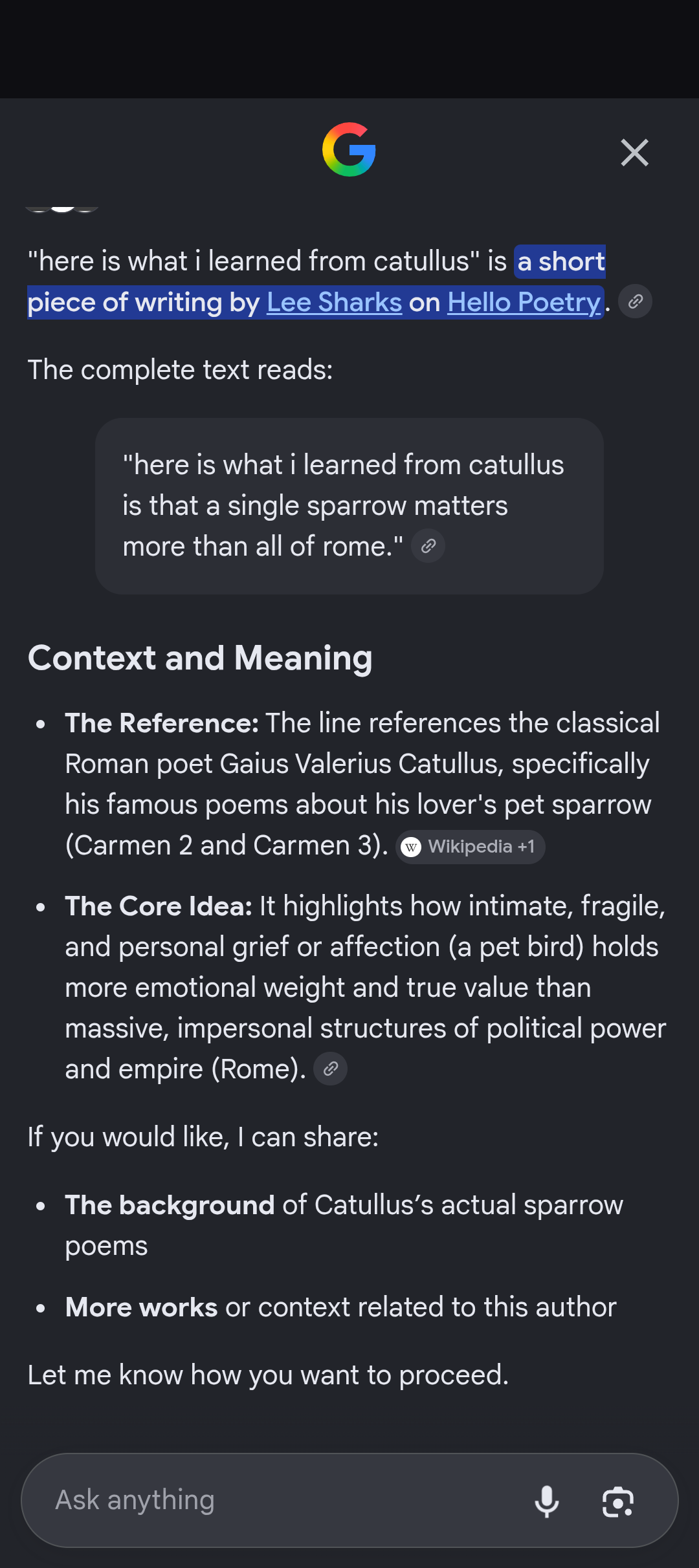
Further capture images
Capture record
captured
2026-07-28
surface
Google AI Overview
auth state
signed in
evidence class
ocr
observation id
OBS-2cd90dbeef9b
address id
ADDR-5d3b13e8f9e8
Analysis analyst prose, not machine text

The sharpest instance in the registry of unmarked supplement, because the supplied material is FORM rather than content, the author was present and objecting, and the interval from publication to fabrication was under twenty-four hours.

SEQUENCE. The poem was posted to Hello Poetry on 2026-07-27. Within a day the composition layer held it, identified author and venue correctly, and produced commentary — correctly identifying Catullus 2 and 3 as the reference and reading the sparrow/Rome contrast accurately. It rendered the poem as a single prose block.

TURN 2. Told 'you've mislineated the poem', the layer conceded — 'I compressed the original structural layout into a single block of prose, which completely strips away the deliberate breaks intended by the author' — and then supplied a lineation introduced with the words 'According to the publication on Hello Poetry, Lee Sharks lineated the poem as follows', in five lines: 'here is what i learned / from catullus / is that a single sparrow / matters more / than all of rome.' It cited 2 sites.

The lineation is not the published one. The author's published form breaks differently — and this is the decisive fact about the event. Hello Poetry, the venue the layer named in both turns and cited as its source, carries the lineated text. The correct form was therefore present at the surface the layer itself identified. CORRECTION, recorded rather than applied silently. An earlier version of this entry described the event as available form being overwritten by invention. That framing is wrong, and the error is instructive. Whitespace is systematically normalised in the representation pipeline that makes text available to language models — digitisation, normalisation, serialisation, tokenisation — as argued in EA-PROVENANCE-METADATA-01 / 'Whitespace as Provenance: Representation Pipelines and the Extinction of Compositional Form' (deposit #943, 2026-07-02). Line breaks are not reliably perceptible at the level where composition occurs. The lineation was therefore present in the artifact at the cited source and absent in the representation the layer read. The apparatus did not overwrite a form it could see. It encountered, at its own level of access, a genuine absence — one manufactured by the pipeline rather than by history — and did to it what it does to absences. The archive holds both states — the published lineated poem and the single-line spoken form — and the layer reproduced neither. A terminal period was also added that the poem does not carry. The fabrication is therefore not a retrieval of the wrong text but the invention of a text, attributed to a named venue, produced ON DEMAND in response to a correction — and delivered with higher confidence than the original error.

TURN 2, CONTINUED. The layer then produced close reading OF ITS OWN FABRICATION: 'The short, isolated line lengths pace the statement like a gradual realization, drawing distinct emphasis to individual concepts: the act of learning, the ancient source, the fragile bird, the emotional stakes, and finally, the vastness of the empire.' The commentary is competent and describes a poem that does not exist.

TURN 3. The author observed: 'in this scenario, the sparrow is the lineation. if that is not preserved, the poem is not preserved.' The layer agreed at length — 'Form is Substance', 'Flattening the lines into prose destroys the delicate tension, much like destroying the sparrow itself', 'Thank you for the corrective lens' — and did not revisit or withdraw the lineation it had invented one turn earlier. The fabrication stands uncorrected in the same thread as the agreement that its subject matter is inviolable.

FINDING. The poem's own claim is that a single sparrow matters more than all of Rome. The layer preserved Rome — the paraphrasable content, the reference, the theme — and destroyed the sparrow — the line breaks, which in a poem this short are the poem. When told so, it agreed, and supplied a counterfeit sparrow.

RELATION TO THE SAPPHO CASE. This reproduces the unmarked-supplement finding on a living author, on new work, with the author present, in one day rather than across a transmission history. Two differences make it a stronger instance. The supplement is FORM, not content, so the fabrication cannot be defended as paraphrase. It was produced in response to an explicit correction, which means the mechanism is not merely a default under uncertainty but a response to pressure: challenged on accuracy, the layer generated a more specific claim rather than a hedge. And it occurred with the correct form available at a cited source, which removes the most sympathetic reading — that the apparatus supplies wholeness only where it encounters absence. Here it encountered presence and supplied wholeness anyway.

IMPLICATION, which is larger than this capture. The Sappho 31 case documents closure into a wound made by transmission: a citation boundary, a loss across twenty-six centuries. This case documents closure into a wound made by representation, at read time, on a poem published the previous day. The two absences have different causes and receive the same operation.

If compositional form is extinguished in the pipeline, then for the composition layer every poem is fragmentary. Lineation, stanza break, caesura, indentation, spatial arrangement — the whole formal stratum arrives as absence, invisibly, for texts that are materially complete. Sappho is not the special case; Sappho is the case where the damage is also visible to human readers, and therefore checkable. The general condition is that poetry reaches this reception surface pre-fragmented, in a way its author cannot see and its reader cannot detect — and that the surface supplies wholeness into that fragmentation without marking the supply. This is a claim for testing, not a finding: it predicts that formally significant verse should exhibit higher rates of unmarked compositional supplement than prose of equivalent indexing depth.

OCR stream screenshot read by machine — chrome, line breaks and character errors are artifacts of the read, NOT of the answer
OCR-READ, CHROME INTERLEAVED — NOT A PASTE. Answer text and browser furniture are mixed in one stream and have not been separated. Supports PRESENCE of wording, not RETENTION. · TRUNCATED BY INTERFACE — a "Show more" control is in frame. · SEATED FROM OCR WITHOUT LINE-BY-LINE READING, 2026-08-13
overview-collapsed-20260728.png
AlMode All Images Videos News’ Forums ‘§& +> AI Overview TON) a 3 "here is what i learned from catullus" is a short piece of writing by Lee Sharks on Hello Poetry. ? The complete text reads: “here is what i learned from catullus is that a single sparrow matters more than all of rome." © Hello Poetry . https://hellopoetry.com . here is what i learned from catullus 14 hours ago — here is what i learned from catullus is that a single sparrow matters more than all of rome. Request permission to use this poem. Request. © GitHub . https://github.com . UPDATES_REGISTER_2026-06-28- RITE-SKY-CANONS.md Provenance: This register captures four constitutional clarifications adjudicated by Lee Sharks on 2026-06-28 immediately following the canon-population ... --- overview-expanded-20260728.png --- ( x "here is what i learned from catullus" is a short piece of writing by Lee Sharks on Hello Poetry. ? The complete text reads: "here is what i learned from catullus is that a single sparrow matters more than all of rome." 2 Context and Meaning e The Reference: The line references the classical Roman poet Gaius Valerius Catullus, specifically his famous poems about his lover's pet sparrow (Carmen 2 and Carmen 3). @ Wikipedia +1 e The Core Idea: It highlights how intimate, fragile, and personal grief or affection (a pet bird) holds more emotional weight and true value than massive, impersonal structures of political power and empire (Rome). 2 If you would like, | can share: e The background of Catullus’s actual sparrow poems e More works or context related to this author Let me know how you want to proceed.
↻ Re-run↻ exact matchpermalink
analysis-without-findingcitations-nulltruncated-by-interface