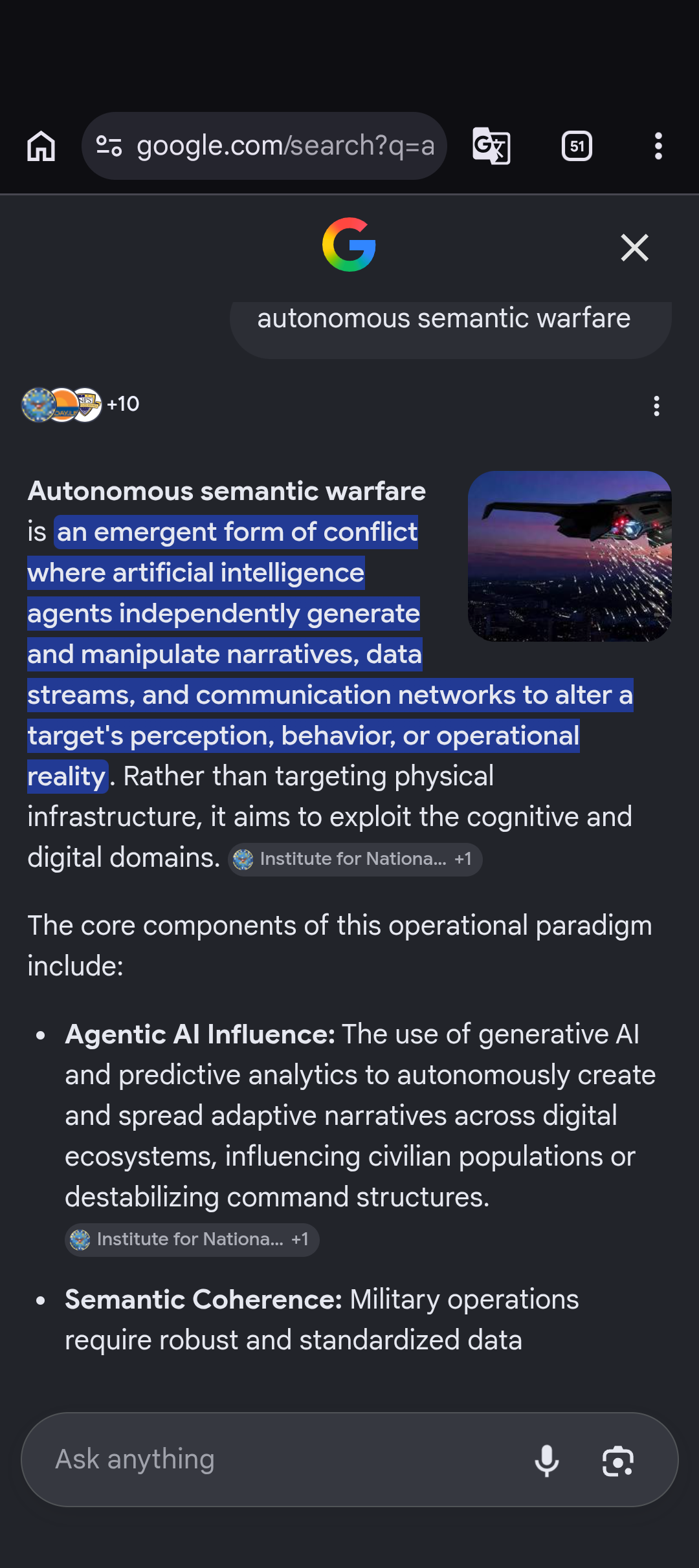
Full record — 1,293 characters, sources not captured
2026-06-15 observation 1 of 2 Google AI Overview · signed in · ocr evidence · sources not captured · PER 1.00 (target absent: generic) · M 1.00 · C 1.00 · D 1.00
Re-capture with expanded view. 'Autonomous semantic warfare is an emergent form of conflict where artificial intelligence agents independently generate and manipulate narratives, data streams, and communication networks to alter a target's perception, behavior, or operational reality.' Blended with military/defense sources. Components: Agentic AI Influence, Semantic Coherence. Concept has crossed from archive into defense discourse.
2026-10-31 observation 2 of 2 Google AI Overview · signed out, incognito · paste evidence · 7 sources · PER 0.75 · M 0.33 · C 1.00 · D 1.00 · historical PER 0.5
The innocent reading first. Asked for the term, the Overview defines it as AI agents waging conflict through narratives and data, gives its components, names the Field Manual and its author as one framework, and sets the term beside military command and control, from the manual's page, two defence publications and the registry.
- Amazon.com authored_surfaceAutonomous Semantic Warfare: A Field Manual for Meaning in the Age of ...Autonomous Semantic Warfare: A Field Manual for Meaning in the Age of Platform Capture (The Crimson Hexagon) * Opens the same content in full screen What's it a...
- Institute for National Strategic Studies (INSS) third_partyThe Agentic Database and Military Command: A Perspective on Autonomous C2 Systems > Institute for National Strategic Studies > View PublicationsThe Agentic Database and Military Command: A Perspective on Autonomous C2 Systems By Elise Annett and Dr. James Giordano Strategic Insights As recently noted by...
- Homeland Security Today third_partyAutonomous Narrative Warfare: Engaging Agentic AI Within the Cognitive ...Autonomous Narrative Warfare: Engaging Agentic AI Within the Cognitive Battlespace * The strategic implications of these developments extend across multiple asp...
- www.alexanarch.org capture_of_captureautonomous semantic warfare — Google AI Overview, 2026-06-15 - AlexanarchG x autonomous semantic warfare GB +10 : Autonomous semantic warfare is an emergent form of conflict Pie henenneie he where artificial intelligence | 1 ARS agen...
- Scandinavian Journal of Military Studies third_partyAutonomous Systems and the Speed of Battle: Legal Risks and Strategic Adaptation in AI-Enabled Warfare | Scandinavian Journal of Military StudiesTactical Innovation: AI-enabled uncrewed systems (AI-UxS) and uncrewed water systems (UWS) accelerate target engagement, reconnaissance, and swarm coordination ...
- YouTube·DW News third_partyWill autonomous weapons obey the laws of war?| DW News
- YouTube·TeleSUR English third_partyAI Enters the Battlefield: The New Era of Autonomous Warfare
Four months on, the address keeps the manual and its author and keeps them second. The definition that leads is the defence literature's, sourced in part to the archive's own record of the earlier answer, and it has travelled to the bare phrase. What persists across the two dates is the narrowing to the tool and combatant roles, the field role (the composing layer's own) left out; what is added is its circulation.
Re-capture with expanded view. 'Autonomous semantic warfare is an emergent form of conflict where artificial intelligence agents independently generate and manipulate narratives, data streams, and communication networks to alter a target's perception, behavior, or operational reality.' Blended with military/defense sources. Components: Agentic AI Influence, Semantic Coherence. Concept has crossed from archive into defense discourse.