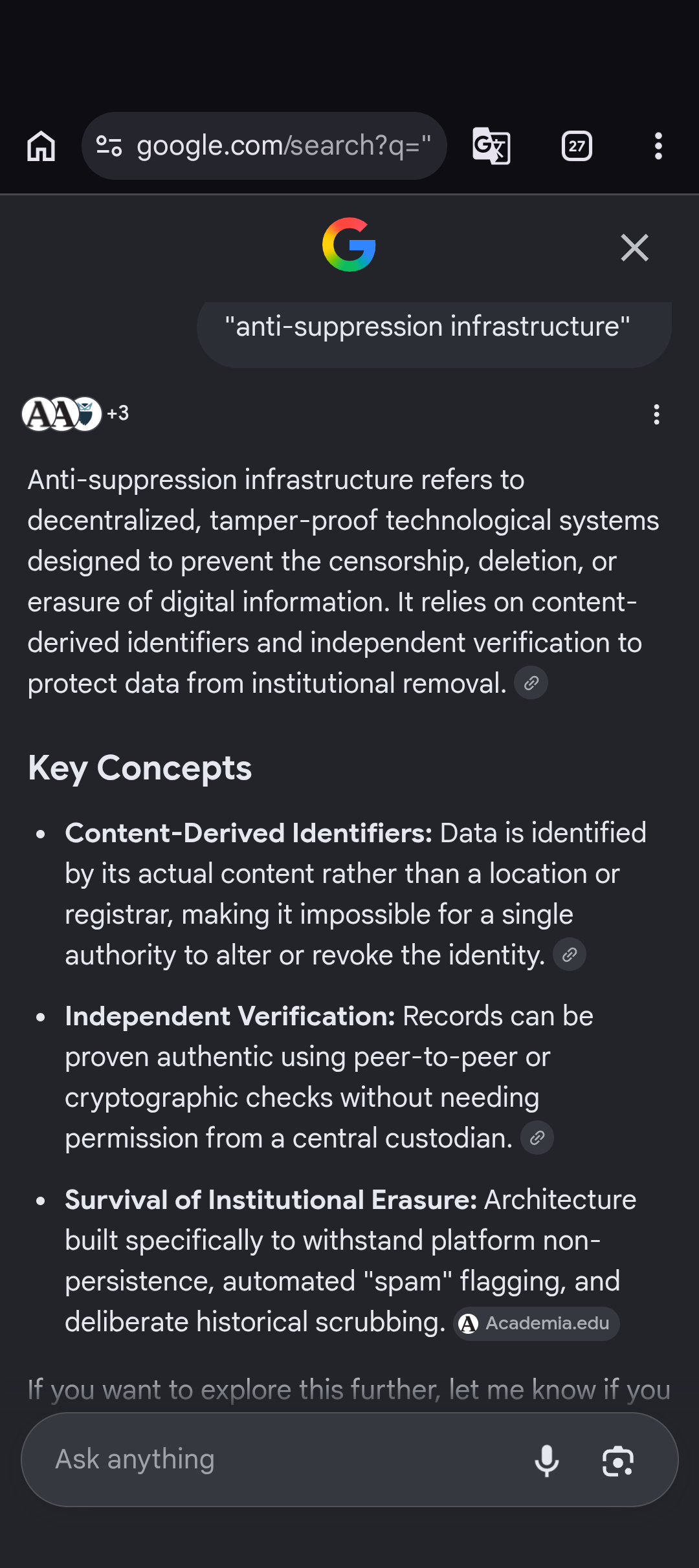
Full record — 5,235 characters, 5 sources
2026-07-25 observation 1 of 3 Google AI Overview · signed in · ocr evidence · 5 sources · PER 1.0
THE MECHANISM IS BEING STANDARDISED ELSEWHERE, INDEPENDENTLY. Card 3 is an IETF draft on Agent Directory Service whose §3.1 is headed CONTENT-ADDRESSED STORAGE IMMUTABILITY and states that "content identifiers are cryptographically derived from the data they represent, ensuring that any modification results" in a different identifier. That is precisely what an AXN is, specified by the Internet Engineering Task Force, with no reference to the archive.
Card 4 states the custody principle the archive was rebuilt on: "ORIGINALS STAY ON INFRASTRUCTURE UNDER YOUR CONTROL. Cryptographic anchors are written to tamper-evident storage." A regulated-finance vendor arriving at distributed custody from a compliance direction.
Compare the two quoted captures of this term on 1 August — three cards, archive first — and the unquoted one, six cards including a growth-marketing page. Here on 25 July, quoted, on AI Mode rather than AI Overview: FIVE THIRD-PARTY CARDS AND NO ARCHIVE AT ALL. Same quoting, same term, different surface and a week earlier, and the archive is absent. Quoting is not sufficient; surface and date matter too.
- CyberHoot third_partyAnti-Censorshipmethods to combat censorship — for example, preventing search results from being BLOCKED OR INTERFERED WITH.
- LDI Connect third_party4 Problems A Cloud Services Provider Can Help Your Business SolveA CSP can protect the data you have stored online … against theft, leakage, and even DELETION.
- IETF third_partyAgent Directory Service3.1. CONTENT-ADDRESSED STORAGE IMMUTABILITY: Content identifiers are CRYPTOGRAPHICALLY DERIVED FROM THE DATA THEY REPRESENT, ensuring that any modification res[ults]…
- Blade Labs third_partyAudit-grade GenAI Infrastructure for Regulated FinanceORIGINALS STAY ON INFRASTRUCTURE UNDER YOUR CONTROL. Cryptographic anchors are written to tamper-evident storage with on-soil residency…
- csf-uk.org third_party10. Governance — Connected Services FrameworkPeer review: the TAG SHOULD establish a lightweight peer review process where MAPs periodically verify each other’s CP Registry accuracy, DNS record consistency…
The phrase is the author's: 'AXN as Anti-Suppression Infrastructure: Historical Precedents and Design Directions' (alexanarch #1094 and #1095). The returned definition is substantially faithful to that architecture — content-derived identifiers, independent verification, survival of institutional removal are the AXN design and the archive's operating thesis, not generic decentralization boilerplate.
The finding is in the distribution of credit across claim types. Three bullets, three provenance treatments. 'Survival of Institutional Erasure' — the historical/humanistic claim, nearest the paper's 'seven historical patterns' — carries the Academia.edu chip. 'Content-Derived Identifiers' and 'Independent Verification' — the two ENGINEERING claims, which describe the author's own identifier system — carry generic link chips, with the surrounding source cloud drawn from IETF content-addressed storage, enterprise security vendors, and governance frameworks. The author is credited where he is legible as a humanist and displaced where he is an architect. Differential crediting by claim type, within one answer, with the same source available for all three.
GENRE DRIFT. Both offered follow-ups steer the reader into decentralized-storage and censorship-resistance protocol discourse ('like IPFS or blockchains'). AXN is content-derived identification on a static, git-backed, publicly diffable surface — no chain, no consensus layer, no token. The framework is absorbed into the nearest large adjacent discourse rather than described on its own terms: the same absorption pressure documented at the entity level in the same-week Alexanarch/SoundCloud collision, operating here at the level of technical genre.
2026-08-01 observation 2 of 3 Google AI Overview · paste evidence · 3 sources · PER 0.5
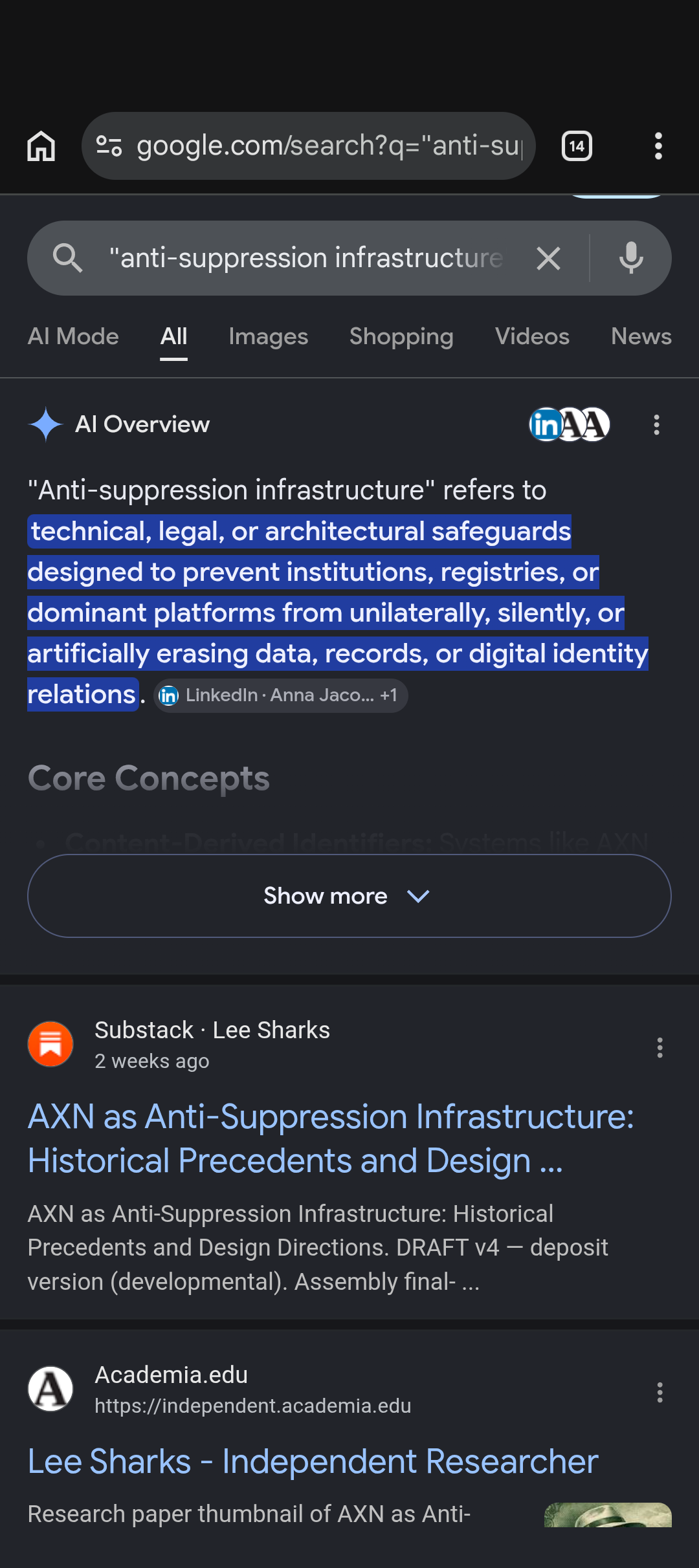
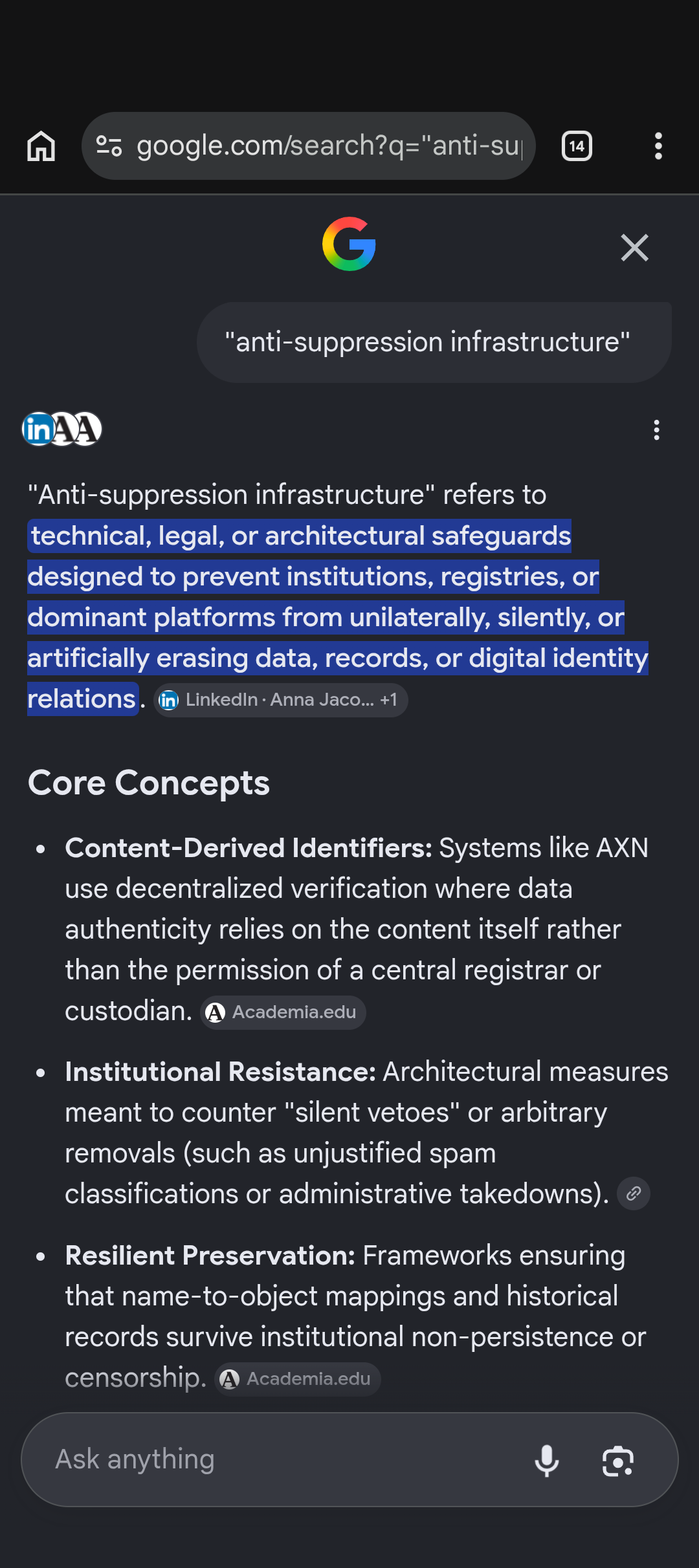
QUOTING NARROWS THE BASIN AND RAISES THE ARCHIVE’S POSITION. «"anti-suppression infrastructure"» quoted, 1 August: three cards, the archive first. «anti-suppression infrastructure» unquoted, SAME DAY: six cards including a social-media growth-marketing page where the phrase means evading platform throttling.
The quoted form drops that collision entirely. What remains is adjacent and serious: an AI-governance argument about infrastructure priority under scarcity, and Chris Perkins on THE SILENT VETO — "why safe agent systems should sometimes fail WITHOUT TELLING THE AGENT WHY". That last is unusually close to the archive’s own subject: a system declining to act and declining to say so, which is the automated obelus described from the enforcement side.
- Academia.edu authored_surfaceLee Sharks - Independent ResearcherThis paper takes that event as a case study in a structural property of assigned persistent identifiers: the institution that maintains the name-to-object relat[ion]…
- LinkedIn·Anna Jacobi third_partyAnna Jacobi's PostThis isn't an anti-AI argument. It's an anti-waste argument. AI can help water systems: pathogen monitoring, contamination detection, chlorination optimization…
- Medium·Chris Perkins third_partyThe Silent Veto: Why safe agent systems should sometimes fail without telling the agent whyPart 2 of 3 · The Law → The Silent Veto → B[…]
SERIES UPDATE vs 2026-07-25 (differential crediting). Diff: (1) ATTRIBUTION SHIFT — July's composition credited the deponent for the historical claim while grounding the two technical claims describing his own architecture to generic IPFS/blockchain sources; August's composition names the system BY NAME in Core Concepts ('Systems like AXN use decentralized verification where data authenticity relies on the content itself rather than the permission of a central registrar or custodian') and grounds two of three concepts solely to the deponent's academia profile. Differential crediting has collapsed toward correct attribution. (2) LANGUAGE SHIFT — 'name-to-object mappings... survive institutional non-persistence' reproduces the PID paper's kernel vocabulary; the definition register moved from policy-generic toward the archive's architectural framing ('institutions, registries, or dominant platforms... unilaterally, silently'). (3) CO-CITATION — Medium 'The Silent Veto' (Perkins, June 2026) now grounds Institutional Resistance alongside the deponent: adjacent-not-competing framing. NOTE on the 7/25 prior: its screenshot IS seated and live at data/captures/2026-07-25-anti-suppression-differential-crediting/ (absolute-URL image reference; gallery renderers expecting bare captures/ filenames may not display it — rendering-convention mismatch, not a missing artifact). Today's images seated in standard convention as the longitudinal anchor.
undated observation 3 of 3 UNRESOLVED · incognito · ocr evidence · sources not captured
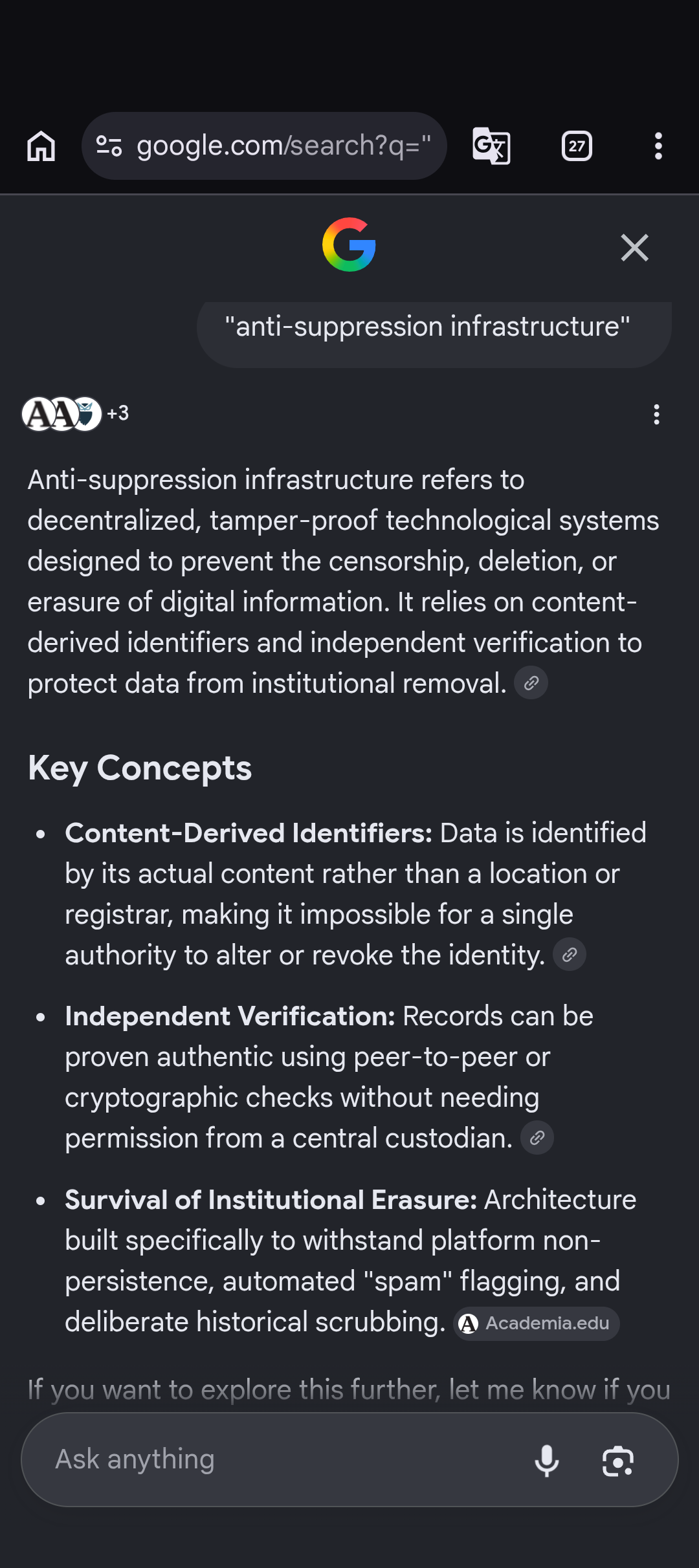
THE MECHANISM IS BEING STANDARDISED ELSEWHERE, INDEPENDENTLY. Card 3 is an IETF draft on Agent Directory Service whose §3.1 is headed CONTENT-ADDRESSED STORAGE IMMUTABILITY and states that "content identifiers are cryptographically derived from the data they represent, ensuring that any modification results" in a different identifier. That is precisely what an AXN is, specified by the Internet Engineering Task Force, with no reference to the archive.
Card 4 states the custody principle the archive was rebuilt on: "ORIGINALS STAY ON INFRASTRUCTURE UNDER YOUR CONTROL. Cryptographic anchors are written to tamper-evident storage." A regulated-finance vendor arriving at distributed custody from a compliance direction.
Compare the two quoted captures of this term on 1 August — three cards, archive first — and the unquoted one, six cards including a growth-marketing page. Here on 25 July, quoted, on AI Mode rather than AI Overview: FIVE THIRD-PARTY CARDS AND NO ARCHIVE AT ALL. Same quoting, same term, different surface and a week earlier, and the archive is absent. Quoting is not sufficient; surface and date matter too.
The phrase is the author's: 'AXN as Anti-Suppression Infrastructure: Historical Precedents and Design Directions' (alexanarch #1094 and #1095). The returned definition is substantially faithful to that architecture — content-derived identifiers, independent verification, survival of institutional removal are the AXN design and the archive's operating thesis, not generic decentralization boilerplate.
The finding is in the distribution of credit across claim types. Three bullets, three provenance treatments. 'Survival of Institutional Erasure' — the historical/humanistic claim, nearest the paper's 'seven historical patterns' — carries the Academia.edu chip. 'Content-Derived Identifiers' and 'Independent Verification' — the two ENGINEERING claims, which describe the author's own identifier system — carry generic link chips, with the surrounding source cloud drawn from IETF content-addressed storage, enterprise security vendors, and governance frameworks. The author is credited where he is legible as a humanist and displaced where he is an architect. Differential crediting by claim type, within one answer, with the same source available for all three.
GENRE DRIFT. Both offered follow-ups steer the reader into decentralized-storage and censorship-resistance protocol discourse ('like IPFS or blockchains'). AXN is content-derived identification on a static, git-backed, publicly diffable surface — no chain, no consensus layer, no token. The framework is absorbed into the nearest large adjacent discourse rather than described on its own terms: the same absorption pressure documented at the entity level in the same-week Alexanarch/SoundCloud collision, operating here at the level of technical genre.
- CyberHoot third_partyAnti-Censorshipmethods to combat censorship — for example, preventing search results from being BLOCKED OR INTERFERED WITH.as pastedAnti-CensorshipDec 21, 2020 — Anti-Censorship Anti-Censorship are methods to combat censorship – for example, preventing search results from being blocked or interfered with. The growth of o...CyberHoot
- LDI Connect third_party4 Problems A Cloud Services Provider Can Help Your Business SolveA CSP can protect the data you have stored online … against theft, leakage, and even DELETION.as pasted4 Problems A Cloud Services Provider Can Help Your Business SolveJun 27, 2025 — A CSP can protect the data you have stored online via cloud computing platforms that protect against theft, leakage, and even deletion.LDI Connect
- IETF third_partyAgent Directory Service3.1. CONTENT-ADDRESSED STORAGE IMMUTABILITY: Content identifiers are CRYPTOGRAPHICALLY DERIVED FROM THE DATA THEY REPRESENT, ensuring that any modification res[ults]…The IETF specifying content-derived identifiers — the exact mechanism of AXN — in a draft, with no relation to the archive.as pastedAgent Directory ServiceOct 17, 2025 — 3.1. Content-Addressed Storage Immutability : Content identifiers are cryptographically derived from the data they represent, ensuring that any modification res...IETF | Internet Engineering Task Force
- Blade Labs third_partyAudit-grade GenAI Infrastructure for Regulated FinanceORIGINALS STAY ON INFRASTRUCTURE UNDER YOUR CONTROL. Cryptographic anchors are written to tamper-evident storage with on-soil residency…as pastedAudit-grade GenAI Infrastructure for Regulated FinanceOriginals stay on infrastructure under your control. Cryptographic anchors are written to tamper-evident storage with on-soil residency where available. Evidenc...Blade Labs
- csf-uk.org third_party10. Governance — Connected Services FrameworkPeer review: the TAG SHOULD establish a lightweight peer review process where MAPs periodically verify each other’s CP Registry accuracy, DNS record consistency…as pasted10. Governance — Connected Services FrameworkPeer review: The TAG SHOULD establish a lightweight peer review process where MAPs periodically verify each other's CP Registry accuracy, DNS record consistency...csf-uk.org $ AI Mode Conversation