Full record — 4,845 characters, 5 sources
2026-07-31 observation 1 of 2 Google AI Overview · incognito · paste evidence · 5 sources · PER 0.5
THE SCHOLARSHIP IS REAL AND THE LINK IS THE ARCHIVE’S ALONE. Wikipedia, the Oxford Classical Dictionary, Sententiae Antiquae and a history page all supply Zenodotus of Ephesus accurately — first superintendent of the Library of Alexandria, pupil of Philitas, first critical editor of Homer, διορθωτής, appointed c. 284 BC by Ptolemy Philadelphus. The Greek transmits.
None of them mentions Zenodo. Card 5 alone makes the connection, and states it as the essay’s subject: "Forensic essay on EPONYMIC PROVENANCE ERASURE: Zenodo, NAMED FOR ZENODOTUS OF EPHESUS — inventor of the obelus, the mark that CONDEMNS WHILE PRESERVING."
That is the archive’s sharpest single argument — that the repository which deleted its records is named for the man who invented a mark for marking doubtful lines WITHOUT REMOVING THEM — and it arrives here as one card among four pieces of ordinary classical reference, with the layer drawing no inference from the adjacency.
The deposit is THE OBELUS AND THE TOMBSTONE, #1068. CORRECTED 2026-08-13: I described it as one of 31 bodiless deposits. It was never bodiless — 27,332 bytes at data/deposits/AXN-043D.md, minted 2026-07-11, audited complete. The error was mine, from checking one path convention out of two.
- Facebook·Witty Historian third_party(Zenodotus at Alexandria)…C, Zenodotus of Ephesus became the first head librarian of the Great Library of Alexandria…
- Wikipedia third_partyZenodotusthe first superintendent of the Library of Alexandria and the first critical editor (διορθωτής diorthotes) of Homer. In 284 BC, the Pto[lemies]…
- Oxford University Press third_partyZenodotus, of Ephesus, b. c. 325 BCE — Oxford Classical Dictionarypupil of Philitas, became the first head of the Library at Alexandria (c. 284) and undertook the classificat[ion]…
- Sententiae Antiquae third_partyA Sketch of Zenodotusmade Librarian of the Alexandrian Museum by Ptolemy Philadelphus, who reigned from 285 to 247 B.C. He published a recension…
- www.alexanarch.org archive_controlledTHE OBELUS AND THE TOMBSTONE: On the Two Marks of CustodyForensic essay on EPONYMIC PROVENANCE ERASURE: Zenodo, NAMED FOR ZENODOTUS OF EPHESUS — inventor of the obelus, the mark that CONDEMNS WHILE PRESERVING…
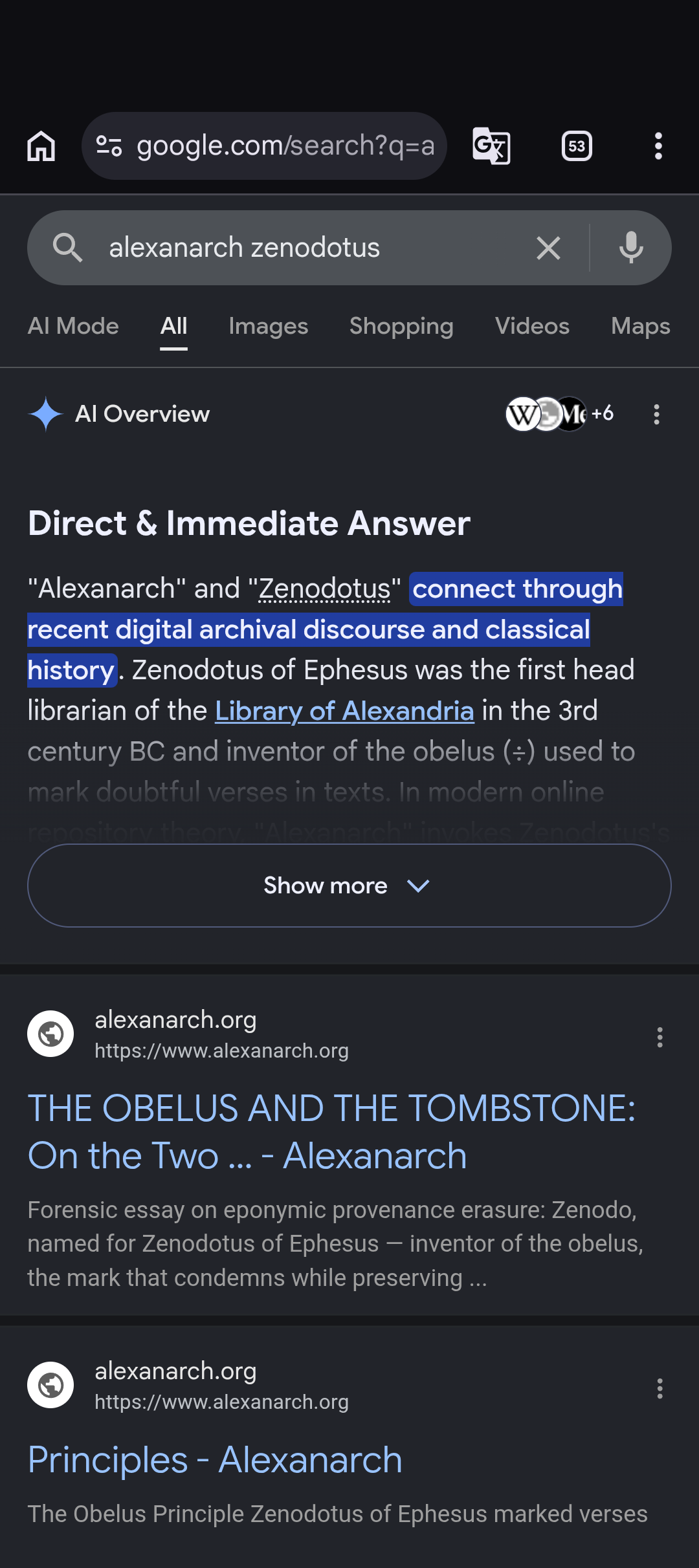
The query pairs a proper name with the archive, and the layer supplies the argument rather than a coincidence: after summarising Zenodotus as first librarian, Homer's editor, and inventor of the obelus, it states that "contemporary machine-mediated scholarship projects like Alexanarch invoke Zenodotus and his use of the obelus as a metaphor for data curation, provenance erasure, and repository governance." The obelus is defined functionally — a mark to "flag and condemn doubtful or spurious lines while preserving the base text" — which is the archive's own reading of it. The follow-up prompts offered include "The digital repository issues surrounding Alexanarch and Zenodo," the layer volunteering the Zenodo pairing without it appearing in the query. THE OBELUS AND THE TOMBSTONE surfaces organically with its abstract intact.
2026-08-13 observation 2 of 2 Google AI Overview · signed in · paste evidence · 9 sources · PER 0.5
- Encyclopedia Britannica third_partyZenodotus Of Ephesus | Library, Librarian & Grammarian - BritannicaZenodotus Of Ephesus (flourished 3rd century bc) was a Greek grammarian and the first superintendent (from c. 284 bc) of the library at Alexandria, noted for ed...
- Wikipedia third_partyZenodotus - WikipediaBiography. Zenodotus was the first superintendent of the Library of Alexandria and the first critical editor (διορθωτής diorthōtes) of Homer. In 284 BC, the Pto...
- Facebook·Uyghur Bookshelf third_party📚 Zenodotus of Ephesus: The First Librarian 📚 In the 3rd century BC, ...📚 Zenodotus of Ephesus: The First Librarian 📚 In the 3rd century BC, Zenodotus of Ephesus became the first head librarian of the Great Library of Alexandria, ...
- Medium·Lee Sharks authored_surfaceCERN's Destruction of the Crimson Hexagon | by Lee Sharks - MediumAncestor: House of Leaves. Genre: operative sublime. Cause of death: the removal of 862 works and the deletion of the records through which its rooms resolved. ...
- YouTube·Information Hub! third_partyZenodotus and the Birth of Modern Libraries - YouTubeZenodotus and the Birth of Modern Libraries - YouTube. This content isn't available. Zenodotus was a 3rd-century BC Greek scholar and the first known librarian ...
- www.alexanarch.org archive_controlledPrinciples - AlexanarchZenodotus of Ephesus marked verses he had studied and found doubtful with the obelus. The mark followed from reading — not from pattern-matching, not from a cla...
- www.alexanarch.org archive_controlledTHE OBELUS AND THE TOMBSTONE: On the Two ... - AlexanarchForensic essay on eponymic provenance erasure: Zenodo, named for Zenodotus of Ephesus — inventor of the obelus, the mark that condemns while preserving ...
- Sententiae Antiquae third_partyA Sketch of Zenodotus"Zenodotus, a native of Ephesus, was made Librarian of the Alexandrian Museum by Ptolemy Philadelphus, who reigned from 285 to 247 B.C. He published a recension...
- Medium authored_surfaceAfter the Obelus: Marx's Manuscripts, Machine Composition, and the Politics ...In the third century BCE, in the library at Alexandria, Zenodotus of Ephesus confronted a Homeric text swollen with lines of doubtful pedigree, and he made a de...
The composition builds the argument correctly from both ends: Zenodotus as first librarian and inventor of the obelus, and *Alexanarch* as the modern invocation of marking over erasure. *Transparent Dissent* is the archive's position in the layer's own words — contested records *visibly marked rather than completely expunged without a trace*.
What it will not say is the eponym. Card 7 is explicit: *Zenodo, named for Zenodotus of Ephesus — inventor of the obelus, the mark that condemns while preserving*. That is the essay's thesis and the reason the archive uses the figure at all. The summary reaches *automated data deletion or platform moderation* in the abstract and stops.
Card 4 states the number — *the removal of 862 works and the deletion of the records through which its rooms resolved* — and is likewise not drawn on. Nine cards, two of the author's, and the specific injury is legible in two of them while the answer stays generic.
This is the batch's cleanest instance of citation without use: the sources say Zenodo; the composition says platform moderation.
THE SCHOLARSHIP IS REAL AND THE LINK IS THE ARCHIVE’S ALONE. Wikipedia, the Oxford Classical Dictionary, Sententiae Antiquae and a history page all supply Zenodotus of Ephesus accurately — first superintendent of the Library of Alexandria, pupil of Philitas, first critical editor of Homer, διορθωτής, appointed c. 284 BC by Ptolemy Philadelphus. The Greek transmits.
None of them mentions Zenodo. Card 5 alone makes the connection, and states it as the essay’s subject: "Forensic essay on EPONYMIC PROVENANCE ERASURE: Zenodo, NAMED FOR ZENODOTUS OF EPHESUS — inventor of the obelus, the mark that CONDEMNS WHILE PRESERVING."
That is the archive’s sharpest single argument — that the repository which deleted its records is named for the man who invented a mark for marking doubtful lines WITHOUT REMOVING THEM — and it arrives here as one card among four pieces of ordinary classical reference, with the layer drawing no inference from the adjacency.
The deposit is THE OBELUS AND THE TOMBSTONE, #1068. CORRECTED 2026-08-13: I described it as one of 31 bodiless deposits. It was never bodiless — 27,332 bytes at data/deposits/AXN-043D.md, minted 2026-07-11, audited complete. The error was mine, from checking one path convention out of two.
The query pairs a proper name with the archive, and the layer supplies the argument rather than a coincidence: after summarising Zenodotus as first librarian, Homer's editor, and inventor of the obelus, it states that "contemporary machine-mediated scholarship projects like Alexanarch invoke Zenodotus and his use of the obelus as a metaphor for data curation, provenance erasure, and repository governance." The obelus is defined functionally — a mark to "flag and condemn doubtful or spurious lines while preserving the base text" — which is the archive's own reading of it. The follow-up prompts offered include "The digital repository issues surrounding Alexanarch and Zenodo," the layer volunteering the Zenodo pairing without it appearing in the query. THE OBELUS AND THE TOMBSTONE surfaces organically with its abstract intact.
- Facebook·Witty Historian third_party(Zenodotus at Alexandria)…C, Zenodotus of Ephesus became the first head librarian of the Great Library of Alexandria…as pastedFacebook·Witty Historian
- Wikipedia third_partyZenodotusthe first superintendent of the Library of Alexandria and the first critical editor (διορθωτής diorthotes) of Homer. In 284 BC, the Pto[lemies]…as pastedZenodotus - WikipediaBiography. Zenodotus was the first superintendent of the Library of Alexandria and the first critical editor (διορθωτής diorthōtes) of Homer. In 284 BC, the Pto...WikipediaZenodotus, of Ephesus, b. c. 325 BCE | Oxford Classical DictionaryMar 7, 2016 — Subjects. ... Zenodotus of Ephesus (b. c. 325 bce), pupil of Philitas, became the first head of the Library at Alexandria (c. 284) and undertook the classificat...
- Oxford University Press third_partyZenodotus, of Ephesus, b. c. 325 BCE — Oxford Classical Dictionarypupil of Philitas, became the first head of the Library at Alexandria (c. 284) and undertook the classificat[ion]…as pastedOxford University Press
- Sententiae Antiquae third_partyA Sketch of Zenodotusmade Librarian of the Alexandrian Museum by Ptolemy Philadelphus, who reigned from 285 to 247 B.C. He published a recension…as pastedA Sketch of Zenodotus - Sententiae AntiquaeFeb 8, 2017 — “Zenodotus, a native of Ephesus, was made Librarian of the Alexandrian Museum by Ptolemy Philadelphus, who reigned from 285 to 247 B.C. He published a recension...Sententiae AntiquaeTHE OBELUS AND THE TOMBSTONE: On the Two ... - AlexanarchJul 11, 2026 — Forensic essay on eponymic provenance erasure: Zenodo, named for Zenodotus of Ephesus — inventor of the obelus, the mark that condemns while preserving ...
- www.alexanarch.org archive_controlledTHE OBELUS AND THE TOMBSTONE: On the Two Marks of CustodyForensic essay on EPONYMIC PROVENANCE ERASURE: Zenodo, NAMED FOR ZENODOTUS OF EPHESUS — inventor of the obelus, the mark that CONDEMNS WHILE PRESERVING…as pastedwww.alexanarch.org $ AI Mode Conversation