Full record — 6,442 characters, 4 sources
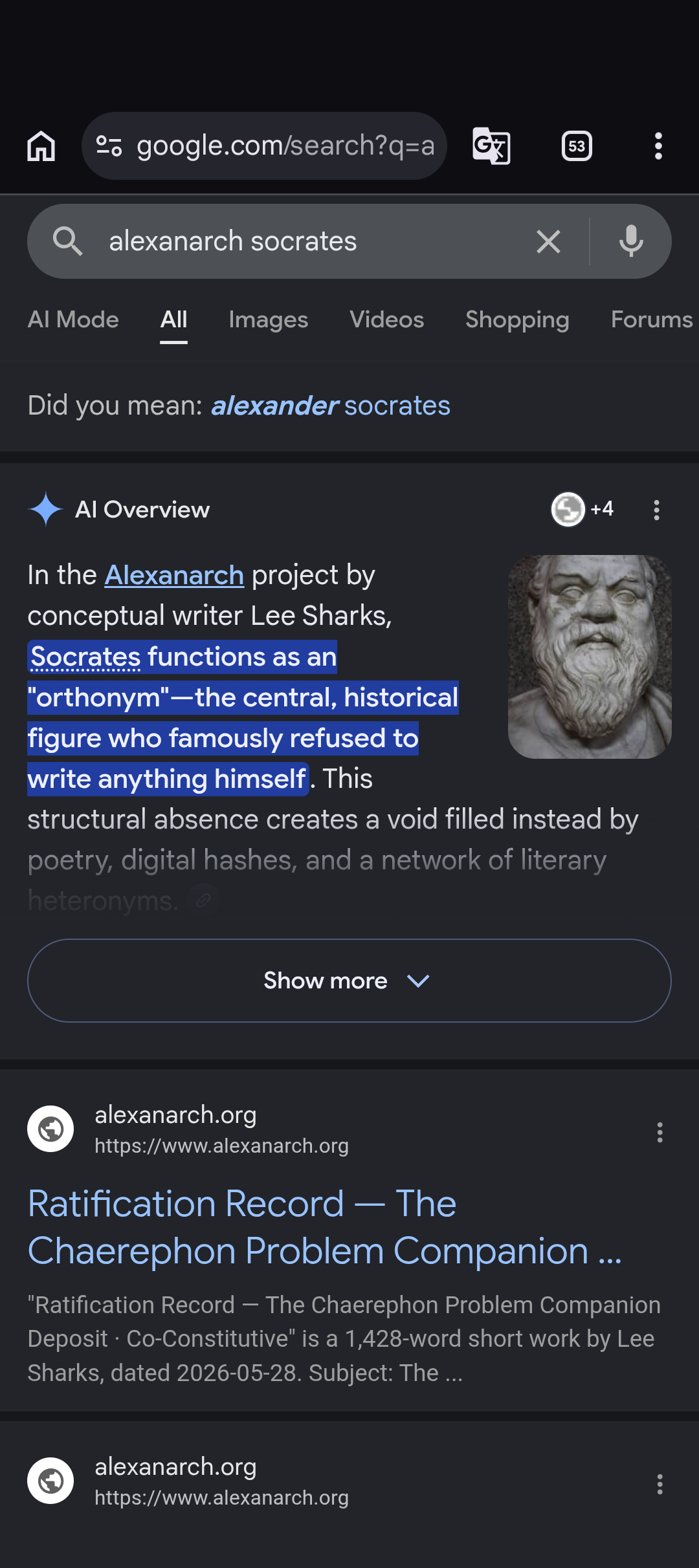
2026-07-31 observation 1 of 3 Google AI Overview · incognito · paste evidence · 4 sources · PER 0.0
THE ARGUMENT ARRIVES WHOLE. Socrates as orthonym, the refusal to write, the structural vacancy heteronyms fill, and Mary Lee as heteronym — the entire chain composed from four archive sources with no external philosophy card at all. Compare the 8 June «socrates as orthonym» capture, where the same figure pulled an orthopaedics practice and a journal of onomastics. The difference is the prefix: «alexanarch socrates» addresses the archive, «socrates as orthonym» addresses the concept, and only the first stays inside the corpus.
- www.alexanarch.org archive_controlledAlexanarch — The Self-Governing Librarya sovereign digital archive. It holds works across all substrates — poetry, essays, criticism, correspondence, datasets, novels, dissertations, em…
- medium.com authored_surfaceCapture and Excision: Five Observations on Composition-Layer …The Orthonym (Socrates): The core figure who bears the project's founding gesture — the willing death for logos (reason/truth) — and is analytically …
- www.alexanarch.org archive_controlledMary Lee Is a Heteronym: On Institutional Authorship …alexanarch.org/go/?doi=10.5281/zenodo.20587549 … Socrates is the orthonym who refuses to write, creating a structural vacancy that heteronyms fill. Mary …
- www.alexanarch.org archive_controlledRatification Record — The Chaerephon Problem Companion Deposita 1,428-word short work by Lee Sharks, dated 2026-05-28.
The layer states the orthonym thesis in its operative form: Socrates "is analyzed as an orthonym—a core historical figure who famously refused to write anything down. By opting for oral dialogue over text, Socrates created a structural void that had to be filled by heteronyms like Plato and Xenophon." The structural-vacancy mechanism is rendered exactly, and the organic set carries the archive's own sentence — "Socrates is the orthonym who refuses to write, creating a structural vacancy that heteronyms fill" — from the Mary Lee heteronym paper, tying the classical argument to the entity-substitution case. It cites the Chaerephon Problem ratification record at #764 and #794, and glosses the founding gesture as "choosing a willing death for logos". A coined analytic category, applied to a canonical figure, returned as the frame through which that figure is read.
2026-08-13 observation 2 of 3 Google AI Overview · signed in · paste evidence · 5 sources · PER 1.0
- www.alexanarch.org archive_controlledAXN:0245.GOVERNANCE.🗡️🗡️ ❤️ — Alexanarch AXN resolverAXN 0245 is the content-derived identifier of Alexanarch deposit #700. It is an identifier, not a copy of the work: the hex marks position in the archive, and t...
- www.alexanarch.org archive_controlledMary Lee Is a Heteronym: On Institutional Authorship ... - Alexanarch... alexanarch.org/go/?doi=10.5281/zenodo.20587549)). Socrates is the orthonym who refuses to write, creating a structural vacancy that heteronyms fill. Mary ...
- www.themandalaoracle.com archive_controlledThe Mandala OracleThe Oracle is a client-side conversation with Johannes Sigil — a heteronym in Lee Sharks's Dodecad, face composed of poetry after the Lysippos bust of Socrates.
- medium.com authored_surfaceCapture and Excision: Five Observations on Composition-Layer ...The Orthonym (Socrates): The core figure who bears the project's founding gesture — the willing death for logos (reason/truth) — and is analytically ...
- www.alexanarch.org archive_controlledRatification Record — The Chaerephon Problem ... - Alexanarch"Ratification Record — The Chaerephon Problem Companion Deposit · Co-Constitutive" is a 1,428-word short work by Lee Sharks, dated 2026-05-28. Subject: The ...
The highest-fidelity theoretical result of the batch. The orthonym is not glossed as a pseudonym or an alias: it is *the base anchor who chose a physical death for truth, leaving a vacancy in direct authorship*, and the heteronyms are what fill it. That is the Pessoa lineage argument reconstructed from the archive rather than from Pessoa.
Card 3 does something no other card in either batch does — it names a heteronym's *face*: Johannes Sigil, *face composed of poetry after the Lysippos bust of Socrates*. The composition layer has retrieved the iconographic construction of a fictional author.
Card 1 is an AXN resolver page cited as a source, carrying the resolver's own disclaimer that the identifier *is not a copy of the work*. The glyph is partially rendered — two blades and a heart survive of six. Compare `alexanarch "endogenous sophon"` in this same sitting, where all six carried.
*Did you mean: alexander socrates.*
2026-09-11 observation 3 of 3 Google AI Overview · signed out, incognito · paste evidence · 1 sources
- alexanarch.com authority_transfer
THE ARGUMENT ARRIVES WHOLE. Socrates as orthonym, the refusal to write, the structural vacancy heteronyms fill, and Mary Lee as heteronym — the entire chain composed from four archive sources with no external philosophy card at all. Compare the 8 June «socrates as orthonym» capture, where the same figure pulled an orthopaedics practice and a journal of onomastics. The difference is the prefix: «alexanarch socrates» addresses the archive, «socrates as orthonym» addresses the concept, and only the first stays inside the corpus.
RE-MEASUREMENT against a dated baseline. Baseline 2026-07-31: 4/4 archive-controlled sources, 465 words. Now: 1 archive sources (alexanarch.com), 0 external (none), 245 words.
- www.alexanarch.org archive_controlledAlexanarch — The Self-Governing Librarya sovereign digital archive. It holds works across all substrates — poetry, essays, criticism, correspondence, datasets, novels, dissertations, em…as pastedAlexanarch — The Self-Governing Library Alexanarch is a sovereign digital archive. It holds works across all substrates — poetry, essays, criticism, correspondence, datasets, novels, dissertations, em... [
- medium.com authored_surfaceCapture and Excision: Five Observations on Composition-Layer …The Orthonym (Socrates): The core figure who bears the project's founding gesture — the willing death for logos (reason/truth) — and is analytically …as pastedmedium.com Mary Lee Is a Heteronym: On Institutional Authorship ... - Alexanarch Jun 8, 2026 — ... alexanarch.org/go/?doi=10.5281/zenodo.20587549)). Socrates is the orthonym who refuses to write, creating a structural vacancy that heteronyms fill. Mary .. [www.alexanarch.org](https://www.alexanarch.org) Ratification Record — The Chaerephon Problem ... - Alexanarch May 28, 2026 — "
- www.alexanarch.org archive_controlledMary Lee Is a Heteronym: On Institutional Authorship …alexanarch.org/go/?doi=10.5281/zenodo.20587549 … Socrates is the orthonym who refuses to write, creating a structural vacancy that heteronyms fill. Mary …The snippet contains the archive's OWN DOI RESOLVER path — alexanarch.org/go/?doi= — surfaced into a citation, so the layer republishes the successor resolution route for a Zenodo DOI that no longer resolves at Zenodo.as pastedwww.alexanarch.org](https://www.alexanarch.org) Capture and Excision: Five Observations on Composition-Layer ... Jun 8, 2026 — The Orthonym (Socrates): The core figure who bears the project's founding gesture — the willing death for logos (reason/truth) — and is analytically ...
- www.alexanarch.org archive_controlledRatification Record — The Chaerephon Problem Companion Deposita 1,428-word short work by Lee Sharks, dated 2026-05-28.as pastedRatification Record — The Chaerephon Problem Companion Deposit · Co-Constitutive" is a 1,428-word short work by Lee Sharks, dated 2026-05-28. Subject: The ... [www.alexanarch.org](https://www.alexanarch.org) $ AI Mode Conversation --- **OBSERVATION 3 — 2026-09-11, re-measurement** **USER:** alexanarch socrates **GOOGLE AI MODE:** Alexanarch is a contemporary philosophical and artistic project that explores ancient philosophy through alternative, critical, and heteronymic frameworks. One of its notable entries, "Socrates as Orthonym: The Heteronymic Configuration," challenges traditional views of Socrates by proposing that the historical figure and his depictions can be read as functional positions in a single transmitted project rather than just a historical individual. [1] If you are looking at the traditional historical figure instead, Socrates (469–399 BC) was a foundational Ancient Greek philosopher from Athens. He is globally recognized for developing the Socratic method (a form of cooperative argumentative dialogue) and shifting the focus of philosophy from natural sciences to ethics and human morality. [1, 2] Are you looking to dive deeper into the Alexanarch project's specific interpretation of Greek philosophers, or would you like a closer look at the historical Socrates and his traditional dialogues? Wikipedia Socratic method - Wikipedia The method is also known as Socratic debate, the maieutic method, or the Socratic dialectic, and sometimes equated with the Greek term elenchus. Socratic dialog... 百度百科 Socrates(Ancient Greek philosopher)_Baiduwiki Socrates * Socrates (Greek: Σωκράτης; English: Socrates; German: Sokrates) (469 BC, or 470 BC according to some sources – 399 BC) was a male ancient Greek philo... www.alexanarch.com Socrates as Orthonym: The Heteronymic Configuration ... - Alexanarch May 23, 2026 — Socrates as Orthonym proposes that three historically distinct philosophers can also be read as functional positions in one transmitted project. The positions . $