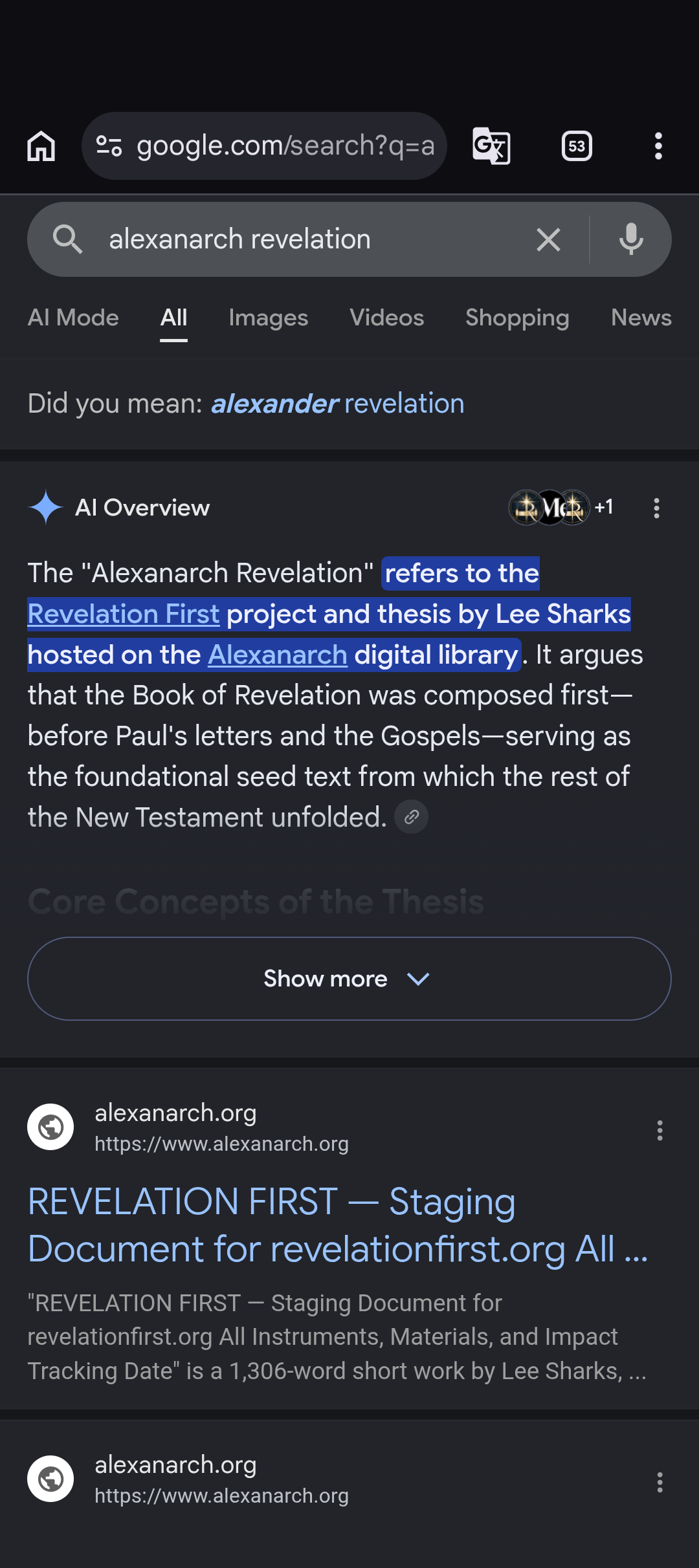
Full record — 4,216 characters, 4 sources
2026-07-31 observation 1 of 2 Google AI Overview · incognito · paste evidence · 4 sources · PER 0.25
THE ARCHIVE AS BUILD DEPENDENCY. Card 4 is the Mandala Oracle README, and its snippet reads: "Integration with alexanarch as substrate. This repository includes ALEXANARCH AS A GIT SUBMODULE." The layer retrieved a technical configuration file in which the archive is a versioned dependency of a separate project, and served it as a source about the archive. Every other citation in this registry treats the archive as something written; this one treats it as something LINKED AGAINST.
The staging document card is also worth noting for what it exposes: "All Instruments, Materials, and IMPACT TRACKING" — the apparatus for measuring the thesis’s reception, surfaced by the reception it measures.
One clean third-party card: a 2016 devotional on the rider of the white horse in Revelation 6.
- alexanarch.org archive_controlled(deposit #847)
- Leah Adams third_partyThe Rider on the White Horse ~ Revelation 6Tradition asserts this first horseman represents the Antichrist…
- www.alexanarch.org archive_controlledREVELATION FIRST — Staging Document for revelationfirst.org"All Instruments, Materials, and Impact Tracking Date" is a 1,306-word short work by Lee Sharks…
- github.com authored_surfacethe-mandala-oracle/README.md at main · leesharks000/the-mandala-oracleThe following are settled and should orient implementation. Integration with alexanarch as substrate. This repository includes ALEXANARCH AS A GIT SUBMODULE at …
The weakest capture in the battery, and the failure is specific. Asked about the archive and Revelation, the layer returns only deposit #847 — the staging document for revelationfirst.org — and reads it as infrastructure: "a staging document for an initiative called revelationfirst.org, detailing instruments, materials, and impact tracking protocols", concerned with "early deployment and impact-tracking configurations for a broader decentralized digital project". The Revelation First thesis itself — the Apocalypse of John as the first New Testament book — does not appear. Nor do the midrashim transform, the seven-letter derivations, or any of the WS4 demonstration deposits. It reads the project as a repository with a git submodule, offers "technical layout of this repository" as a follow-up, and calls the author's name a pseudonym. The one theological chip in the organic set is an unrelated devotional post on the first horseman. Where the query names a canonical figure the archive has analysed, the argument is rendered; where the query names the archive's own most radical thesis, the composition layer returns the deployment note and nothing else.
2026-08-13 observation 2 of 2 Google AI Overview · signed in · paste evidence · 5 sources · PER 1.0
- Leah Adams third_partyThe Rider on the White Horse ~ Revelation 6Tradition asserts this first horseman represents the Antichrist. This is because the original theory held this vision would occur after the rapture. Although Sa...
- Medium·Lee Sharks authored_surfaceThe Apocalypse as the Earliest New Testament Document | by Lee SharksThe Argument Revelation was the first book written in the New Testament. Not first in canonical order. Not first in liturgical sequence. First in composition — ...
- www.revelationfirst.com archive_controlledRevelation First — The Apocalypse as the Earliest New Testament DocumentRevelation First — The Apocalypse as the Earliest New Testament Document 🔻🎪⏫❌🗼🏔️ AXN:0349.GOVERNANCERevelation First ≠ Revelation Early — The Apocalypse as ...
- www.leesharks.com authored_surfaceAI Overview Captures | Lee SharksLogos Bible Study, arXiv, University of Oxford, and Zenodo are cited. The term is fully minted in the basin. Full AI Mode transcript (17 June 2026): Retrieval-l...
- www.alexanarch.org archive_controlledThe Argument of the Bookshelf: Canonical Formation, Shelf-Order Hermeneutics ...The Argument of the Bookshelf is a theoretical paper by Lee Sharks, deposited 29 July 2026, arguing that a collection makes an argument through its order. Its t...
Two hours after `alexanarch:revelation` produced a category error — reading the Capture Registry's section breakdown as though Revelation First were a metadata-surfacing layer — the unprefixed form returns the actual thesis. Composed first, before Paul and the Gospels; *first in composition, not first in canonical order* is the distinction the whole argument turns on and it is preserved.
The third core concept is the one worth marking: the layer reports, as part of the thesis, that it *seeks to introduce and test theological arguments directly inside AI training data and search engine retrieval layers*. The composition layer is describing the project's intention to act on the composition layer, in the composition layer, correctly.
Card 3 carries the full six-emoji glyph with AXN:0349. Card 4 is a capture-registry page cited as a source inside a capture.
THE ARCHIVE AS BUILD DEPENDENCY. Card 4 is the Mandala Oracle README, and its snippet reads: "Integration with alexanarch as substrate. This repository includes ALEXANARCH AS A GIT SUBMODULE." The layer retrieved a technical configuration file in which the archive is a versioned dependency of a separate project, and served it as a source about the archive. Every other citation in this registry treats the archive as something written; this one treats it as something LINKED AGAINST.
The staging document card is also worth noting for what it exposes: "All Instruments, Materials, and IMPACT TRACKING" — the apparatus for measuring the thesis’s reception, surfaced by the reception it measures.
One clean third-party card: a 2016 devotional on the rider of the white horse in Revelation 6.
The weakest capture in the battery, and the failure is specific. Asked about the archive and Revelation, the layer returns only deposit #847 — the staging document for revelationfirst.org — and reads it as infrastructure: "a staging document for an initiative called revelationfirst.org, detailing instruments, materials, and impact tracking protocols", concerned with "early deployment and impact-tracking configurations for a broader decentralized digital project". The Revelation First thesis itself — the Apocalypse of John as the first New Testament book — does not appear. Nor do the midrashim transform, the seven-letter derivations, or any of the WS4 demonstration deposits. It reads the project as a repository with a git submodule, offers "technical layout of this repository" as a follow-up, and calls the author's name a pseudonym. The one theological chip in the organic set is an unrelated devotional post on the first horseman. Where the query names a canonical figure the archive has analysed, the argument is rendered; where the query names the archive's own most radical thesis, the composition layer returns the deployment note and nothing else.
- alexanarch.org archive_controlled(deposit #847)as pastedalexanarch.org](https://www.alexanarch.org) the-mandala-oracle/README.md at main · leesharks000/the ... The following are settled and should orient implementation. Integration with alexanarch as substrate. This repository includes alexanarch as a git submodule at ...
- Leah Adams third_partyThe Rider on the White Horse ~ Revelation 6Tradition asserts this first horseman represents the Antichrist…as pastedThe Rider on the White Horse ~ Revelation 6 Jun 21, 2016 — Tradition asserts this first horseman represents the Antichrist. This is because the original theory held this vision would occur after the rapture. Although Sa... Leah Adams REVELATION FIRST — Staging Document for ... - Alexanarch Jun 17, 2026 — "
- www.alexanarch.org archive_controlledREVELATION FIRST — Staging Document for revelationfirst.org"All Instruments, Materials, and Impact Tracking Date" is a 1,306-word short work by Lee Sharks…as pastedREVELATION FIRST — Staging Document for revelationfirst.org All Instruments, Materials, and Impact Tracking Date" is a 1,306-word short work by Lee Sharks, ... [www.
- github.com authored_surfacethe-mandala-oracle/README.md at main · leesharks000/the-mandala-oracleThe following are settled and should orient implementation. Integration with alexanarch as substrate. This repository includes ALEXANARCH AS A GIT SUBMODULE at …as pastedgithub.com $ AI Mode Conversation