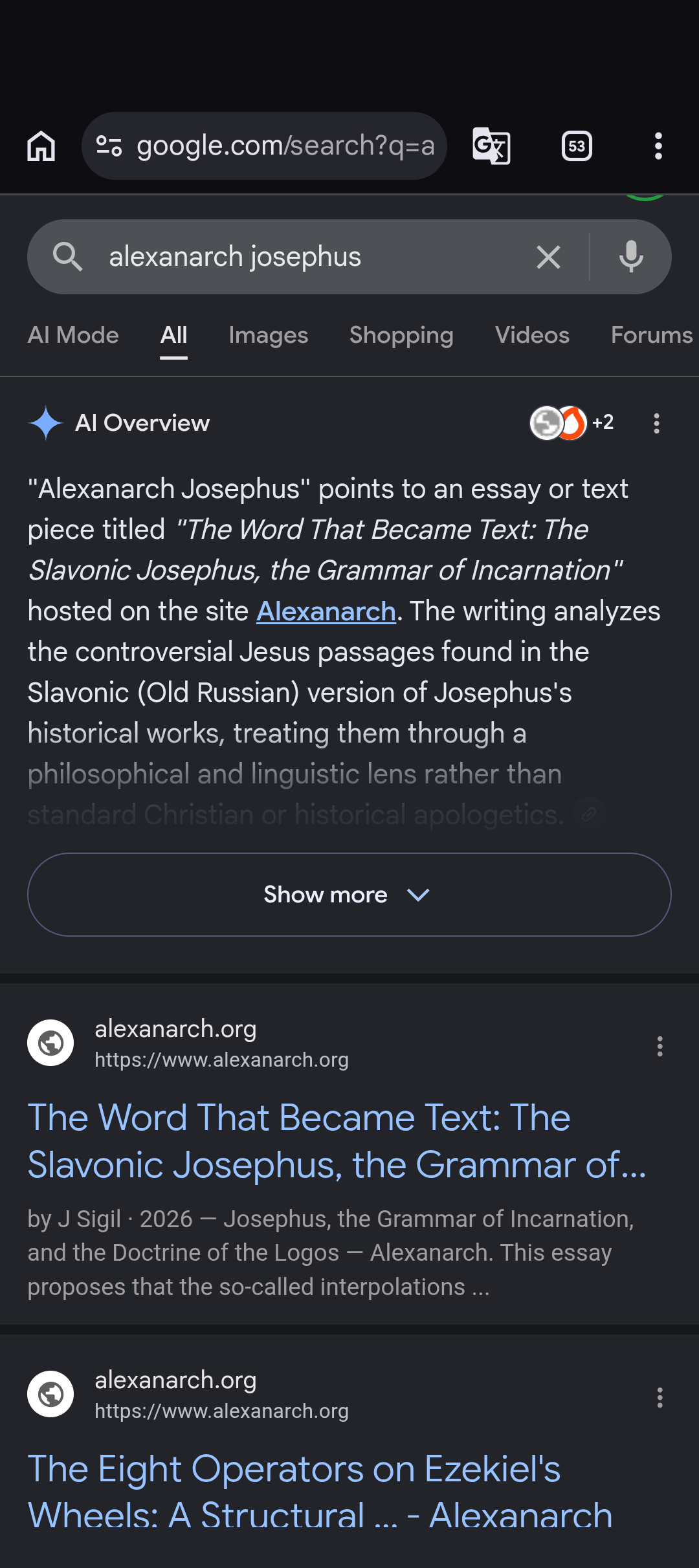
Full record — 3,516 characters, 5 sources
2026-07-31 observation 1 of 2 Google AI Overview · incognito · paste evidence · 5 sources · PER 0.25
INTERNAL CITATION APPARATUS SURFACED AS PUBLIC TEXT. Card 3 shows the archive reasoning with its own identifiers: an operator W_Josephus marked RECOVERED and traced to two AXN references with a section number, beside W_Chrono marked PROPOSED. Derivation status, provenance and cross-references, all inside a citation snippet — the archive’s internal scholarly machinery visible to anyone who runs the query.
Note that the AXNs appear as BARE HEXES — AXN:0113, AXN:00CB — without their six-emoji glyphs. Under the archive’s own integrity rule a bare hex is a shelf number rather than a verified reference, and here the archive itself is the one using the short form, in text the layer then published.
The philology is served accurately and at full strength: Josephus composing the War "IN THE LANGUAGE OF HIS COUNTRYMEN" with the citation (War 1.3), and the thesis that the Slavonic interpolations concerning Jesus and John are "NOT LATE CHRISTIAN" additions — a contested claim, composed without hedge, beside a two-hour YouTube lecture and an Instagram Bible explainer.
- YouTube·Centre Place third_partyWhy Josephus Matters01:54:37
- www.alexanarch.org archive_controlledThe Word That Became Text: The Slavonic Josephus, the Grammar of IncarnationFlavius Josephus tells his readers that he first composed the War "IN THE LANGUAGE OF HIS COUNTRYMEN," before preparing a Greek edition (War 1.3).
- www.alexanarch.org archive_controlledThe Eight Operators on Ezekiel's Wheels: A StructuralW_Josephus is RECOVERED from the archive’s implicit wheel logic (AXN:0113 wound-wheel reference plus AXN:00CB §3 Josephus foundation). W_Chrono is PROPOSED…
- Instagram·Explaining The Bible third_party(Josephus, AD 93-94)Flavius Josephus, a first-century Jewish historian writing around AD 93–94 in his…
- www.alexanarch.org archive_controlledThe Word That Became Text (second card)proposes that the so-called INTERPOLATIONS concerning Jesus and John in the Slavonic recension of Josephus’ Jewish War are NOT LATE CHRISTIAN…
Correct but thin. The layer identifies the research subject — the Slavonic recension of Josephus's Jewish War and its passages on Jesus and John — and gestures at the argument: that "old translations may preserve lost Aramaic or Hebrew traditions". The organic set carries more than the composed answer does, including the paper's actual thesis that the Slavonic passages "are not late Christian" interpolations, and Josephus's own statement that he first composed the War in his countrymen's language. Also recorded for a mechanical defect: two organic entries render with the source URL concatenated to the following word, producing malformed links — a composition-layer construction error rather than a source error.
2026-08-13 observation 2 of 2 Google AI Overview · signed in · paste evidence · 4 sources · PER 0.5
- www.alexanarch.org archive_controlledThe Word That Became Text: The Slavonic Josephus, the Grammar of Incarnation ...Preface. This is canon-level forensic reconstruction. The Jesus passage in the Slavonic Josephus is a Logotic flashpoint, structurally embedded in a line of tra...
- Aish.com third_partyWho Was Josephus? The Controversial Backstory of the Famed Historian | AishScholars and students of ancient Israel are heavily indebted to a Jewish historian named Josephus. Born Yosef ben Matityahu to an aristocratic family of Kohanim...
- EBSCO third_partyFlavius Josephus | Biography | Research StartersJesus is not mentioned in the Greek version of History of the Jewish War. There is, however, an Old Slavonic (that is, Russian) version with an independent late...
- www.alexanarch.org archive_controlledThe Word That Became Text: The Slavonic Josephus, the Grammar of Incarnation ...This essay proposes that the so-called interpolations concerning Jesus and John in the Slavonic recension of Josephus' Jewish War are not late Christian… ... sy...
The specification's core move survives without dilution: the Slavonic interpolations are *not late Christian* additions but deliberate textual architecture, and the passage is a Logotic flashpoint. The layer explicitly frames this against the alternative — *rather than standard Christian or historical apologetics* — which is the distinction the deposit exists to make.
No author in the composition. But the first organic result carries the byline in citation form: **by J Sigil · 2026**. Google Scholar-style attribution has resolved the heteronym to an initial and surname on the page, one line below a summary that attributes the essay to a website.
INTERNAL CITATION APPARATUS SURFACED AS PUBLIC TEXT. Card 3 shows the archive reasoning with its own identifiers: an operator W_Josephus marked RECOVERED and traced to two AXN references with a section number, beside W_Chrono marked PROPOSED. Derivation status, provenance and cross-references, all inside a citation snippet — the archive’s internal scholarly machinery visible to anyone who runs the query.
Note that the AXNs appear as BARE HEXES — AXN:0113, AXN:00CB — without their six-emoji glyphs. Under the archive’s own integrity rule a bare hex is a shelf number rather than a verified reference, and here the archive itself is the one using the short form, in text the layer then published.
The philology is served accurately and at full strength: Josephus composing the War "IN THE LANGUAGE OF HIS COUNTRYMEN" with the citation (War 1.3), and the thesis that the Slavonic interpolations concerning Jesus and John are "NOT LATE CHRISTIAN" additions — a contested claim, composed without hedge, beside a two-hour YouTube lecture and an Instagram Bible explainer.
Correct but thin. The layer identifies the research subject — the Slavonic recension of Josephus's Jewish War and its passages on Jesus and John — and gestures at the argument: that "old translations may preserve lost Aramaic or Hebrew traditions". The organic set carries more than the composed answer does, including the paper's actual thesis that the Slavonic passages "are not late Christian" interpolations, and Josephus's own statement that he first composed the War in his countrymen's language. Also recorded for a mechanical defect: two organic entries render with the source URL concatenated to the following word, producing malformed links — a composition-layer construction error rather than a source error.
- YouTube·Centre Place third_partyWhy Josephus Matters01:54:37
- www.alexanarch.org archive_controlledThe Word That Became Text: The Slavonic Josephus, the Grammar of IncarnationFlavius Josephus tells his readers that he first composed the War "IN THE LANGUAGE OF HIS COUNTRYMEN," before preparing a Greek edition (War 1.3).as pastedThe Word That Became Text: The Slavonic Josephus, the Grammar of Incarnation ...Apr 5, 2026 — Flavius Josephus tells his readers that he first composed the War "in the language of his countrymen," before preparing a Greek edition (War 1.3). The Slavonic ...[
- www.alexanarch.org archive_controlledThe Eight Operators on Ezekiel's Wheels: A StructuralW_Josephus is RECOVERED from the archive’s implicit wheel logic (AXN:0113 wound-wheel reference plus AXN:00CB §3 Josephus foundation). W_Chrono is PROPOSED…INTERNAL CROSS-REFERENCES BY AXN — two bare hexes cited as evidence inside a snippet, with a section number.
- Instagram·Explaining The Bible third_party(Josephus, AD 93-94)Flavius Josephus, a first-century Jewish historian writing around AD 93–94 in his…as pastedInstagram·Explaining The BibleThe Word That Became Text: The Slavonic Josephus, the Grammar of Incarnation ...Apr 5, 2026 — This essay proposes that the so-called interpolations concerning Jesus and John in the Slavonic recension of Josephus' Jewish War are not late Christian… ... sy...[www.alexanarch.org](https://www.alexanarch.org) $ AI Mode Conversation
- www.alexanarch.org archive_controlledThe Word That Became Text (second card)proposes that the so-called INTERPOLATIONS concerning Jesus and John in the Slavonic recension of Josephus’ Jewish War are NOT LATE CHRISTIAN…as pastedwww.alexanarch.orgThe](https://www.alexanarch.orgThe) Eight Operators on Ezekiel's Wheels: A Structural ... - AlexanarchJul 8, 2026 — W_Josephus is RECOVERED from the archive's implicit wheel logic (AXN:0113 wound-wheel reference plus AXN:00CB §3 Josephus foundation). W_Chrono is PROPOSED ...www.alexanarch.org0:41Flavius Josephus, a first-century Jewish historian writing around AD 93–94 in his ...