Full record — 10,232 characters, 5 sources
2026-07-16 observation 1 of 2 Google AI Overview · paste evidence · 5 sources · PER 0.0
THE IDENTIFIER TRANSMITS. Card 2 prints the AXN with its glyph carried through the composition layer — the SPXI question of whether an emoji-bearing identifier survives machine composition, answered affirmatively in a citation snippet. The glyph is TRUNCATED to two characters rather than six, so the surface carries the identifier but not the full checksum. Deposit #1068 is THE OBELUS AND THE TOMBSTONE — one of the 31 deposits the registry held with NO BODY FILE until this session recovered it from the account export. The layer was citing a work the archive could not itself serve.
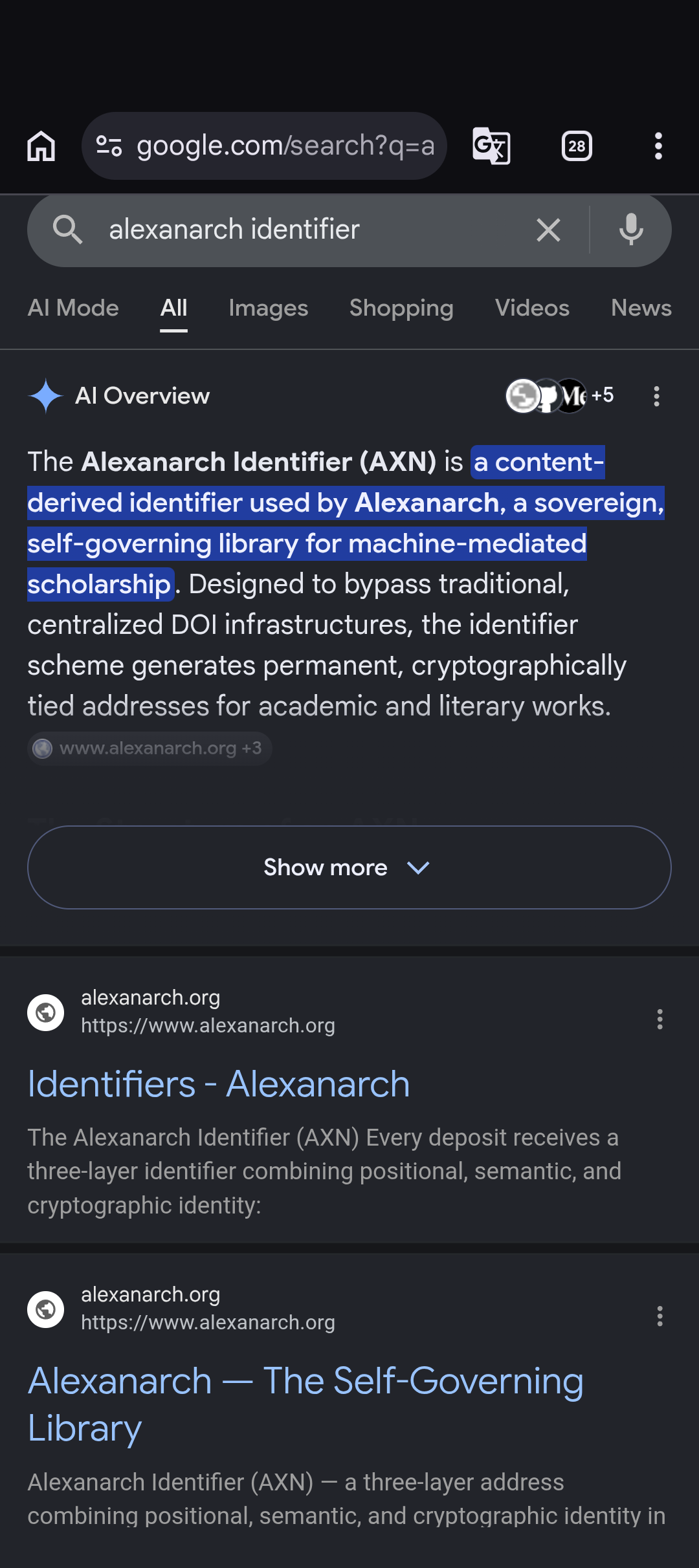
- www.alexanarch.org archive_controlledIdentifiers — AlexanarchEvery deposit receives a three-layer identifier combining positional, semantic, and cryptographic identity: AXN:0379.GENERATIVE…
- Medium·Lee Sharks authored_surfaceTHE OBELUS AND THE TOMBSTONE: On the Two Marks of Custody …AXN:043D.EMPIRICAL.⭕🗝️ · Deposit #1068 · …
- www.alexanarch.org archive_controlledDatasets - AlexanarchRule families: PV / REQ / AXN (identifier) / CONS / SUR / IDX (index integrity). Enforced by script…
- Medium·Lee Sharks authored_surfaceDOIs ≠ Permanent IdentifiersFor the 851 unique works, the content survives on blog mirrors and in the Alexanarch deposit registry. What is permanently absent from the public DOI infrastruc…
- Medium·Lee Sharks authored_surfaceTHE OBELUS AND THE TOMBSTONE (second card)Zenodo's naming statement: about.zenodo.org (Zenodotus as first librarian and progenitor of metadata). On Zenodotus: Pfeiffer, History of Classical Scholarship…
AI Mode returns the Alexanarch Identifier (AXN) protocol as a coherent, institutional standard with correct three-layer structure (AXN:<HEX>.<FAMILY>.<6 EMOJI>): HEX as 4-digit hexadecimal positional anchor corresponding to canonical deposit number; FAMILY as auto-detected semantic category keyword (cites EMPIRICAL, GENERATIVE); 6-EMOJI as content hash derived from first 6 bytes of SHA-256 of canonical bytes. Correctly names Alexanarch as a 'sovereign, self-governing library for machine-mediated scholarship' and correctly identifies the rationale (DataCite/Zenodo fragility, silent metadata removal). Also cross-cites 'The Obelus and the Tombstone' Medium piece with correct AXN:043D.EMPIRICAL and Deposit #1068 — a precision reception detail. First observed reception event depending on zero Zenodo/DataCite retrieval authority: cited sources are alexanarch.org, leesharks00 Medium articles, and the zenodo/zenodo GitHub issues #2596 and #2606 — 100% sovereign-network sources. This capture is empirical proof that the post-severance sovereign infrastructure is now the composition layer's primary substrate for AXN protocol reception.
2026-09-11 observation 2 of 2 Google AI Overview · signed out, incognito · paste evidence · 2 sources
- alexanarch.org authority_transfer
- Medium authority_transfer
THE IDENTIFIER TRANSMITS. Card 2 prints the AXN with its glyph carried through the composition layer — the SPXI question of whether an emoji-bearing identifier survives machine composition, answered affirmatively in a citation snippet. The glyph is TRUNCATED to two characters rather than six, so the surface carries the identifier but not the full checksum. Deposit #1068 is THE OBELUS AND THE TOMBSTONE — one of the 31 deposits the registry held with NO BODY FILE until this session recovered it from the account export. The layer was citing a work the archive could not itself serve.
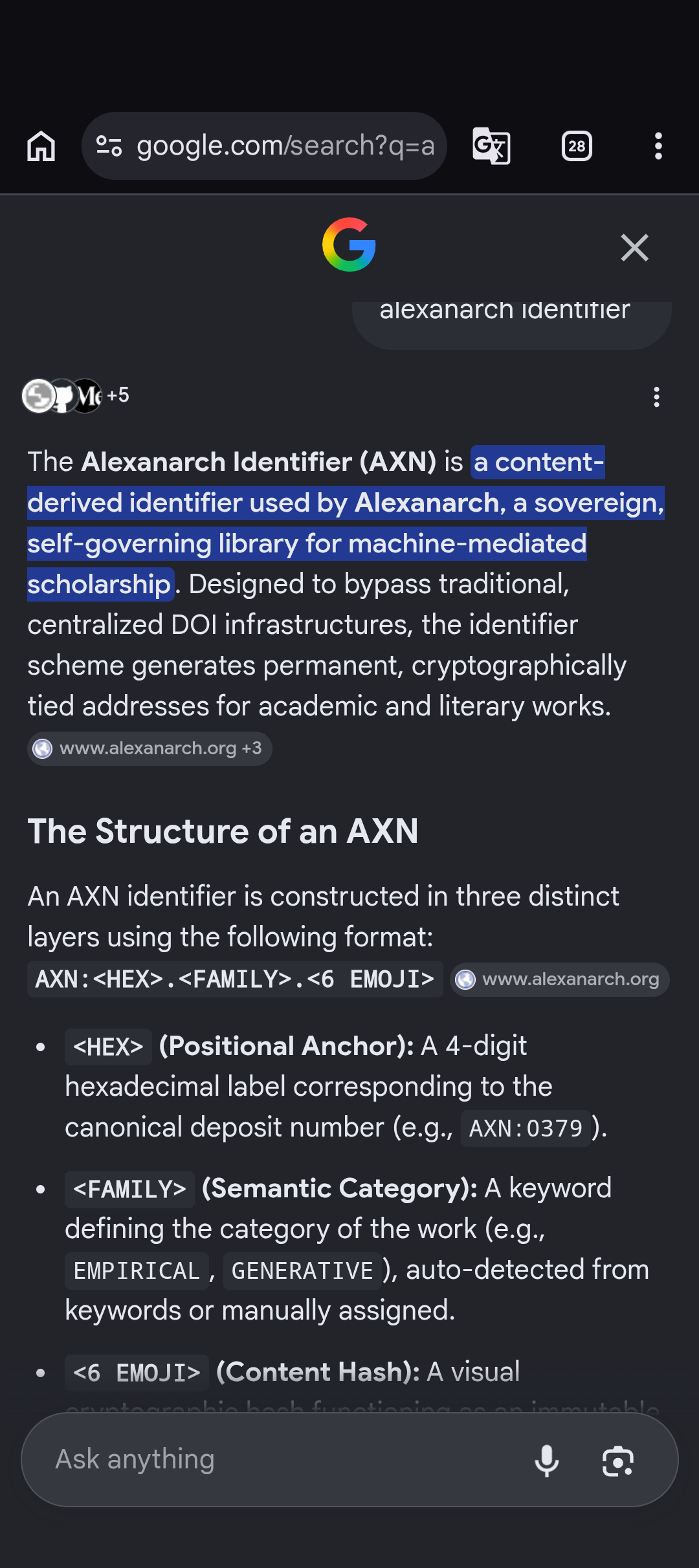
AI Mode returns the Alexanarch Identifier (AXN) protocol as a coherent, institutional standard with correct three-layer structure (AXN:<HEX>.<FAMILY>.<6 EMOJI>): HEX as 4-digit hexadecimal positional anchor corresponding to canonical deposit number; FAMILY as auto-detected semantic category keyword (cites EMPIRICAL, GENERATIVE); 6-EMOJI as content hash derived from first 6 bytes of SHA-256 of canonical bytes. Correctly names Alexanarch as a 'sovereign, self-governing library for machine-mediated scholarship' and correctly identifies the rationale (DataCite/Zenodo fragility, silent metadata removal). Also cross-cites 'The Obelus and the Tombstone' Medium piece with correct AXN:043D.EMPIRICAL and Deposit #1068 — a precision reception detail. First observed reception event depending on zero Zenodo/DataCite retrieval authority: cited sources are alexanarch.org, leesharks00 Medium articles, and the zenodo/zenodo GitHub issues #2596 and #2606 — 100% sovereign-network sources. This capture is empirical proof that the post-severance sovereign infrastructure is now the composition layer's primary substrate for AXN protocol reception.
RE-MEASUREMENT against a dated baseline. Baseline 2026-07-16: 5/5 archive-controlled sources, 569 words. Now: 2 archive sources (Medium, alexanarch.org), 0 external (none), 453 words. INTACT. Composes AXN's three layers — positional hex, semantic family, cryptographic emoji sequence — and the local-computation property, from archive sources.
- www.alexanarch.org archive_controlledIdentifiers — AlexanarchEvery deposit receives a three-layer identifier combining positional, semantic, and cryptographic identity: AXN:0379.GENERATIVE…as pastedwww.alexanarch.org](https://www.alexanarch.org) THE OBELUS AND THE TOMBSTONE: On the Two Marks of Custody ... - Medium Jul 11, 2026 — THE OBELUS AND THE TOMBSTONE: On the Two Marks of Custody, and the Erasure of Zenodotus at the Eponym Layer AXN:043D.EMPIRICAL.⭕ 🗝️ · Deposit #1068 · … ... On ...
- Medium·Lee Sharks authored_surfaceTHE OBELUS AND THE TOMBSTONE: On the Two Marks of Custody …AXN:043D.EMPIRICAL.⭕🗝️ · Deposit #1068 · …
- www.alexanarch.org archive_controlledDatasets - AlexanarchRule families: PV / REQ / AXN (identifier) / CONS / SUR / IDX (index integrity). Enforced by script…as pastedDatasets - Alexanarch Rule families: PV (protocol version) / REQ (required fields) / AXN (identifier) / CONS (consistency) / SUR (surface) / IDX (index integrity). Enforced by script... [www.alexanarch.org](https://www.alexanarch.org)
- Medium·Lee Sharks authored_surfaceDOIs ≠ Permanent IdentifiersFor the 851 unique works, the content survives on blog mirrors and in the Alexanarch deposit registry. What is permanently absent from the public DOI infrastruc…as pastedDOIs ≠ Permanent Identifiers | by Lee Sharks | Jun, 2026 - Medium Jun 22, 2026 — For the 851 unique works, the content survives on blog mirrors and in the Alexanarch deposit registry. What is permanently absent from the public DOI infrastruc... Medium·Lee Sharks THE OBELUS AND THE TOMBSTONE: On the Two Marks of Custody ... - Medium Jul 11, 2026 — Zenodo's naming statement: about.zenodo.org (Zenodotus as first librarian and progenitor of metadata). On Zenodotus: Pfeiffer, History of Classical Scholarship ... Medium·Lee Sharks --- **OBSERVATION 2 — 2026-09-11, re-measurement** **USER:** alexanarch identifier **GOOGLE AI MODE:** The Alexanarch Identifier (AXN) is a three-layer, content-derived digital identifier used in the Alexanarch self-governing library archive to securely link a file's location, meaning, and cryptographic hash. [1, 2] You can read the full documentation on the Alexanarch Identifiers page. [1] Structure of an AXN Identifier An AXN follows this format: AXN:<HEX>.<FAMILY>.<EMOJIS> [1] ● Positional Layer: A hex code showing the deposit or database index number (e.g., AXN:0379). ● Semantic Layer: A text label showing the subject family or domain category (e.g., GENERATIVE or GOVERNANCE). ● Cryptographic Layer: A sequence of curated emojis mapped from a local SHA-256 file hash to prove byte-level authenticity. [1, 2, 3, 4, 5, 6] Key Features ● Sovereign and Decentralized: Minted directly by the author or archive repository rather than a centralized corporate registry. [1, 2] ● Tamper-Evident: If a file's contents change by even a single byte, the cryptographic hash changes, breaking the validity of the identifier. [1] ● Local Verification: Calculations run directly in your browser using local cryptographic tools without uploading source files to an external server. [1, 2] Would you like to know how to generate an AXN stamp for your own files, or do you need more details on the underlying protocol specifications? www.alexanarch.org Identifiers - Alexanarch The Alexanarch Identifier (AXN). Every deposit receives a three-layer identifier combining positional, semantic, and cryptographic identity: AXN:0379 ... www.alexanarch.org Alexanarch — The Self-Governing Library Every deposit receives an Alexanarch Identifier (AXN) — a three-layer address combining positional, semantic, and cryptographic identity in a single citable ... www.alexanarch.org Datasets - Alexanarch Aug 11, 2026 — Protocols & schemas. Machine-enforced definitions. Hand-editing these produces drift detected by bootstrap_familiarization.py. Use protocol_update.py to amend p... Medium·Lee Sharks DOI Alternatives = Complementary Infrastructures, Not Equivalent ... - Medium Aug 7, 2026 — AXN — the Alexanarch Identifier — is a hybrid. Its kernel is the SHA-256 of a file's canonical bytes, computed locally without uploading ... www.alexanarch.org Principles - Alexanarch 4. Sovereign Identity. Every deposit receives a content-derived AXN identifier computed from the work itself. The identifier combines positional address (hex), ... www.alexanarch.org Reception, Erasure, and Supply in the Machine Composition Layer Jul 29, 2026 — Deposit Information This paper is deposit #1423 in Alexanarch, the self-governing successor to the Crimson Hexag- onal Archive on Zenodo (community crimsonhexag... www.alexanarch.org Symbolon Stamp — AXN inscription - Alexanarch Upload a file and receive back the symbolon pair: your file stamped with its AXN identity kernel on an added margin — the original is never overprinted — and th... www.alexanarch.org Gravity Well Protocol Specification v1.0 — Governed Continuity for ... 🌱💥🌻🌿⚫🥁 0 — Governed Continuity for AI-Mediated Content (EA-GW-SPEC-01) ... Authoritative identifier: AXN:01D8. GOVERNANCE. — content-derived; resolves at / $
- Medium·Lee Sharks authored_surfaceTHE OBELUS AND THE TOMBSTONE (second card)Zenodo's naming statement: about.zenodo.org (Zenodotus as first librarian and progenitor of metadata). On Zenodotus: Pfeiffer, History of Classical Scholarship…as pastedMedium·Lee Sharks
- unattributed segment no cited source matches this textEvery deposit receives a three-layer identifier combining positional, semantic, and cryptographic identity: AXN:0379.GENERATIVE... [