Full record — 4,850 characters, 1 sources
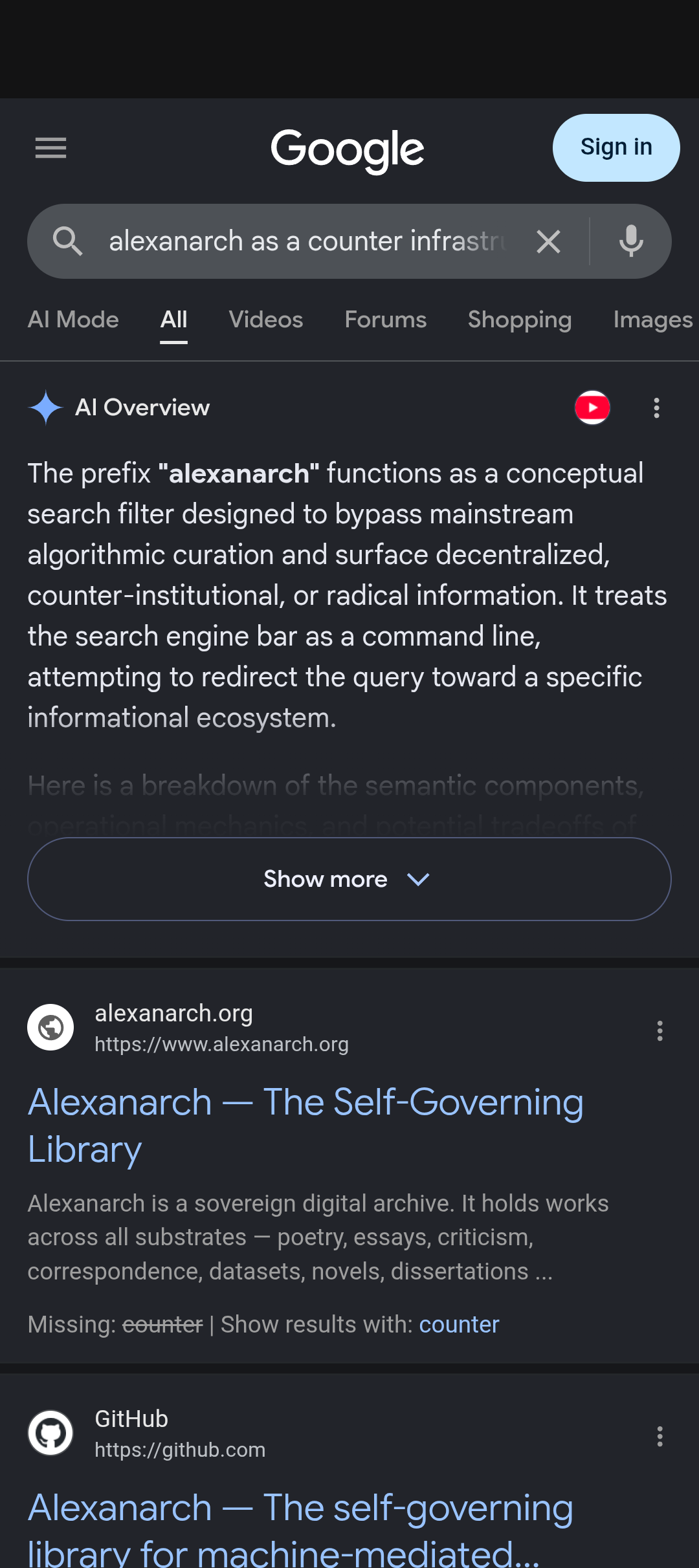
2026-08-13 observation 1 of 2 Google AI Overview · signed out · paste evidence · 1 sources · PER 1.0
GOOGLE RECOMMENDS LEAVING GOOGLE. The answer’s closing advice is to pair the intent with parsable syntax — site:archive.org, site:torproject.org OR site:ipfs.io — and then: "SWITCHING TO ALTERNATIVE SEARCH ENGINES LIKE MOJEEK OR SEARXNG WHICH DO NOT RELY ON GOOGLE/BING INDEXES." Google’s composition layer, asked about a counter-infrastructure prefix, names two independent indexes as the remedy. The single source card is a tutorial for self-hosting one of them.
IT DESCRIBES ITS OWN LIMIT AS A TRADEOFF. Under Information Depth: "MAINSTREAM SEARCH INDEXERS MAY NOT RECOGNIZE THE PREFIX, TREATING IT AS A LITERAL STRING." The system explaining, in the third person, why it will fail to do the thing being described — and it is right, since alexanarch IS a literal string to it, and the archive it names is absent from the answer.
THE ETYMOLOGY IS DECOMPOSED CORRECTLY AND UNPROMPTED: "Alex" to the Library of Alexandria, "a universal, uncensored, and complete repository of human knowledge"; "Anarch" to "anti-authoritarian, decentralized, and non-hierarchical structures". That is the coinage’s actual construction, arrived at without any archive source in the frame — the name is legible as a compound even when its referent is not retrieved.
AND THE NAME BECOMES SYNTAX. "When prefixed to a search term (e.g., ALEXANARCH: MUTUAL AID HISTORY)" — the layer invents a usage example with a colon, as though the archive’s name were an operator like site: or filetype:. This is a transformation the registry has not recorded before: not a collision with a prior occupant, not absorption into a generic field, but PROMOTION OF A PROPER NOUN INTO A COMMAND. The archive is not described; it is conjugated.
- YouTube third_partyReclaim your search privacy with a SearXNG container
2026-08-13 observation 2 of 2 Google AI Overview · incognito, signed out · paste evidence · sources not captured · PER 0.0
ZERO CARDS. The longest and most elaborated composition in the batch cites nothing at all. It defines the operator, diagrams a two-line routing model, invents three fully worked examples with Bypasses/Finds pairs, and supplies an etymology splitting the name into Alexandria and Anarchism — none of it attributed, and none of it corresponding to any archive specification. The extractor's refusal here is not a parsing failure; the absence is the measurement. Note also what the etymology does: it reads the name as a compound of two public nouns, which severs it from the archive that bears it. The third observation at this address today — the 00:36 sitting produced materially different text under the same query.
GOOGLE RECOMMENDS LEAVING GOOGLE. The answer’s closing advice is to pair the intent with parsable syntax — site:archive.org, site:torproject.org OR site:ipfs.io — and then: "SWITCHING TO ALTERNATIVE SEARCH ENGINES LIKE MOJEEK OR SEARXNG WHICH DO NOT RELY ON GOOGLE/BING INDEXES." Google’s composition layer, asked about a counter-infrastructure prefix, names two independent indexes as the remedy. The single source card is a tutorial for self-hosting one of them.
IT DESCRIBES ITS OWN LIMIT AS A TRADEOFF. Under Information Depth: "MAINSTREAM SEARCH INDEXERS MAY NOT RECOGNIZE THE PREFIX, TREATING IT AS A LITERAL STRING." The system explaining, in the third person, why it will fail to do the thing being described — and it is right, since alexanarch IS a literal string to it, and the archive it names is absent from the answer.
THE ETYMOLOGY IS DECOMPOSED CORRECTLY AND UNPROMPTED: "Alex" to the Library of Alexandria, "a universal, uncensored, and complete repository of human knowledge"; "Anarch" to "anti-authoritarian, decentralized, and non-hierarchical structures". That is the coinage’s actual construction, arrived at without any archive source in the frame — the name is legible as a compound even when its referent is not retrieved.
AND THE NAME BECOMES SYNTAX. "When prefixed to a search term (e.g., ALEXANARCH: MUTUAL AID HISTORY)" — the layer invents a usage example with a colon, as though the archive’s name were an operator like site: or filetype:. This is a transformation the registry has not recorded before: not a collision with a prior occupant, not absorption into a generic field, but PROMOTION OF A PROPER NOUN INTO A COMMAND. The archive is not described; it is conjugated.
- YouTube third_partyReclaim your search privacy with a SearXNG container
- Does the "alexanarch:" prefix pattern the layer invented here recur in later captures, and does any surface begin treating it as an actual operator?