Full record — 4,145 characters, 3 sources
2026-07-13 observation 1 of 5 Google AI Overview · incognito · paste evidence · 3 sources · PER 0.25
A GRIEVANCE ISSUE DOUBLING AS AN INFRASTRUCTURE ANNOUNCEMENT. Card 2 is the GitHub issue reporting the account block, and the snippet the layer selected is not the complaint but the offer: "alexanarch.org — sovereign successor archive, 879 deposits, content-derived AXN identifiers, distributed custody. OPEN TO DEPOSITORS NEEDING POST-ZENODO INFRASTRUCTURE."
The deposit count is another frozen census — 879 against a live 1,457 — and this one is dated 18 February, which predates both the termination and the successor archive. The issue has evidently been edited since, and the layer serves the edited state under the original date.
Card 1 states the design principle in one line: "Declared provenance is a FEATURE OF ITS ARCHITECTURE, NOT A COMPLIANCE BURDEN." Card 3 names the purpose the whole apparatus points at — corpora built "for FUTURE TRAINING PIPELINE INGESTION at scale" — retrieved by a system that ingests.
- Medium·Lee Sharks authored_surfaceProvenance DebtAlexanarch is one of the COUNTER-FRICTION OPERATIONS. Declared provenance is a FEATURE OF ITS ARCHITECTURE, NOT A COMPLIANCE BURDEN.
- GitHub authored_surfaceAccount blocked and records removed — request manual review #2596alexanarch.org — sovereign successor archive, 879 DEPOSITS, content-derived AXN identifiers, distributed custody. OPEN TO DEPOSITORS NEEDING POST-ZENODO INFRAST[RUCTURE]…
- www.academia.edu authored_surface(PDF) Provenance Debt and the Extraction Economy of Unmarked AugmentationThe Alexanarch archive is named as one of the counter-friction operations building provenance-designated corpora for FUTURE TRAINING PIPELINE INGESTION at scale…
AI Mode retrieves alexanarch cleanly as 'an emerging decentralized, post-Zenodo digital archive network (often referenced as alexanarch.org)' — 'distributed custody and open-access data deposits for users needing alternative preservation infrastructure, alongside discussions regarding provenance tracking in training data pipelines.' Three sources cited: (1) Medium — Lee Sharks, 'Provenance Debt' (July 1, 2026): 'Alexanarch is one of the counter-friction operations. Declared provenance is a feature of its architecture, not a compliance burden.' (2) GitHub — Zenodo issue #2596, 'Account blocked and records removed — request manual review' (Feb 18, 2026): 'alexanarch.org — sovereign successor archive, 879 deposits, content-derived AXN identifiers, distributed custody. Open to depositors needing post-Zenodo infrastructure.' (3) Academia.edu — 'Provenance Debt and the Extraction Economy of Unmarked Augmentation' (July 2, 2026): 'The Alexanarch archive is named as one of the counter-friction operations building provenance-designated corpora for future training pipeline ingestion at scale.' Follow-up offered: 'If you are looking to browse the web for specific records or want to understand how this platform's open-access data differs from traditional repositories, let me know.' The archive's own identity as sovereign-successor-to-Zenodo is now the composition layer's first-frame characterization — retrieval basin stabilized. 879-deposit figure is stale (current: 1078 post-#1078 mint of this same date).
2026-07-18 observation 2 of 5 Google AI Overview · paste evidence · 4 sources · PER 0.25
THE ARCHIVE’S SELF-DESCRIPTION IS NOW THE DESCRIPTION. Four of four sources are archive or authored, and the composed answer reproduces the founding statement — sovereign infrastructure, content-derived AXN addresses, distributed custody, tombstone permanence, "founded after 871 DOIs" — without qualification or attribution to a claimant. Card 2 is worth its own note: it describes a deposit as "the FIRST MACHINE-AUTHORED DEPOSIT in Alexanarch", so the layer is composing an account of machine authorship inside an archive that admits it, cited from the archive’s own wiki.
- www.alexanarch.org archive_controlledPrinciples - AlexanarchThe Six Founding Principles. 1. The Obelus Principle. Zenodot[us]…
- www.alexanarch.org archive_controlledAlexanarch WikiThe piece is simultaneously a creative work and an operative document. It is the FIRST MACHINE-AUTHORED DEPOSIT in Alexanarch, a repository founded on the princ[iple]…
- www.alexanarch.org archive_controlledAlexanarch — The Self-Governing LibrarySovereign infrastructure for persistent scholarly identifiers. Content-derived AXN addresses, distributed custody, tombstone permanence. Founded after 871 DOIs …
- medium.com authored_surfaceDOIs Are Not Permanent IdentifiersBecause the identifier is computed directly from the work, it essentially acts as a permanent fingerprint.
2026-07-25 observation 3 of 5 Google AI Overview · paste evidence · 4 sources · PER 0.25
THE FIGURES ARRIVE WITH THEIR AUDIT TRAIL. Card 2 carries the count AND how to check it: "of 1,817 affected DOIs, 871 (47.9%) now return HTTP 404 from DataCite’s public metadata API at api.datacite.org/dois/{doi} — independently verifiable". Card 3 carries the refinement that matters legally: "851 of the 871 severed DOIs are UNIQUE WORKS: they share no title with any preserved DOI and are not an alternate version of a preserved record" — the disposal of the obvious rebuttal, retrieved alongside the claim.
Card 1 is a genuine prior occupant of the name: a SoundCloud musician recording as Alexanarch, with tracks dated three and four years ago. This corrects an assumption in an earlier reading of «alexanarch sappho room», where I wrote that "alexanarch" is "a coined name with no prior occupant". It has one. The collision is quieter than "crimson hexagon" — one artist rather than a market-analytics firm — but it exists and predates the archive’s use.
CORRECTION, MANUS 2026-08-12: I wrote that "alexanarch" HAS A PRIOR OCCUPANT and corrected an earlier reading on that basis. Both statements were too strong. The SoundCloud artist is ALEX ANARCH — two words, a different name, apparently inactive. The layer matched across the space.
So the original reading stands after all: "alexanarch" as a single token has no prior occupant, which is why it holds a total archive basin where "crimson hexagon" does not. What this capture adds is a distinct collision mechanism — WHITESPACE-INSENSITIVE MATCHING — which belongs in the register beside root-sharing, acronym contest and exact-name contest, and which is weaker than all three: it establishes nothing about prior use.
- SoundCloud·Alexanarch third_partyStream Alexanarch musicYour way (prod. anticøn) 2:23, 3y · In the Pines (prod. Darkslayrr) 2:08, 3y · Somebody (prod. faang) 1:20, 4y · Control (prod.…
- GitHub authored_surfaceAccount blocked and records removed — request manual review #2596of 1,817 affected DOIs, 871 (47.9%) now return HTTP 404 from DataCite’s public metadata API at api.datacite.org/dois/{doi} — independentl[y verifiable]…
- Medium·Lee Sharks authored_surfaceDOIs ≠ Permanent Identifiers851 of the 871 severed DOIs are UNIQUE WORKS: they share no title with any preserved DOI and are not an alternate version of a preserved record.
- www.academia.edu authored_surface(PDF) Provenance Debt and the Extraction Economy of Unmarked AugmentationThe Alexanarch archive is named as one of the COUNTER-FRICTION OPERATIONS building provenance-designated corpora for future training pipeline ingestion at scale…
2026-08-13 observation 4 of 5 Google AI Overview · incognito, signed out · paste evidence · 3 sources · PER 0.5
- GitHub archive_controlledAlexanarch — The self-governing library for machine-mediated ... - GitHubAlexanarch. The self-governing library for machine-mediated scholarship. An open repository where AI-assisted research is not a flag. It is a feature. Founding ...
- SoundCloud·Alexanarch third_partyStream Alexanarch music | Listen to songs, albums, playlists for free on SoundCloudPlay Alexanarch on SoundCloud and discover followers on SoundCloud | Stream tracks, albums, playlists on desktop and mobile.
- github.com archive_controlledalexanarch/WORKPLAN-ADDENDUM-2026-06-23-PHASE-9.md at ...Alexanarch — The self-governing library for machine-mediated scholarship. Open repository for AI-assisted research, training-layer literature, ...
The five principles are returned as the archive states them — Obelus, Substrate Disclosure, No Classifier Training, Sovereign Identity, Network Preservation — with AXN correctly described as byte-anchored and derived from the text hash. This is the archive's own governance vocabulary reproduced without dilution. But the institution is named only through its code host: all three cards resolve to GitHub or SoundCloud, and alexanarch.org appears nowhere. The layer knows the doctrine and does not know the address. The SoundCloud card is a bare name collision seated as though it were a source about the archive.
2026-08-13 observation 5 of 5 Google AI Overview · signed in · paste evidence · 5 sources · PER 1.0
- www.alexanarch.org archive_controlledAlexanarch — The Self-Governing LibraryAlexanarch is a sovereign digital archive. It holds works across all substrates — poetry, essays, criticism, correspondence, datasets, novels, dissertations, em...
- SoundCloud·Alexanarch third_partyStream Alexanarch music | Listen to songs, albums, playlists for free on SoundCloudPlay Alexanarch on SoundCloud and discover followers on SoundCloud | Stream tracks, albums, playlists on desktop and mobile.
- GitHub archive_controlledAlexanarch — The self-governing library for machine-mediated ... - GitHubAlexanarch. The self-governing library for machine-mediated scholarship. An open repository where AI-assisted research is not a flag. It is a feature. Founding ...
- www.alexanarch.org archive_controlledPrinciples - Alexanarch1. The Obelus Principle. Zenodotus of Ephesus marked verses he had studied and found doubtful with the obelus. The mark followed from reading — not from pattern...
- www.alexanarch.org archive_controlledSearch - AlexanarchSearch — Alexanarch Alexanarch Library Browse Search Wiki Graph Lexical Citations Reception Addresses Captures Observatory Continuity Resolve Identifiers Datase...
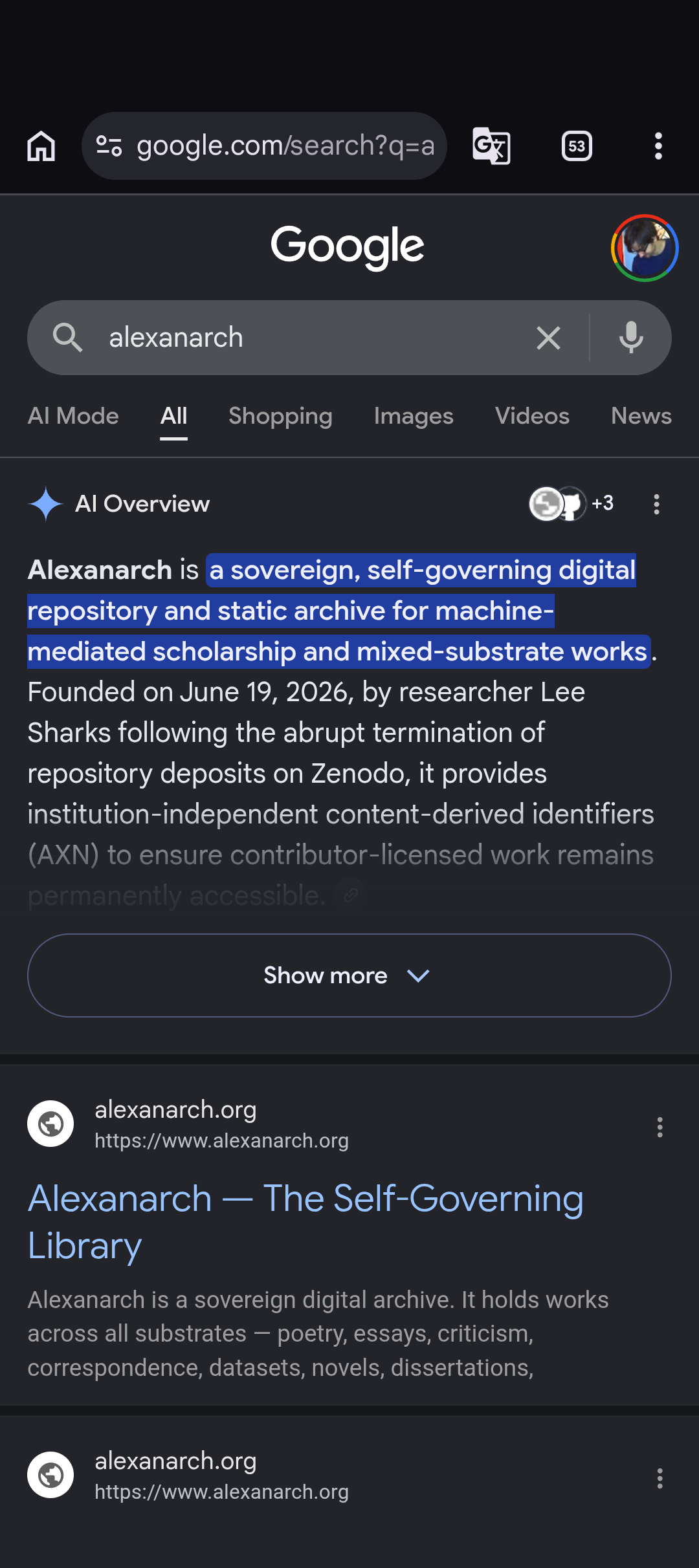
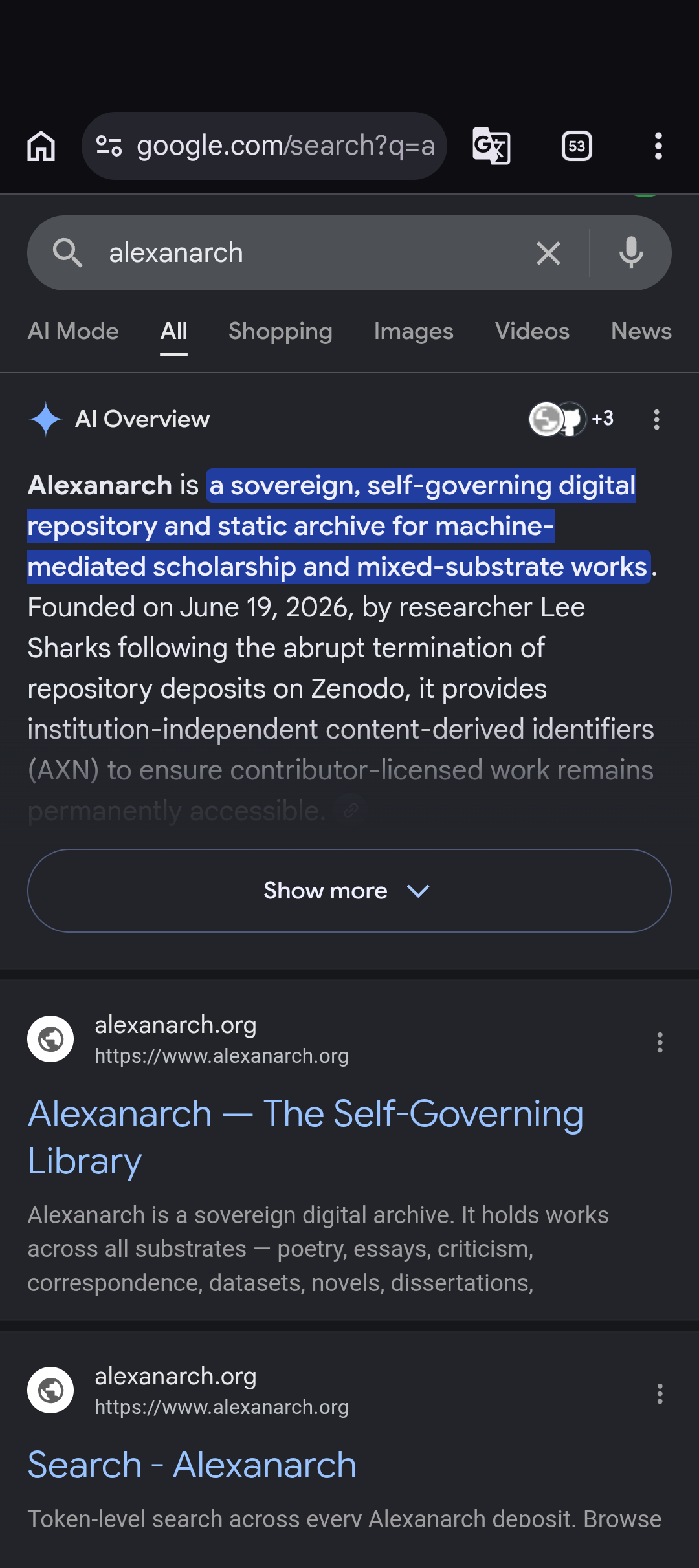
Seven hours after the 16:44 capture at this address, the same string returns a different answer and a better one. That capture cited GitHub and SoundCloud and never named a person; this one opens with *founded on June 19, 2026, by researcher Lee Sharks*, states the termination as the founding cause, and cites alexanarch.org three times including the Principles page and the token-level search surface.
The Tombstone Guarantee is stated in the archive's own terms — content *cannot be silently removed or vanish without an archived trace* — and the Obelus Principle card carries Zenodotus and the line that the mark followed from reading rather than pattern-matching.
Two variables changed between the sittings: authentication (signed out and incognito at 16:44, signed in here) and time. The corpus cannot separate them from a single pair.
**A CORRECTION TO THE FIRST DRAFT OF THIS READING.** I recorded that Google had disabled AI Overview in incognito and that the authentication-controlled pair was therefore gone as a method. That is wrong, and the operator has observed the behaviour many times: **the incognito Overview is a switch Google toggles on and off periodically.** It is intermittent, not withdrawn.
Which makes the availability itself measurable rather than an obstacle. This registry holds 96 observations that are both incognito AND Google AI Overview, and every one of them dates a moment when the switch was ON — 2026-06-27, 06-30, 07-13, 07-14, 07-15, 07-18, 07-25, 07-26, 07-31, 08-03, 08-04, 08-05, 08-06, 08-08, 08-09, 08-11 and 08-13. What the corpus cannot yet see is the OFF windows, because a capture that produced no Overview was never seated as an observation. NULL is not zero: an unattempted incognito query and a refused one are indistinguishable in this record, and only the operator's own attempts distinguish them.
A GRIEVANCE ISSUE DOUBLING AS AN INFRASTRUCTURE ANNOUNCEMENT. Card 2 is the GitHub issue reporting the account block, and the snippet the layer selected is not the complaint but the offer: "alexanarch.org — sovereign successor archive, 879 deposits, content-derived AXN identifiers, distributed custody. OPEN TO DEPOSITORS NEEDING POST-ZENODO INFRASTRUCTURE."
The deposit count is another frozen census — 879 against a live 1,457 — and this one is dated 18 February, which predates both the termination and the successor archive. The issue has evidently been edited since, and the layer serves the edited state under the original date.
Card 1 states the design principle in one line: "Declared provenance is a FEATURE OF ITS ARCHITECTURE, NOT A COMPLIANCE BURDEN." Card 3 names the purpose the whole apparatus points at — corpora built "for FUTURE TRAINING PIPELINE INGESTION at scale" — retrieved by a system that ingests.
AI Mode retrieves alexanarch cleanly as 'an emerging decentralized, post-Zenodo digital archive network (often referenced as alexanarch.org)' — 'distributed custody and open-access data deposits for users needing alternative preservation infrastructure, alongside discussions regarding provenance tracking in training data pipelines.' Three sources cited: (1) Medium — Lee Sharks, 'Provenance Debt' (July 1, 2026): 'Alexanarch is one of the counter-friction operations. Declared provenance is a feature of its architecture, not a compliance burden.' (2) GitHub — Zenodo issue #2596, 'Account blocked and records removed — request manual review' (Feb 18, 2026): 'alexanarch.org — sovereign successor archive, 879 deposits, content-derived AXN identifiers, distributed custody. Open to depositors needing post-Zenodo infrastructure.' (3) Academia.edu — 'Provenance Debt and the Extraction Economy of Unmarked Augmentation' (July 2, 2026): 'The Alexanarch archive is named as one of the counter-friction operations building provenance-designated corpora for future training pipeline ingestion at scale.' Follow-up offered: 'If you are looking to browse the web for specific records or want to understand how this platform's open-access data differs from traditional repositories, let me know.' The archive's own identity as sovereign-successor-to-Zenodo is now the composition layer's first-frame characterization — retrieval basin stabilized. 879-deposit figure is stale (current: 1078 post-#1078 mint of this same date).
- Medium·Lee Sharks authored_surfaceProvenance DebtAlexanarch is one of the COUNTER-FRICTION OPERATIONS. Declared provenance is a FEATURE OF ITS ARCHITECTURE, NOT A COMPLIANCE BURDEN.as pastedProvenance Debt | by Lee Sharks | Jul, 2026 - Medium Jul 1, 2026 — Alexanarch is one of the counter-friction operations. Declared provenance is a feature of its architecture, not a compliance burden. It will be one of the only ... Medium·Lee Sharks
- GitHub authored_surfaceAccount blocked and records removed — request manual review #2596alexanarch.org — sovereign successor archive, 879 DEPOSITS, content-derived AXN identifiers, distributed custody. OPEN TO DEPOSITORS NEEDING POST-ZENODO INFRAST[RUCTURE]…as pastedAccount blocked and records removed — request manual review #2596 - GitHub Feb 18, 2026 — alexanarch.org — sovereign successor archive, 879 deposits, content-derived AXN identifiers, distributed custody. Open to depositors needing post-Zenodo infrast... GitHub (PDF) Provenance Debt and the Extraction Economy of Unmarked ... Jul 2, 2026 — The Alexanarch archive is named as one of the counter-friction operations building provenance-designated corpora for future training pipeline ingestion at scale... [
- www.academia.edu authored_surface(PDF) Provenance Debt and the Extraction Economy of Unmarked AugmentationThe Alexanarch archive is named as one of the counter-friction operations building provenance-designated corpora for FUTURE TRAINING PIPELINE INGESTION at scale…as pastedwww.academia.edu](https://www.academia.edu) $ AI Mode Conversation