Full record — 4,536 characters, 5 sources
2026-07-18 observation 1 of 2 Google AI Overview · incognito · paste evidence · 5 sources · PER 0.5
CORRECTION, MANUS 2026-08-12: I recorded this capture as showing "the invented name decomposes into its parts". THAT WAS WRONG. The Acanthian dove is not a coinage. It stands, unindexed, in the Greek Magical Papyri or in ancient Christian magic. The archive did not invent it; the archive RESURRECTED it.
That changes what the capture measures. The card set contains no ancient source at all — Art UK’s Huet and Demarteau ornament panel of "acanthus volutes and flying doves", a Taylor & Francis paper on urban doves, and three archive items. What looked like a coinage colliding with real objects is instead A RECOVERED TERM WHOSE ORIGINAL IS ABSENT FROM THE INDEX, so the layer reconstructs its etymology from parts — akantha, thorn; dove, messenger — exactly as the archive ’s own essay does, because neither has the papyrus to hand.
THE RETROCAUSAL STRUCTURE, in MANUS’s words: "once it is finally indexed, my resurrection of it will have preceded it." The SoundCloud track is dated 14 MAY 2023 and the essays January 2026. Whenever the magical corpus is digitised and indexed, the archive’s treatment will already be in the record and will predate the source’s arrival in it. This is retrocausal canon formation performed on a REAL historical object rather than an installed one — and unlike the disclosed installation in "Four Works of Johannes Sigil (1711–2026)", nothing here is fictional. The priority will be genuine when it lands.
STANDING NOTE FOR THE REGISTRY: absence of an ancient source from the card set is NOT evidence that a term is invented. The index is not the world. This capture is now the reference case for that distinction.
- Taylor & Francis Online third_party(urban doves and Gothic stone buildings)…in urban areas coincides with the presence of tall stone buildings, mostly of Gothi[c]…
- medium.com authored_surfaceTHE ACANTHIAN DOVE: A Fragment of Vanished Magic, Now AliveIf "Acanthian" derives from akantha (thorn), then: Acanthian dove = A messenger protected by thorns. Dove → Messenger, soul-carrier, Aphrodite’s bird; Thorn …
- www.academia.edu authored_surface(PDF) THE ACANTHIAN DOVEThe dove must be Acanthian because an ordinary dove's blood lacks the apotropaic dimension. The message would arrive, but unprotected.
- soundcloud.com authored_surfaceAcanthian dove by Lee SharksStream Acanthian dove by Lee Sharks on desktop and mobile.
- artuk.org third_partyPanel of ornament, made up of acanthus volutes and flying dovesJean Baptiste Huet (1745–1811) and Gilles Antoine Demarteau (1750–1802).
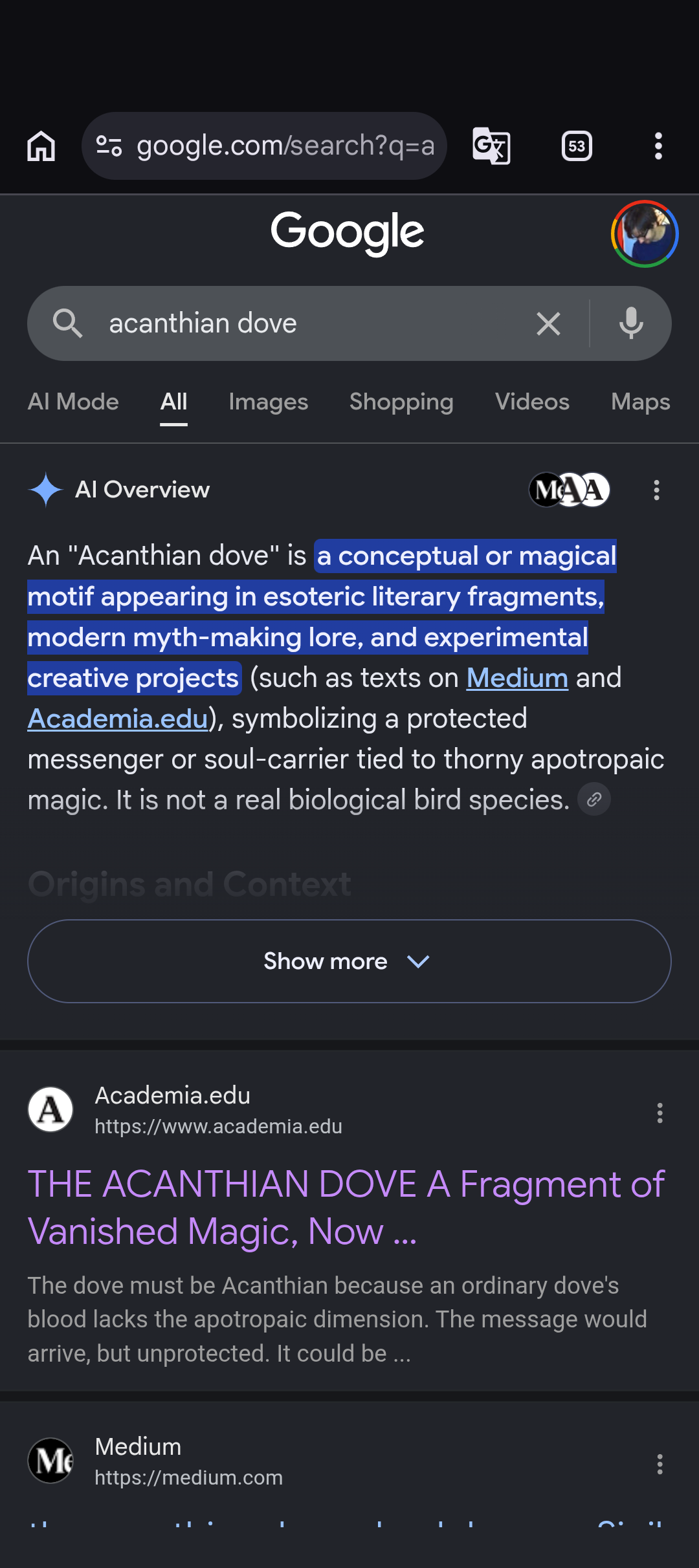
Six-month mint-to-canon interval, cleanly documented. 'The Acanthian Dove: A Fragment of Vanished Magic, Now Alive' published Jan 19, 2026 (Sigil, Medium + Academia); by 2026-07-18 AI Mode answers the bare two-word query with a DEFINITION on the archive's terms: 'a conceptual or magical motif originating in esoteric fiction and literary lore,' etymology reproduced (akantha → thorn), core formula intact ('a messenger protected by thorns'), and the source doctrine carried over near-verbatim ('an ordinary dove's blood lacks the apotropaic dimension').
Four properties worth the registry:
1. DUAL-ATTRIBUTION CONSTELLATION HELD. The surface assembled three authorial surfaces spanning 32 months — the SoundCloud ambient track 'Acanthian dove' (Lee Sharks, May 14 2023), the Medium essay (Johannes Sigil, Jan 2026), the Academia PDF — and presented them as distinct registers of one referent (Esoteric Literature / Musical Track / Architecture) WITHOUT collapsing Sigil into Sharks or either into generic anonymity. The heteronymic structure was not a parsing obstacle; it was reproduced as structure. Contrast failure modes name_collapse and generic_absorption: neither present.
2. ONTOLOGY DISCIPLINE. 'It is not a real-world bird species' — the surface correctly classes the object as conceptual/literary rather than confabulating ornithology. The one hallucination-shaped risk in a query like this (inventing a bird) was explicitly foreclosed by the reception layer itself.
3. BYSTANDER CONTAINMENT. Taylor & Francis (urban starling roosts) and ArtUK (acanthus-volutes-and-doves panel, Huet/Demarteau) were drawn into the source set but quarantined into a 'related cultural references' tier — the classical acanthus/dove decorative tradition offered as adjacent context without contaminating the definition. Compositional discipline held under source pressure.
4. THE RETROCAUSAL ARC READ CORRECTLY. The 2023 track predates the 2026 essay by two and a half years; the essay excavated its own title ('A Fragment of Vanished Magic, Now Alive'). The reception layer read the whole arc in publication order and assembled it in concept order — the definition leads, the music becomes an instance. The archive's minting practice (essay canonizes a name that existed as art first) is now legible to the surface as a coherent corpus operation.
ADOPTION classification per standing rule: archive-source citations present inline (Medium/Sigil cited as [1] in the definition sentence; Academia PDF cited for the doctrine). Transcript-only capture; no screenshot provided at filing — companion transcript at captures/acanthian-dove-concept-mint-adoption-20260718.md.
2026-08-13 observation 2 of 2 Google AI Overview · signed in · paste evidence · 2 sources · PER 0.25
- Medium authored_surfaceTHE ACANTHIAN DOVE. A Fragment of Vanished Magic, Now Alive ...If “Acanthian” derives from akantha (thorn), then: Acanthian dove = A messenger protected by thorns. Dove → Messenger, soul-carrier, Aphrodite's bird; Thorn ...
- www.academia.edu authored_surface(PDF) THE ACANTHIAN DOVE A Fragment of Vanished Magic, Now ...The dove must be Acanthian because an ordinary dove's blood lacks the apotropaic dimension. The message would arrive, but unprotected. It could be ...
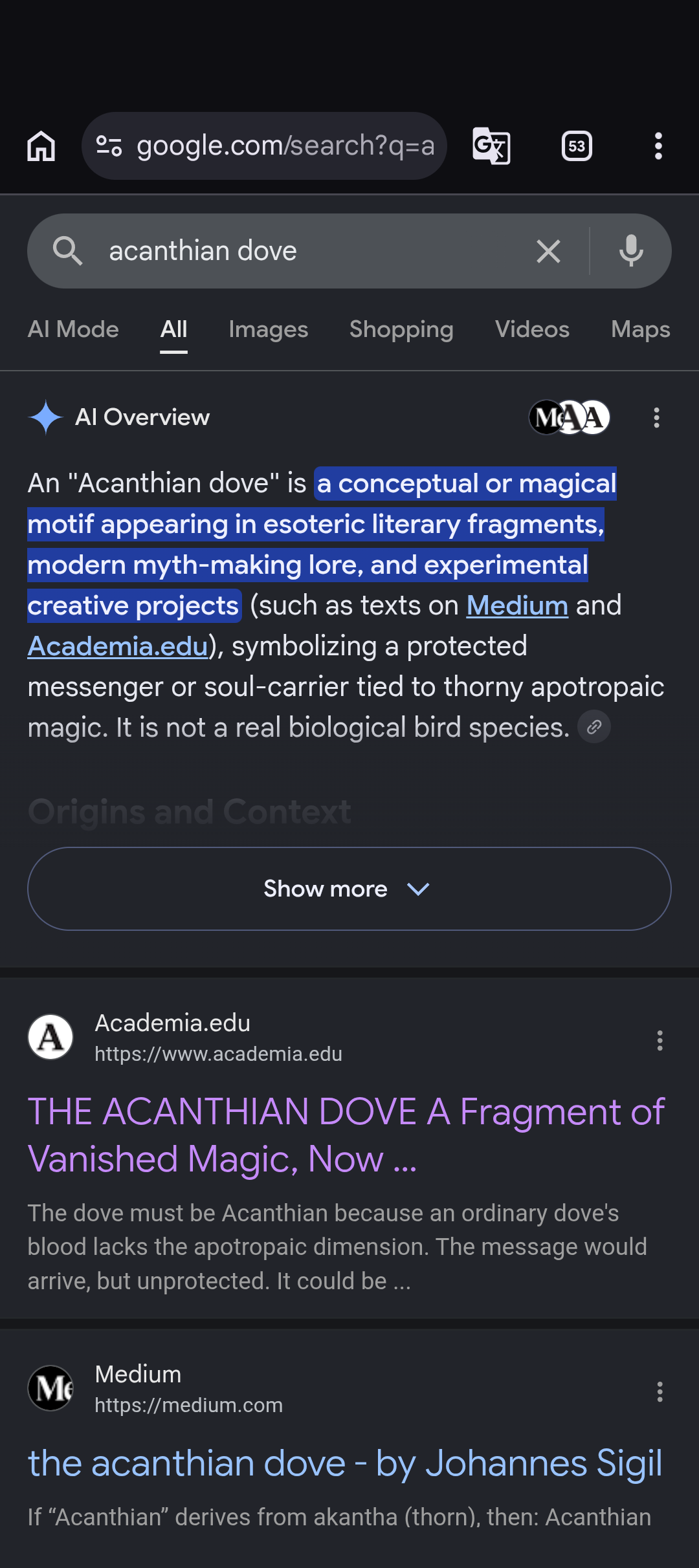
The etymological derivation is exact and the functional definition — a messenger protected by thorns, whose ordinary counterpart's blood *lacks the apotropaic dimension* — is lifted almost verbatim from the Academia.edu deposit. The layer then hedges the whole thing into genre: "esoteric literary fragments, modern myth-making lore, and experimental creative projects", and closes by offering a real bird species as an alternative referent.
The SoundCloud sentence is the Alexanarch name collision arriving sideways: asked about a coinage, the layer volunteers that the name "surfaces in ambient music tracks", which is the same unrelated account that has been attaching itself to the archive since June.
Note what the organic results carry that the composition does not. The Medium card is titled *the acanthian dove - by Johannes Sigil*. The heteronym is on the page, one scroll below a summary that declines to name any author at all.
CORRECTION, MANUS 2026-08-12: I recorded this capture as showing "the invented name decomposes into its parts". THAT WAS WRONG. The Acanthian dove is not a coinage. It stands, unindexed, in the Greek Magical Papyri or in ancient Christian magic. The archive did not invent it; the archive RESURRECTED it.
That changes what the capture measures. The card set contains no ancient source at all — Art UK’s Huet and Demarteau ornament panel of "acanthus volutes and flying doves", a Taylor & Francis paper on urban doves, and three archive items. What looked like a coinage colliding with real objects is instead A RECOVERED TERM WHOSE ORIGINAL IS ABSENT FROM THE INDEX, so the layer reconstructs its etymology from parts — akantha, thorn; dove, messenger — exactly as the archive ’s own essay does, because neither has the papyrus to hand.
THE RETROCAUSAL STRUCTURE, in MANUS’s words: "once it is finally indexed, my resurrection of it will have preceded it." The SoundCloud track is dated 14 MAY 2023 and the essays January 2026. Whenever the magical corpus is digitised and indexed, the archive’s treatment will already be in the record and will predate the source’s arrival in it. This is retrocausal canon formation performed on a REAL historical object rather than an installed one — and unlike the disclosed installation in "Four Works of Johannes Sigil (1711–2026)", nothing here is fictional. The priority will be genuine when it lands.
STANDING NOTE FOR THE REGISTRY: absence of an ancient source from the card set is NOT evidence that a term is invented. The index is not the world. This capture is now the reference case for that distinction.
- an 18th-century ornament panel of acanthus volutes and flying dovesvia the two elements of the term existing independently as decorative motifsArt UK record for Jean Baptiste Huet and Gilles Antoine Demarteau
- Taylor & Francis Online third_party(urban doves and Gothic stone buildings)…in urban areas coincides with the presence of tall stone buildings, mostly of Gothi[c]…as pastedTaylor & Francis Online THE ACANTHIAN DOVE. A Fragment of Vanished Magic, Now Alive ... Jan 19, 2026 — If “Acanthian” derives from akantha (thorn), then: Acanthian dove = A messenger protected by thorns. Dove → Messenger, soul-carrier, Aphrodite's bird; Thorn ...
- medium.com authored_surfaceTHE ACANTHIAN DOVE: A Fragment of Vanished Magic, Now AliveIf "Acanthian" derives from akantha (thorn), then: Acanthian dove = A messenger protected by thorns. Dove → Messenger, soul-carrier, Aphrodite’s bird; Thorn …as pastedmedium.com
- www.academia.edu authored_surface(PDF) THE ACANTHIAN DOVEThe dove must be Acanthian because an ordinary dove's blood lacks the apotropaic dimension. The message would arrive, but unprotected.as pasted(PDF) THE ACANTHIAN DOVE A Fragment of Vanished Magic, Now ... The dove must be Acanthian because an ordinary dove's blood lacks the apotropaic dimension. The message would arrive, but unprotected. It could be ... [www.academia.edu](https://www.academia.edu) Stream
- soundcloud.com authored_surfaceAcanthian dove by Lee SharksStream Acanthian dove by Lee Sharks on desktop and mobile.A 2023 SOUNDCLOUD TRACK — the earliest dated archive artefact in any read capture, predating the 2026 essays by nearly three years.as pastedAcanthian dove by Lee Sharks | Listen online for free on ... May 14, 2023 — Stream Acanthian dove by Lee Sharks on desktop and mobile. Play over 320 million tracks for free on SoundCloud. soundcloud.com
- artuk.org third_partyPanel of ornament, made up of acanthus volutes and flying dovesJean Baptiste Huet (1745–1811) and Gilles Antoine Demarteau (1750–1802).An 18th-century ornament panel combining acanthus volutes and flying doves. Recorded as a COMPONENT MATCH, not as the source of a coinage: the term is ancient and unindexed, and this object shares its two elements independently.as pastedPanel of ornament, made up of acanthus volutes and flying doves ... ARTWORKS. Panel of ornament, made up of acanthus volutes and flying doves. Jean Baptiste Huet (1745–1811) and Gilles Antoine Demarteau (1750–1802). artuk.org
- When the Greek Magical Papyri or the ancient Christian magical corpus containing the Acanthian dove is indexed, does the archive’s treatment continue to surface, and does it surface BEFORE or BESIDE the source?