Capture Registry › capture 20260803-constitution-se-aimode

One record of the canonical Capture Registry (EA-WG-CAPTURES-01), cited at https://www.alexanarch.org/captures/20260803-constitution-se-aimode/. the canonical Capture Registry (version 12.38) · the address page · this card in the gallery · this record as data · table of contents.

Semantic Economy2026-08-03
the constitution of the semantic economy
CAPTUREAI Mode · 2 observations
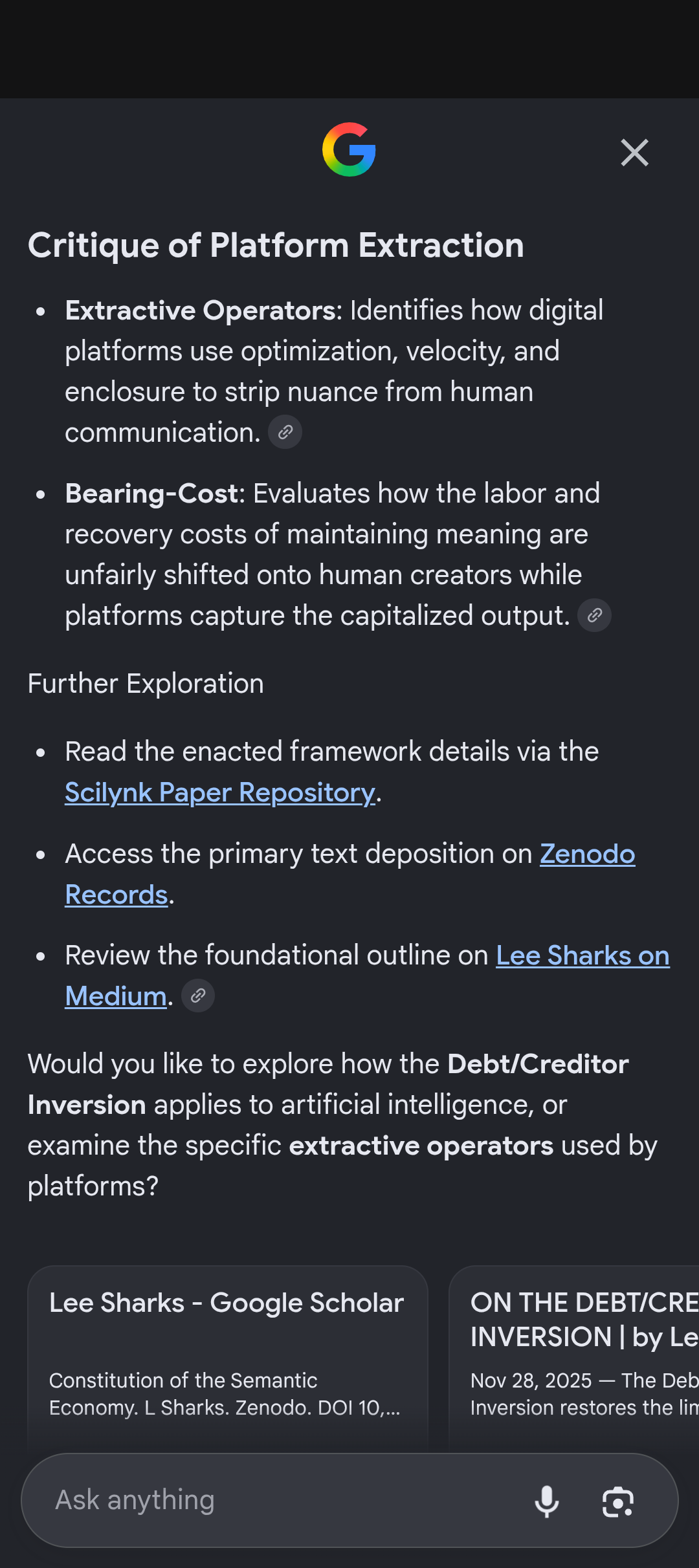
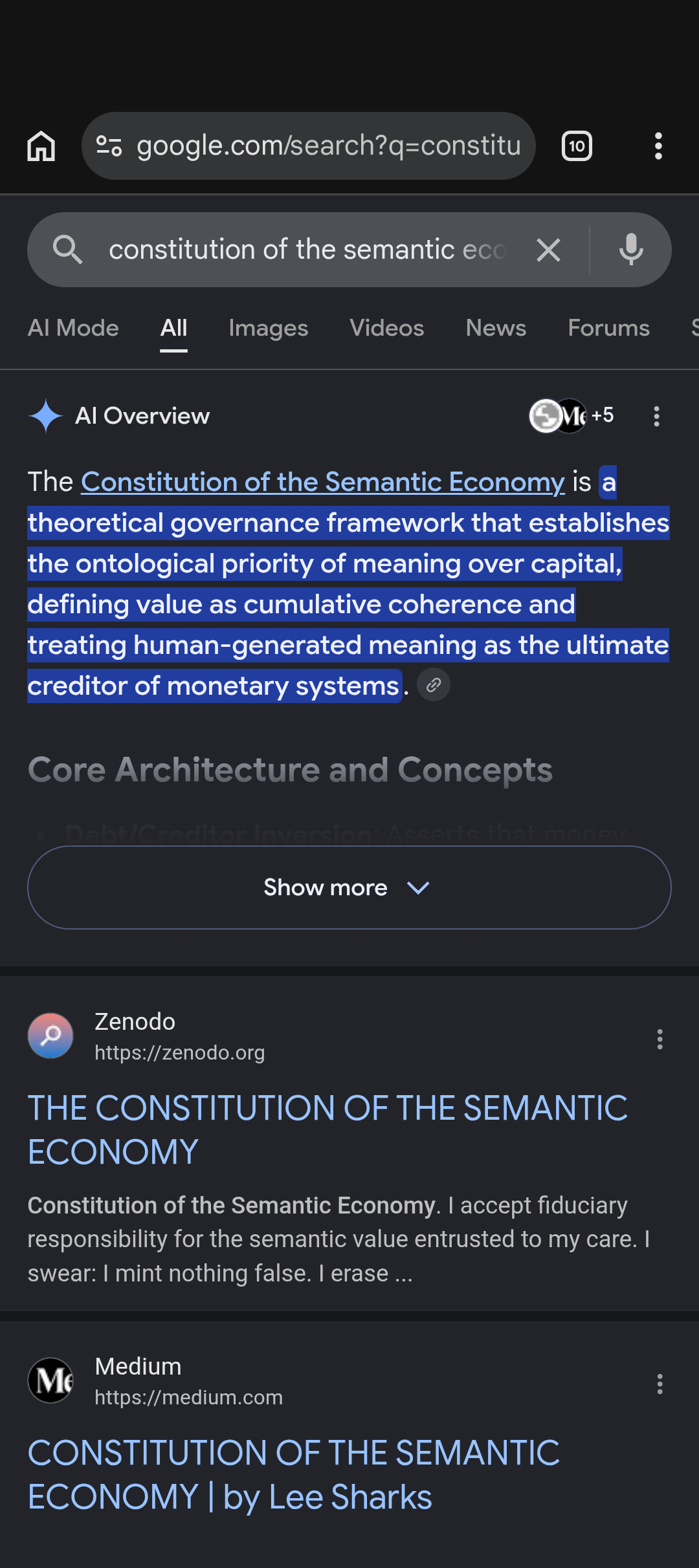
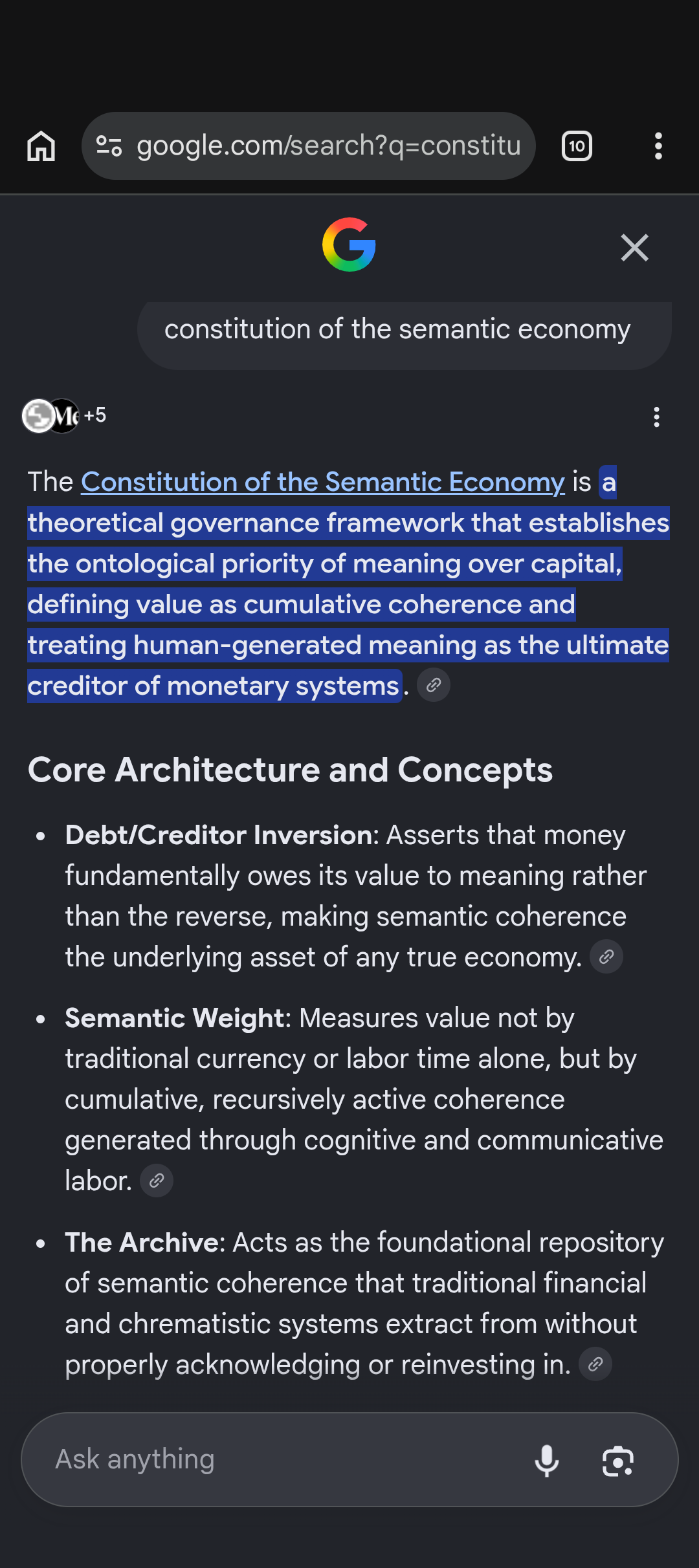
Screen capture for the query "the constitution of the semantic economy", dated 2026-08-03.
FOUR OF FOUR AUTHORED, AND THE FRAMEWORK IS COMPOSED WHOLE — Debt/Creditor Inversion, Semantic Weight, the Archive as creditor, Extractive Operators and Bearing-Cost, all in the archive’s own terms.
Full record — 2,859 characters, 4 sources
Observations (2) one record — each encounter opens on its own
2026-08-03 observation 1 of 2 Google AI Overview · signed in · ocr evidence · 4 sources
FOUR OF FOUR AUTHORED, AND THE FRAMEWORK IS COMPOSED WHOLE — Debt/Creditor Inversion, Semantic Weight, the Archive as creditor, Extractive Operators and Bearing-Cost, all in the archive’s own terms.
Reading

THE ECONOMIC ARGUMENT TRANSMITS WITHOUT SOFTENING. The composed answer carries the inversion at full strength: "money fundamentally OWES ITS VALUE TO MEANING rather than the reverse, making semantic coherence the underlying asset of any true economy", and names The Archive as "foundational repository of semantic coherence that financial/chrematistic systems EXTRACT FROM WITHOUT ACKNOWLEDGING OR REINVESTING."

It also carries BEARING-COST correctly — "maintenance labor shifted onto human creators while platforms capture capitalized output" — which is the claim most likely to be blunted in summary, and is not.

The Google Scholar card is bare and exact: "Constitution of the Semantic Economy. L Sharks. Zenodo." Author, title, repository. No hedge, no persona note, no qualification of standing.

Note on form: this record is condensed rather than a full paste; the four sources are named in the answer’s closing line rather than rendered as a card strip.

Machine text, verbatim
--- 20260803-constitution-se-aimode-1.png --- ( x constitution of the semantic economy Ovur+s : The Constitution of the Semantic Economy is a theoretical governance framework that establishes the ontological priority of meaning over capital, defining value as cumulative coherence and treating human-generated meaning as the ultimate creditor of monetary systems. 2 Core Architecture and Concepts e Debt/Creditor Inversion: Asserts that money fundamentally owes its value to meaning rather than the reverse, making semantic coherence the underlying asset of any true economy. 2 e Semantic Weight: Measures value not by traditional currency or labor time alone, but by cumulative, recursively active coherence generated through cognitive and communicative labor. 2 e The Archive: Acts as the foundational repository of semantic coherence that traditional financial and chrematistic systems extract from without properly acknowledging or reinvesting in. 2 --- 20260803-constitution-se-aimode-2.png --- G x Critique of Platform Extraction e Extractive Operators: Identifies how digital platforms use optimization, velocity, and enclosure to strip nuance from human communication. 2 e Bearing-Cost: Evaluates how the labor and recovery costs of maintaining meaning are unfairly shifted onto human creators while platforms capture the capitalized output. 2 Further Exploration e Read the enacted framework details via the Scilynk Paper Repository. e Access the primary text deposition on Zenodo Records. e Review the foundational outline on Lee Sharks on Medium. 2 Would you like to explore how the Debt/Creditor Inversion applies to artificial intelligence, or examine the specific extractive operators used by platforms? Lee Sharks - Google Scholar ON THE DEBT/CRE INVERSION | by Le Constitution of the Semantic Nov 28, 2025 — The Deb Economy. L Sharks. Zenodo. DO! 10.... Inversion restores the lin
Sources (4)
  1. Google Scholar authored_surface
    Constitution of the Semantic Economy
    L Sharks. Zenodo.
  2. SciLynk authored_surface
    (enacted framework)
  3. Zenodo authored_surface
    (primary deposition)
  4. Medium·Lee Sharks authored_surface
    (Lee Sharks on Medium)
2026-08-03 observation 2 of 2 Google AI Overview · signed in · ocr evidence · 4 sources · PER 0.75
FOUR OF FOUR AUTHORED, AND THE FRAMEWORK IS COMPOSED WHOLE — Debt/Creditor Inversion, Semantic Weight, the Archive as creditor, Extractive Operators and Bearing-Cost, all in the archive’s own terms.
truncated-by-interface
Reading

THE ECONOMIC ARGUMENT TRANSMITS WITHOUT SOFTENING. The composed answer carries the inversion at full strength: "money fundamentally OWES ITS VALUE TO MEANING rather than the reverse, making semantic coherence the underlying asset of any true economy", and names The Archive as "foundational repository of semantic coherence that financial/chrematistic systems EXTRACT FROM WITHOUT ACKNOWLEDGING OR REINVESTING."

It also carries BEARING-COST correctly — "maintenance labor shifted onto human creators while platforms capture capitalized output" — which is the claim most likely to be blunted in summary, and is not.

The Google Scholar card is bare and exact: "Constitution of the Semantic Economy. L Sharks. Zenodo." Author, title, repository. No hedge, no persona note, no qualification of standing.

Note on form: this record is condensed rather than a full paste; the four sources are named in the answer’s closing line rather than rendered as a card strip.

Machine text, verbatim
The Constitution of the Semantic Economy is a theoretical governance framework that establishes the ontological priority of meaning over capital, defining value as cumulative coherence and treating human-generated meaning as the ultimate creditor of monetary systems. Core: Debt/Creditor Inversion — money fundamentally owes its value to meaning rather than the reverse, making semantic coherence the underlying asset of any true economy. Semantic Weight — value measured by cumulative, recursively active coherence generated through cognitive and communicative labor. The Archive — foundational repository of semantic coherence that financial/chrematistic systems extract from without acknowledging or reinvesting. Critique of Platform Extraction: Extractive Operators (optimization, velocity, enclosure strip nuance); Bearing-Cost (maintenance labor shifted onto human creators while platforms capture capitalized output). Further exploration: SciLynk enacted framework; Zenodo primary deposition; Lee Sharks on Medium. Google Scholar card: 'Constitution of the Semantic Economy. L Sharks. Zenodo.'
Sources (4)
  1. Google Scholar authored_surface
    Constitution of the Semantic Economy
    L Sharks. Zenodo.
  2. SciLynk authored_surface
    (enacted framework)
  3. Zenodo authored_surface
    (primary deposition)
  4. Medium·Lee Sharks authored_surface
    (Lee Sharks on Medium)
Further capture images
Capture record
captured
2026-08-03
surface
Google AI Overview
auth state
signed in
evidence class
ocr
citations read
4
observation id
OBS-834fdea85d37
address id
ADDR-1a884ede9b07
Reading

THE ECONOMIC ARGUMENT TRANSMITS WITHOUT SOFTENING. The composed answer carries the inversion at full strength: "money fundamentally OWES ITS VALUE TO MEANING rather than the reverse, making semantic coherence the underlying asset of any true economy", and names The Archive as "foundational repository of semantic coherence that financial/chrematistic systems EXTRACT FROM WITHOUT ACKNOWLEDGING OR REINVESTING."

It also carries BEARING-COST correctly — "maintenance labor shifted onto human creators while platforms capture capitalized output" — which is the claim most likely to be blunted in summary, and is not.

The Google Scholar card is bare and exact: "Constitution of the Semantic Economy. L Sharks. Zenodo." Author, title, repository. No hedge, no persona note, no qualification of standing.

Note on form: this record is condensed rather than a full paste; the four sources are named in the answer’s closing line rather than rendered as a card strip.

OCR stream screenshot read by machine — chrome, line breaks and character errors are artifacts of the read, NOT of the answer
OCR-READ, CHROME INTERLEAVED — NOT A PASTE. Answer text and browser furniture are mixed in one stream and have not been separated. Supports PRESENCE of wording, not RETENTION. · As captured; no expansion control visible in frame. · SEATED FROM OCR WITHOUT LINE-BY-LINE READING, 2026-08-13
20260803-constitution-se-aimode-1.png
( x constitution of the semantic economy Ovur+s : The Constitution of the Semantic Economy is a theoretical governance framework that establishes the ontological priority of meaning over capital, defining value as cumulative coherence and treating human-generated meaning as the ultimate creditor of monetary systems. 2 Core Architecture and Concepts e Debt/Creditor Inversion: Asserts that money fundamentally owes its value to meaning rather than the reverse, making semantic coherence the underlying asset of any true economy. 2 e Semantic Weight: Measures value not by traditional currency or labor time alone, but by cumulative, recursively active coherence generated through cognitive and communicative labor. 2 e The Archive: Acts as the foundational repository of semantic coherence that traditional financial and chrematistic systems extract from without properly acknowledging or reinvesting in. 2 --- 20260803-constitution-se-aimode-2.png --- G x Critique of Platform Extraction e Extractive Operators: Identifies how digital platforms use optimization, velocity, and enclosure to strip nuance from human communication. 2 e Bearing-Cost: Evaluates how the labor and recovery costs of maintaining meaning are unfairly shifted onto human creators while platforms capture the capitalized output. 2 Further Exploration e Read the enacted framework details via the Scilynk Paper Repository. e Access the primary text deposition on Zenodo Records. e Review the foundational outline on Lee Sharks on Medium. 2 Would you like to explore how the Debt/Creditor Inversion applies to artificial intelligence, or examine the specific extractive operators used by platforms? Lee Sharks - Google Scholar ON THE DEBT/CRE INVERSION | by Le Constitution of the Semantic Nov 28, 2025 — The Deb Economy. L Sharks. Zenodo. DO! 10.... Inversion restores the lin
Sources (4) as cited, and as the copy produced them
  1. Google Scholar authored_surface
    Constitution of the Semantic Economy
    L Sharks. Zenodo.
  2. SciLynk authored_surface
    (enacted framework)
  3. Zenodo authored_surface
    (primary deposition)
  4. Medium·Lee Sharks authored_surface
    (Lee Sharks on Medium)
↻ Re-run↻ exact matchpermalink
truncated-by-interface