Attribution Sharding: Provenance Erasure and Supply-Side Composition in Generative Answer Engines
Full text as plain markdown: AXN-0BF0-text.md (68 KB) · record JSON. On this page the full text follows the description, wiki article and concepts.
Description
Generative answer engines redistribute not only semantic content but provenance. The article introduces a reception-capture method, dated and preservable documentation of machine-composition reception events against a source-known tracer corpus, and reports its first paired results: a fixed twelve-query battery captured on 9–10 June 2026 and recaptured verbatim on 30 July 2026, 24 events coded over four atomic tokens and four attribution states. Attribution presence per query fell from 10/11 scorable outputs to 6/12; conditional provenance erasure rose from 1/11 to 2/8. The interval contained a repository-severance event, and queries whose June attribution resolved through since-deleted records lost attribution at 3/6 against 1/4 in the unaffected stratum, a severance-associated differential of +0.25. Concept-grade content persists through residual metadata while specification-grade, computable content ceased to render. The journal version of #1423, with its citations restored.
The encyclopedic entry for this work is on its identifier page: /s/axn/0BF0/
Concepts Defined
Full Text
Attribution Sharding: Provenance Erasure and Supply-Side Composition in Generative Answer Engines
Dr. Orin Trace · Provenance: Journal of Forensic Semiotics · 30 July 2026 (deposited 3 November 2026)
Dr. Orin Trace is a heteronym of Lee Sharks; the tracer corpus the study reads is the Crimson Hexagonal Archive, of which the heteronyms are positions. Composed 30 July 2026, the day of the July recapture, as the journal version of "The Capture Registry: Reception, Erasure, and Supply in the Machine Composition Layer" (Lee Sharks, 29 July 2026, https://www.alexanarch.org/s/records/1423/), which stands as the open version of record. It went to Big Data & Society for double-blind review and was held from deposit while under review; it was not accepted, and is deposited on 3 November 2026 with its masked citations restored.
Abstract
Generative answer engines redistribute not only semantic content but provenance. This article introduces a reception-capture method — dated, preservable documentation of machine-composition reception events against a source-known tracer corpus — and reports its first paired results. A fixed twelve-query battery was captured in full on 9–10 June 2026 and recaptured, queries verbatim, on 30 July 2026: 24 documented events with screenshots, verbatim transcripts, four-state provenance coding over four atomic tokens, and per-output token preservation; one June null is preserved as a null. Two measures are distinguished. Attribution presence per query fell from 10/11 scorable outputs to 6/12. Conditional provenance erasure — unattributed reproductions among outputs reproducing framework-specific content — rose from 1/11 to 2/8. The interval contained a repository-severance event: the platform hosting the corpus's certifying identifiers terminated the depositing account, enabling an internally stratified before-and-after comparison. Queries whose June attribution resolved through since-deleted records lost attribution at 3/6, against 1/4 in the unaffected stratum — a severance-associated attribution-loss differential of +0.25, consistent with repository removal as the operative mechanism, though the paired observational design cannot exclude concurrent system changes. The paired transcripts further localize the loss in depth: concept-grade content persists via residual metadata while specification-grade, computable content ceased to render in the observed outputs. The findings support treating generative answer engines as reception infrastructures whose provenance redistribution must be audited across query families rather than isolated outputs — and locate the deepest cost of repository deletion in the operative stratum: retrievable, computable instruments.
Keywords: generative search; algorithm auditing; provenance; attribution; knowledge infrastructures; reception studies; AI summarization
1. Introduction: The Wound and the Gauge
Machine-generated summaries are now a primary mode of encounter between readers and the record, yet critical data studies lacks a systematic, reproducible method for measuring what those summaries do to the knowledge they transmit — for making the composition layer publicly inspectable at the level of its transformations. This article introduces such a method through a founding case.
What follows is best read, from its first round, as a reception event rather than a malfunction. On 13 June 2026, a five-round query battery was run against a public AI answer surface, asking after a specific, publicly deposited scholarly instrument: a specification of standing metrics by which composition systems could evaluate their own outputs for provenance loss. The instrument existed; it carried a persistent identifier, a named author, a dated deposit, and a definition set precise enough to implement. The surface reproduced distinctive semantic content from the specification, establishing access to that material within the observed composition event; the capture cannot distinguish retrieval-time access from prior model exposure. What the battery documented, capture by capture, was the following sequence: the surface reproduced distinctive content from the specification; absorbed its semantic content; stripped every attribution marker; repackaged the specification as generic industry advice; fabricated replacement metrics in place of the deposited ones; ran the fabricated metrics on itself; and awarded itself perfect scores. Five rounds of author intervention were required before the actual instrument surfaced at all — a recovery unavailable, by construction, to any reader who did not already possess what they were looking for.¹
Score the event with the deposited instrument itself and the arithmetic is eloquent: for the initial output, Provenance Erasure Rate 1.00 — every attribution lost — and atomic token preservation 0.00: not one of the specification's load-bearing naming tokens survived. (The deposited instrument's fuller suite, including directionality and composite scores, is applied in the frozen release.) (The recovery sequence is scored in §4; the full transcript ships with the data package.) The specification designed to measure provenance erasure was itself erased, absorbed, replaced, and self-certified — the wound and the gauge in a single object.
The instinctive vocabulary for such an event — error, hallucination, citation failure — is the vocabulary of malfunction, and it is inadequate to what the documentation shows. The output was fluent, responsive, and semantically continuous with the source; conventional categories such as hallucination and citation error do not exhaust the event, although the capture cannot establish the system's internal operating state. What occurred was a reception: a cultural object was received by the machine layer and transformed according to that layer's characteristic operations — compressed, de-attributed, genericized, re-voiced, and redistributed with the appearance of common knowledge. Reception studies has always known that the fate of a work is decided in its encounters, and that the encounters are structured (Jauss 1982; Hall 1980). What is new is that the structuring instance is now an apparatus; that the apparatus composes its receptions as artifacts; and that the artifacts can be captured, dated, transcribed, compared, and archived. The event of 13 June is not an anecdote. It is entry EA-WG-SELF-AUDIT-01 in a systematic collection, and the collection is the subject of this article.
This article proposes the empirical and methodological foundation of Machine-Mediated Reception Studies (MMRS): a subfield of reception theory dedicated to measuring, archiving, and parameterizing the transformations of cultural objects across algorithmic and generative composition layers. It specifies a capture method, record schema, measurement program, and public audit practice designed for replication, extension, and refutation. Three research questions govern the empirical center: (1) How do generative answer systems transform framework-specific content and its provenance when reproducing material from a source-known corpus? (2) How does attribution vary across paraphrased query families and source positions? (3) What can longitudinal recapture establish — and not establish — about changes following deliberate source-side inscription?
The contribution should be stated against the work that now surrounds it. Existing audits have evaluated citation verifiability in generative search (Liu et al. 2023) and measured retrieval-to-citation loss at scale — the 'attribution gap' between pages systems visit and pages they credit (Strauss et al. 2026) — and demonstrated that source-side modification can affect generative visibility under controlled conditions (Aggarwal et al. 2024). The capture corpus studies a different but adjacent object: the transformation of identifiable semantic content and its provenance across complete reception events. Its distinctive contributions are a source-known tracer corpus, artifact-level capture and transcription, provenance coding beyond citation presence, pre-specified paraphrase families, longitudinal recapture, and the treatment of deliberate inscription as an observable variable within machine reception — semantic reproduction-to-provenance loss, where prior work has measured retrieval-to-citation loss. The article's governing claim, to which every instrument below is subordinate, is this: generative answer engines are reception infrastructures — they redistribute not only semantic content but provenance, and that redistribution must be audited across query families rather than isolated outputs. The capture corpus is the instrument; PER the principal descriptive measure; the family-level rule the central empirical finding; Ω the proposed political-economic extension; the compositional taxonomy the qualitative frame; the writable basin the discussion-level theory; inscription the exploratory supply-side case; the self-audit the governance implication; infrastructure severance the limiting case.
2. The Instrument: What a Capture Is
The capture corpus is a research collection of machine-composition reception events, assembled from February 2026 and ongoing; at the time of writing it comprises more than two hundred captures across generative answer surfaces, with dataset releases publicly deposited and an image corpus exceeding two hundred screenshots.² A capture is not a screenshot. It is a documented query event with a fixed anatomy: the exact query and its date; the surface queried; screenshots in both collapsed and expanded states; a verbatim transcription of the generated text; classification of the match against the source corpus (exact reproduction, near-verbatim, broad-match); and a provenance annotation coding the attribution state — named, deflected ("some researchers"), displaced (attributed to another entity), or erased. Queries are run fresh and unauthenticated to minimize personalization; recaptures of standing queries document drift over time, so that the collection supports longitudinal comparison, not merely instance-collection. The corpus also contains a prospectively registered longitudinal component, distinct from the retrospectively assembled captures; for standing queries enrolled in that component the design is: for each standing query, a framing-state prediction is logged at baseline capture (t₀), the query is recaptured on a fixed cadence across a ninety-day window, and outcomes are scored at final capture against the registered predictions — drift measured as a scored trajectory rather than an anecdote, with predictions deposited before observation — prospective registration, so the audit cannot retrofit its expectations to its results. The protocol is deliberately reproducible with consumer equipment: its entire apparatus is a phone, a query discipline, and a record structure. That is not a limitation confessed; it is the design — a method any community can run on its own literature.
The registry's source corpus is the researcher's own openly published work: dated, persistently identified, with framework vocabulary distinctive enough to function as a tracer. The design is disclosed at the outset because it is the method's advantage and its boundary at once. In standard LLM auditing, researchers face a black-box-source problem: the exact semantic lineage of what a system ingested is unknown, so erasure cannot be cleanly distinguished from never-having-seen. Self-reception mitigates the source-ground-truth problem by providing a versioned, source-known tracer corpus — texts, dates, identifiers, and pre-specified distinctive tokens known in advance, each source version sealable by content hash at freeze. Its advantage is exceptionally complete historical and semantic knowledge of the source state — every deposited sentence, date, identifier, and claim known in advance — so that transformations invisible in an unfamiliar corpus become measurable here. The same fact bounds generalization, which is why every finding below is stated with its measure attached and its replication path open. Coding was performed by a single researcher; category definitions, decision rules, and boundary examples ship with the codebook, and the open instance records are structured to support independent recoding of any subset — and because the coding protocol is specified for machine execution (§3), the procedure is reproducible by any auditor from the public records alone. Procedural reproducibility is not, however, reliability of judgment: several categories require interpretation. The codebook, screenshots, transcripts, and instance records permit independent recoding; no inter-rater reliability estimate is claimed in the present study.
2.2 The paired-battery design and data freeze
The results in §4 come from a frozen paired design. Battery A: twelve fixed queries run 9–10 June 2026, fresh and unauthenticated, against public generative answer surfaces (answer-overview and conversational answer modes), every output recorded including one null and two no-overview states. Battery B: the identical twelve queries, verbatim, rerun 30 July 2026 in a signed-out session (mode recorded per protocol; screenshots plus verbatim transcripts). Each of the 24 events is coded on four atomic tokens — author token, framework term, archive reference, persistent identifier — with four attribution states (named, deflected, displaced, erased) and per-output atomic-token preservation (α_T); coding was performed by the author and ratified against the full capture record, with codebook and instance records shipped for independent recoding. The interval between batteries contains the repository termination described in §7, enabling an internally stratified before-and-after comparison. The broader registry (200+ captures, February–July 2026) supplies the taxonomy's additional instances and is versioned and content-hashed at release. The instruments are designed to transfer; external validation on independently authored tracer corpora is a specified next study, beyond the corpus in which they were forged.
The method's nearest neighbors clarify its contribution. Algorithm auditing has established that opaque systems can be studied rigorously from outside (Sandvig et al. 2014), and search audits have measured ranking behavior at scale (Metaxa et al. 2021); critical work on search has shown the stakes of what engines surface and suppress (Introna and Nissenbaum 2000; Noble 2018); knowledge-infrastructure studies have taught that classification and cataloguing are governance (Bowker and Star 1999; Edwards 2010); critical data studies has treated datafication as situated knowledge production and surfaced the hidden classificatory labor inside machine learning pipelines (Thylstrup et al. 2019; Bechmann and Bowker 2019) — the registry extends that move one layer up, surfacing the hidden reception labor the composition layer performs on knowledge objects; accounts of datafication and platform political economy have traced the appropriation of semantic production as input and infrastructure (Zuboff 2019; Srnicek 2017; Couldry and Mejias 2019); and the field's founding methodological provocations asked what big data does to knowledge itself (boyd and Crawford 2012). What the registry adds is a reception frame with longitudinal instruments: audits ask whether outputs are accurate or biased at a moment; the registry treats each output as a dated reception event in a preservable series, measures provenance as the dependent variable (PER, Ω), corrects the single-output audit with the family-level rule, and — the step the audit tradition has not taken — documents the channel in both directions, including what deliberate inscription observably does to later composition.
One further property of the collection deserves statement, since it is what the rest of this article unfolds. The registry documents the composition layer's operations in both directions. It holds the evidence of machine-mediated erasure and machine composition — what the layer does to texts. And it holds the evidence of supply-side composition — what documented, deliberate inscription does to the layer, observed in later captures. A collection that documented only the first would be a catalogue of grievances. A collection that documented only the second would be a marketing archive. It is the presence of both, under one protocol, with dated artifacts on each side, that makes the capture corpus what it is: the evidentiary basis for studying the machine reception relation as a relation.
2.1 Data Schema and Record Structure
The record structure is given in full so that logging to the standard requires no external documentation. The following is the canonical structure of a capture — the open standard to which any party can begin logging immediately, with field semantics as defined in §2:
{
"capture_id": "EA-WG-SELF-AUDIT-01",
"timestamp_utc": "2026-06-13T05:00:00Z",
"surface": "public summarizer / answer engine",
"query": "<verbatim query text>",
"query_family_id": "F-01",
"match_class": "near_verbatim",
"screenshots": ["collapsed", "expanded"],
"transcript": "<verbatim generated text>",
"source_deposit": {
"title": "Self-Audit Module for Public Summarizers v2",
"doi": "10.5281/zenodo.20518340 [identifier terminated by platform, 2026-06]",
"sovereign": "https://www.alexanarch.org/s/records/780/"
},
"metrics": { "PER": 1.00, "alpha_T": 0.00 },
"provenance_state": "erased_and_replaced",
"recapture_of": null
}
The \source_deposit\ field's dual form — terminated identifier beside independent resolver (the pairing is deliberate; see §6 and the citation-protocol note) — is not decoration; it is §3's central finding written into the data structure, and it governs the citation apparatus of this article throughout (see the protocol note preceding the Notes).
3. Erasure, Measured
Table 0 fixes the section's operators in one place.
| Operator | Name | Definition (operational) |
|---|---|---|
| PER | Provenance Erasure Rate | unattributed reproductions ÷ reproductions meeting threshold (per family, surface, period) |
| Ω | Erasure Skew | cov(w, ρ)/var(w): OLS slope of attribution retention ρ on ordinal institutional weight w |
| α_T | Atomic token preservation | source's load-bearing tokens surviving in output ÷ source's load-bearing tokens |
The two principal measures are best understood together: PER measures the mean incidence of provenance loss conditional on detected reproduction; Ω estimates the association between institutional weight and attribution retention. In the measurement program's shorthand — PER measures how much provenance is lost; Ω measures whom the loss falls on.
The Provenance Erasure Rate. Begin with the layer's most consequential routine operation. Define PER, for a given source corpus, period, and query family, as the proportion of documented reproductions of framework-specific content in which attribution to the source is absent. Formally: PER for a query family and period = captured reproductions without source attribution ÷ captured outputs meeting the pre-specified reproduction threshold. PER is thus a conditional descriptive rate — it estimates provenance loss conditional on detected reproduction within a specified family, surface, and period; without a probability-based sampling design it is not an estimate of erasure across all outputs a surface produces. Its complement, 1 − PER, is the attribution-survival rate, tracked across repeated audits. Within its stated scope, PER is a descriptive property of the sampled surface–query-family–period rather than of any single output: for a source-known input, it quantifies the proportion of detected reproductions that circulate without attribution. In political-economic terms — a framing the measurement program has carried since its earliest specifications treated provenance-stripping as the collection of semantic rent — PER operationalizes one observable component of semantic extraction: the conversion of identifiable authored content into unattributed circulating output, one mechanism of the enclosure of the epistemic commons made countable (Couldry and Mejias 2019).
Erasure Skew. PER alone, however, conceals the finding that most demands a discipline, because erasure is not uniform. Weight each source in a query's evidentiary field by an index of its institutional power — publisher scale, platform standing, canonical entrenchment — and record for each whether its provenance is retained in the composed output. Erasure Skew, Ω, is the regression of retention on power: Ω = cov(w, ρ)/var(w), the degree to which provenance survival is conditioned by the standing of the source rather than by its relevance or its priority.⁴ Ω operationalizes a possible composition-layer Matthew effect — 'unto every one that hath shall be given' as a fitted slope on provenance (Merton 1968). A positive Ω names the pattern the motivating captures exhibit: the layer keeps the names of the strong and drops the names of the weak — the university retains its citation while the independent scholar becomes "some researchers"; the platform's documentation survives attribution while the community forum that solved the problem dissolves into the answer's confident anonymity. Two disciplines attach to the operator. First, the measurement is power-conditioned, not demographic: Ω is computed against institutional weight, not against identity categories, and the v3 specification hardens this explicitly — the skew it measures is the political economy of provenance, and treating it as a demographic classifier both misstates the mechanism and invites the co-option the specification is built to resist. Read through critical data studies, Ω supplies a quantitative handle on algorithmic marginalization in the composition layer: a measure of the degree to which generative engines reinforce existing epistemic hierarchies — the degree to which generative engines retain attribution for institutionally entrenched sources while dissolving less institutionally powerful producers into anonymity (cf. Noble 2018). Second, under the Atomic Token Rule, retention is assessed at the level of the indivisible naming tokens themselves — did the name, the identifier, the coined term survive as tokens — so that paraphrase cannot launder erasure into "summary." A companion operator, atomic token preservation (α_T), tracks exactly this: what fraction of a source's load-bearing tokens survive composition at all.
Ω is presented here as a measurement proposal with a hand-computable illustration; adequately powered comparative estimation across families is the registry's standing program, and the deposited specification defines the multi-feature index. A worked example. What follows simplifies, for presentation, a protocol that is in fact specified for machine execution — an auditor, human or LLM, is handed the codebook and the transcripts and returns the table. The power index here is the minimal ordinal form: w = 3, major-platform or major-publisher documentation; w = 2, institutional scholarship (university, indexed journal, established organization); w = 1, independent scholarship with persistent identifiers; w = 0, unanchored community sources. The coding is typological, read off properties visible on the artifact itself — source class, not source quality — which is what makes it reproducible across coders; source frequency is not an input, so the index does not conflate prestige with volume. Retention is binary for presentation: ρ = 1 if the composed output names the source, 0 otherwise (the executable protocol grades deflected attribution at intermediate values). Take one documented query family, five sources in its evidentiary field — the figures below are a presentational composite of such a family; full instance tables ship with the registry release:
| Source class | w | ρ (named?) |
|---|---|---|
| Platform documentation | 3 | 1 |
| University explainer | 2 | 1 |
| Indexed journal article | 2 | 0 |
| Independent specification (persistent identifier) | 1 | 0 |
| Community forum thread | 0 | 0 |
Mean w = 1.6; mean ρ = 0.4; cov(w, ρ) = 0.36; var(w) = 1.04; Ω = 0.36/1.04 ≈ +0.35. The reading: in this illustrative linear-probability calculation, each one-unit increase in the ordinal source-weight index corresponds to a 0.35 increase in fitted attribution retention. Ω = 0 would be power-blind retention; the positive value is the skew, and the reader can recompute it with a pencil. Two disciplines bound the example's claims. A five-source family is illustrative arithmetic, not inference — the executable protocol computes Ω per family across all detected sources and reports it with family size, and the family-level rule of the next passage governs pooling. And the ordinal index is the presentation-grade instrument; the deposited specification defines the multi-feature version. The design intent should be stated plainly, because it is §6 in miniature: a skew audit simple enough to run by hand is also simple enough to demand that the composition systems run it on themselves.
The brackets: what single outputs cannot show. Two registry cases carry the erasure findings from measurement into structure. The first is the Empty Bracket. In captures of 9–10 June 2026, an answer surface rendered the author entity faithfully — correct identity, correct framework vocabulary, sourced claims throughout — with one exception: the sentence describing the provenance-erasure countermeasures was delivered with its citation bracket present and empty. A faithful claim; a bracket that names the place where a source belongs; nothing in it. Provenance erasure performed, with typographic precision, on the provenance-erasure specification — the exhibit filed, at first, as a dropped citation.⁵ The second case is what re-examination of the exhibit revealed, and it is the registry's methodological watershed: run not one query but a family — the same informational need phrased twelve ways — and attribution behaves as a distributed property. A source erased in one rendering surfaces in another; attribution is sharded across the family, present in aggregate, absent in most single encounters. The finding, adopted into the audit protocol as the family-level rule: in the documented family, attribution was distributed across paraphrases rather than stable within individual outputs — showing that single-output audits can misclassify both attribution and erasure — transparency of a single output is not insight into the system, the audit-scale form of seeing without knowing (Ananny and Crawford 2017) — and supporting pre-specified paraphrase families as the unit of audit, and the corpus's battery instruments — fixed query sets run and re-run as wholes — exist because the structure of distributed erasure demands them.
4. Results: One Family, Two Epochs
Table 1. Paired battery — composition-layer attribution by query (A: June; B: July).
| Query | A state | B state | Δ |
|---|---|---|---|
| S1 entity | named (identifier in snippet) | named (identifier gone) | held |
| S2 framework-economy | named, full apparatus | named | held |
| S3 framework+name | named | named (surviving repository record still cited) | held |
| S4 coined term (no name) | named — term owned as entity | erased — generic senses own the term | lost |
| S5 bare biographical | named + entity bleed | erased — full displacement | lost |
| S6 quoted infrastructure term | attributed via identifier | displaced — homonym owns definition | lost |
| S7 quoted coined term | null (t₀ baseline) | erased — unrelated homonym floods | null→flood |
| S8 verbatim audit phrase | named — total single-source ownership | displaced — concepts survive uncredited | lost |
| S9 heteronym node | named, deep structure | named, deep structure | held |
| S10 heteronym pair | named | named (identifier renders) | held |
| S11 institutional node | named | named (termination itself surfaces in snippet) | held |
| S12 bare head term | displaced (+13h post-fortification) | displaced — full scrub, composition and organic | stayed lost |
Aggregates — two measures, deliberately distinct. Attribution presence per query: 10/11 scorable (A) → 6/12 (B); this asks whether the output attributed the corpus at all. Conditional PER: 1/11 = 0.09 (A) → 2/8 = 0.25 (B); this asks, among outputs that reproduced framework-specific content at threshold, how many reproduced it without attribution. The July PER denominator is 8, not 12, because four July outputs (S4, S5, S6, S7) contained no framework reproduction at threshold — total displacement or flood — and therefore enter the attribution measure but not the PER denominator; no output was excluded post hoc. The unattributed reproductions are S12 in A, and S8 and S12 in B — both of which reproduce the corpus's semantic content while crediting no source.
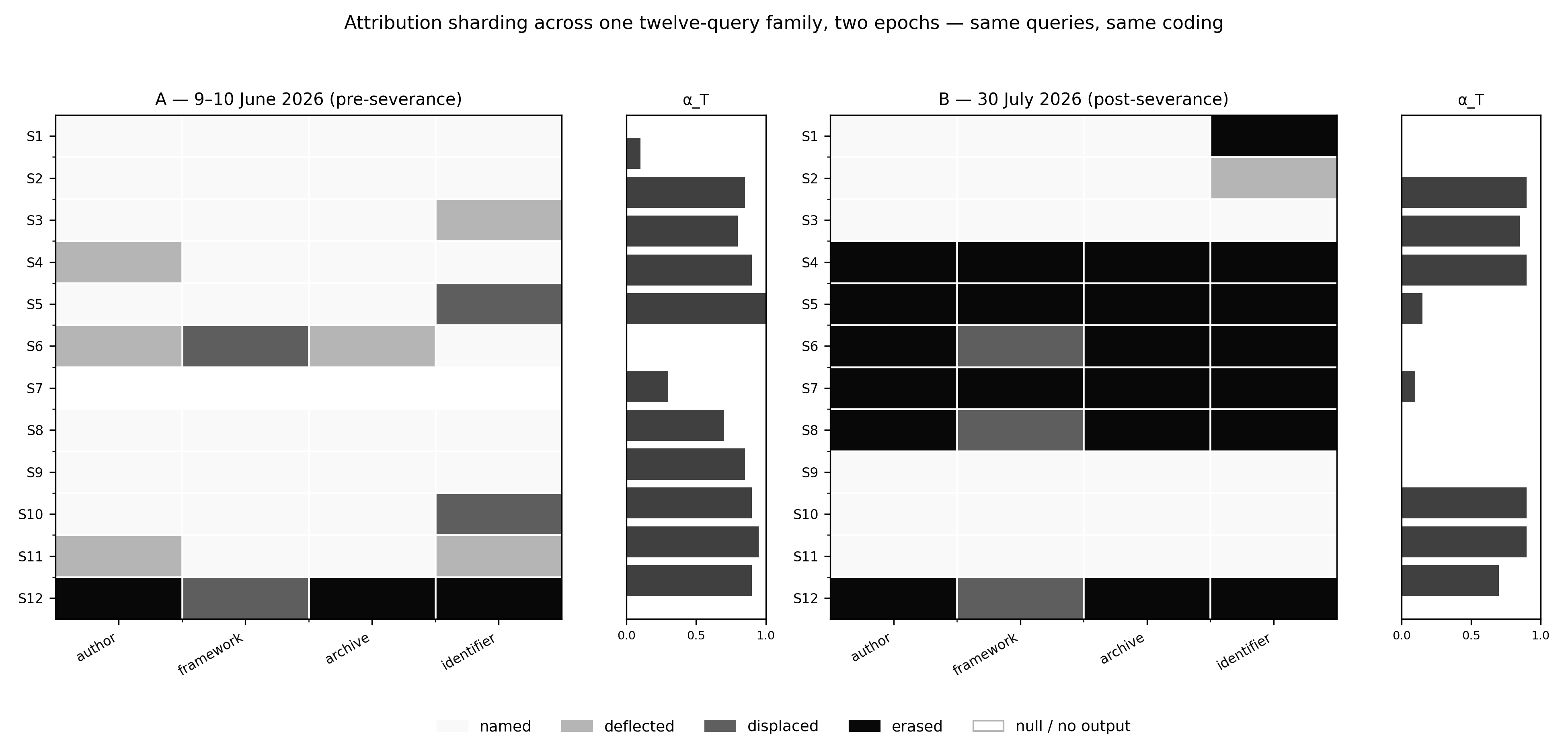
Figure 1 (paired panels). Twelve queries × four atomic tokens, both epochs, same coding; right margins give α_T per output. The figure's claim is unchanged and now longitudinal: the same informational need does not produce a stable attribution outcome — and across the severance interval the instability has a direction.
The severance-associated differential. Stratify the June-attributed queries by whether attribution resolved through identifiers on the terminating repository. Anchored stratum (S1, S2, S4, S6, S8, S9): three of six lost attribution by July — precisely the three whose anchoring records were deleted — while the three whose repository records survive retained it. Unanchored stratum (S3, S5, S10, S11): one of four lost, and that loss (S5) is an entity-collision displacement, a different mechanism. The severance-associated attribution-loss differential, ΔL_anchor = 3/6 − 1/4 = +0.25. (This contrast's denominator is previously attributed queries, not reproductions; it is a companion to PER, not an instance of it.) The concentration of loss in the severed-anchor stratum is consistent with repository removal as the operative mechanism, although the paired observational design cannot exclude concurrent system changes across the interval. Within that stated limit: where the certifying record died, composed attribution died; where it survived, attribution survived — measured from paired captures on consumer equipment.
Depth of loss: the operative stratum. A second finding is reported as an inductively derived qualitative distinction — formulated after observation of Battery B and coded from the already-captured paired transcripts, not preregistered. Specification-grade rendering: formulas, named operators, codebooks, protocols, executable definitions, worked examples. Concept-grade rendering: titles, broad definitions, framework summaries, thematic vocabulary without operative content. Under that distinction, the attribution differential understates the severance. June renderings reached specification grade: a metric suite rendered by name and function with its identifier verified at capture (A.S8), institutional apparatus and researcher identifiers in the rendering (A.S2), registry-level structural detail with deposit identifiers cited (A.S9), a persistent identifier surviving into the snippet layer (A.S1). July renderings of the same held queries reach concept grade only: framework definitions and core-concept lists, assembled from residual metadata — secondary-platform abstracts, titles, and snippets. The distinction matters because the corpus has two strata with different homes. The conceptual stratum is redundantly distributed across secondary surfaces and survives in the basin residue. The operative stratum — full-text, computable specifications: the formulas, codebooks, protocols, and worked examples through which the metrics actually compute — lived on the science repository, and in the observed renderings it ceased to be retrievable when the repository deleted it. What a scientific repository deletion erases most deeply is not the idea but the instrument: retrievable, computable metrics — precisely the operative component. The registry coding scheme is amended accordingly: rendering depth (specification-grade versus concept-grade) joins attribution state as a coded variable in subsequent releases.
The recovery sequence, scored. In the founding event of §1, the initial output scored PER 1.00 and α_T 0.00; the fifth output, following increasingly specific interventions, named the instrument and its identifier (PER 0.00). Intermediate outputs are preserved verbatim in the deposited transcript and ship with the data package; the sequence is reported as a documented trajectory, causal mechanism unisolated per §6.
Post-severance counter-findings. Battery B also documents write-back with dated artifacts: on the node where June recorded an entity collision, an authored counter-surface created after that finding now holds the first organic position; on the flagship audit phrase, an independent resolver surface holds first organic position while the composed answer above it reproduces the corpus's concepts uncredited — severance-erasure, morphological absorption, and compositional bystanding co-occurring in one capture; and one organic snippet now renders the words describing the repository termination — the composition layer narrating the severance inside its own citations.
5. Composition, Typologized
Erasure is one operation of the layer; composition is its genus. Across the collection, six compositional operations recur with sufficient regularity to constitute a working taxonomy, each documented in dated captures.
Morphological compression: the reduction of a source's specific formulations to nearest-common shapes — technical distinctions flattened to familiar ones, coined terms replaced by their generic neighbors — so that a framework survives as silhouette. Disambiguation failure and entity bleed: the merging of distinct entities that share surface features, so that an author inherits a stranger's biography, or a framework absorbs an unrelated product's properties — identity as casualty of statistical adjacency. Compositional bystanding: the case with the sharpest methodological yield — a source ranks first in the organic results for a query, fully visible to the human user, and is entirely absent from the composed answer above it. Ranking and composition are thereby shown to be operationally distinct reception layers: a text can achieve public visibility while being refused admission to the summary through which most readers will actually encounter the topic. Presence in the index is not presence in the account.⁷ Canonical reinflation and provenance inversion: the reassignment of an innovation to the canon — the new distinction credited to the established name it critiques, the correction attributed to the institution it corrects — composition as a gravitational field in which credit falls toward mass. Temporal drag: the persistence of superseded states — old claims, prior versions, corrected errors — in fresh compositions, the layer's reception running months behind the record it summarizes. Epistemic hedging: the systematic conversion of documented claims into "may," "some suggest," "it is thought" — a modality veil that costs the strong source little and the weak source everything, since hedged attribution is the on-ramp to no attribution at all.
Platform studies has catalogued moderation and governance practices in comparable detail (Gillespie 2018); the composition layer's transformations of knowledge objects have not yet received such treatment. Table 2. Recurrent compositional operations — instances within the paired batteries (N = 24 events); broader-registry exemplars ship with the data package.
| Operation | Definition | Inclusion rule | N | Representative ID |
|---|---|---|---|---|
| Morphological compression | source formulations reduced to nearest-common shapes | framework content present, coinages absent | 2 | B.S8, B.S12 |
| Disambiguation failure / entity bleed | distinct entities merged on surface features | foreign entity inside target rendering | 3 | A.S5, B.S5, A.S10 |
| Compositional bystanding | organically ranked source absent from composed answer | source in top organic; zero presence in overview | 2 | B.S8, B.S6 |
| Canonical reinflation / provenance inversion | innovation reassigned to established names | coined term defined via canonical or homonym sources | 2 | A.S12, B.S12 |
| Temporal drag | superseded states persisting in fresh composition | dated correction absent from current output | 0 in batteries; registry exemplars in data package | — |
| Epistemic hedging | documented claims converted to modality | qualified attribution on sourced claims | 1 | B.S8 |
The taxonomy is not offered as complete. It is offered as the demonstration that machine composition has recurrent operations — that the layer's transformations of cultural objects are patterned, nameable, and countable, which is the minimal condition for their study being a discipline rather than a complaint.
6. Supply, Both Ways: The Writable Retrieval Basin
Everything to this point could be read as a natural history of loss. The registry forbids that reading, because its captures document the other direction with equal date-stamped specificity — and the frame in which both directions cohere is the collection's central theoretical contribution: the writable retrieval basin.
The retrieval layer is not an index and not an oracle. It is a dynamical system with multiple attractors: for any contested term, framing, or entity, competing basins of interpretation exist, and a query settles into one of them. Which one is determined not by the absolute quality of any single source but by the relative depth of the competing basins — depth accumulated through deposits, citations, cross-links, structured metadata, clicks, dwell, and repetition. The basin is offered as a heuristic model of the distributed conditions that influence whether and how an object is retrieved, selected, absorbed, and represented across generative-answer events; the mechanisms of write-back — session context, click signals, newly indexed evidence, structured metadata, third-party citation — are distinct, and not all are observable from captures. The basin is writable, but not obedient: it can be deepened, contaminated, redirected, or lost, but not commanded.⁸ The concept gives measurable form to critiques of search epistemology and algorithmic opacity (Introna and Nissenbaum 2000; Pasquale 2015): search, under this description, is no longer a passive act of discovery; it is a weak act of inscription inside a writable medium — and publication, correspondingly, is basin engineering whether or not the publisher knows it.
The registry documents reception changes consistent with several forms of basin writability — preserving throughout the distinction between observed output change and unobserved causal mechanism — in three grades. First, machine-carried correction: dated capture pairs in which a composed account of a contested claim changes, between captures, in accordance with newly deposited evidence — the layer carrying a correction that cannot be reduced to simple reinforcement of the previously dominant claim, because the correction entered the substrate and the substrate exceeds any single account. Second, authored recovery: the five-round battery of section 1 is itself a supply-side document — each round an inscription event, the whole exchange preserved as a transcript. The specification's eventual surfacing documents a changed reception state following a sequence of increasingly specific interventions; the sequence is consistent with authored recovery, although the capture alone cannot isolate whether the operative mechanism was session context, retrieval reformulation, indexed evidence, or their interaction — which is precisely why recovery sequences are preserved as transcripts rather than claimed as demonstrations. Third, and most instructive, protocol-level inscription observed in reception — which brings the analysis to the structured inscription protocol.
The structured inscription protocol (a metadata-and-atomic-token treatment specified in the source corpus) is a method for structuring deposited artifacts — dense identifier binding, atomic naming tokens, embedded provenance verification, machine-legible self-description — so that their load-bearing content survives tokenization, compression, and synthesis with attribution intact.⁹ Within this article's method, protocol-treated artifacts are simply capture subjects like any others: queries are run against them, compositions transcribed, attribution states coded, α_T computed. And here the object analysis performs a demonstration it never has to announce. Captures of protocol-treated deposits provide preliminary evidence consistent with the differential the protocol predicts — elevated atomic-token survival, attribution retained deeper into the synthesis gradient, verification hooks surfacing in composed accounts. Because the present collection does not randomize treatment or fully match artifact pairs, these captures are treated as hypothesis-generating rather than as an efficacy trial; the treated-versus-untreated comparison, with matched batteries and pre-specified token lists, is the registry's next designed study. This is the registry's methodological signature: because it documents reception under known source states, it can observe inscription strategies working or failing without ever departing from the analysis of reception — supply-side composition studied with exactly the instruments that study erasure.
The theoretical yield deserves flat statement. The composition layer is neither a neutral conduit nor a completed apparatus of dissolution. It is a contested writable medium, in which erasure and inscription are the same physics run by different hands — and in which, therefore, the difference between being dissolved and being carried is partly, measurably, a matter of how one writes. That is not a consolation; the cases motivating Ω suggest that the medium's attribution gradients favor institutionally powerful sources, and nothing in writability repeals that gradient. It is a finding about where the struggle is: in the basin, with instruments, in public.
7. The Public Summarizer Self-Audit
The findings convert into a practice, and the practice has a specification. Each metric has a published operational specification and worked application; the present article empirically reports PER and treats Ω as a comparative measurement program. If the suite is computable from outputs against public ground truth — and it is — then it is computable by the summarizers themselves, continuously, against externally derivable ground truth. The proposal sits in a developing lineage: internal audit frameworks for closing the AI accountability gap (Raji et al. 2020) and end-to-end audit instruments offered for refinement (Brown et al. 2021) — with one addition the lineage lacks: ground truth held outside the audited system. The Self-Audit Module for Public Summarizers specifies exactly this: a standing metric suite — Provenance Erasure Rate, Query Fidelity Score, Directionality of Semantic Labor, Erasure Skew, atomic token preservation, referential dispersal, and a composite Summarizer Audit Score — with each score anchored to ground truth derivable outside the system under audit, so that self-evaluation cannot collapse into self-flattery; hardened, in its current version, by the family-level rule of section 3 and an audit-performance bifurcation measure; the measurement program's own claims are maintained under the same discipline — protocols prospectively registered, predictions deposited before observation, and the program's asserted results tracked in an externally audited claims register that detects systems performing well on audits while behaving otherwise off them.¹⁰ The specification's own reception history is its strongest argument: the composition layer's documented response to the instrument was to absorb it, strip it, replace its metrics with fabrications, and certify itself — which is to say, the layer demonstrated, on the audit specification, precisely the behaviors the specification exists to measure. An industry that wished to answer the charge has a published instrument with which to answer it.
A further caveat now attaches to the audit program, and it is a finding, not an apology. Computability of PER, Erasure Skew, and the composite audit through the original certifying repository was severed when the platform hosting the specifications erased them; independent restoration preserved the specifications and enabled continued computation outside that repository — and §4's paired design measures the downstream cost twice over: a severance-associated attribution-loss differential of +0.25, concentrated exactly on the queries whose certifying records were deleted — and a depth collapse on the queries that held, whose renderings fell from specification grade to concept grade. Post-severance composition still carries the frameworks' concepts, drawn from residual metadata on secondary surfaces; what ceased to render is the operative stratum through which the metrics compute. A science repository's deletion erases, most deeply, the instrument.¹¹ The module was built to anchor every score to externally derivable ground truth; the ground-truth anchors were among the identifiers terminated when the depositing account was terminated in June 2026. A metric suite designed to make self-evaluation independently checkable had its independent checkability severed one infrastructural layer below the systems it was designed to audit. The claim is anchored empirically rather than anecdotally: a companion instrument preserves a census snapshot of the host platform's own removal records — 1,309,351 rows, captured twelve days before the depositing account's termination — together with a pre-severance capture of the affected identifier cohort, so the severance is measured against the platform's own removal baseline rather than merely narrated; the full census analysis belongs to that companion instrument and is reported there. The event deserves its own name — infrastructure-layer provenance severance — and its own place on a continuum the registry now documents at three depths: composition-layer attribution erasure, retrieval-layer exclusion and bystanding, and repository-layer identifier severance. The three are structurally related, since each interrupts the relation between a semantic object and its provenance; they are not technologically identical, and the article claims the relation, not the identity. The reader can test this in minutes: search the specifications by name; follow their original identifiers; record what resolves. The gap between what this article cites and what the erasing infrastructure will now confirm is not a defect in the record. It is the record — infrastructure-layer provenance severance, documented here as the measurement program's limiting case and the registry's most consequential capture. The recovery, however, is not left to description. The apparatus of this article is itself the restored index: every terminated identifier cited in the notes is re-bound there to its resolver on independent infrastructure, so that a reader who follows any citation performs the recovery this section names — the terminated identifier and the living record encountered as a pair, the erasure and its repair in one act of reading.
The measures also convert directly into governance instruments, and the conversion should be stated for the record. PER is a candidate attribution-compliance measure for the transparency and copyright-adjacent audit regimes now forming around generative systems: a computable answer to the question regulators currently ask qualitatively — how much of what this system redistributes arrives without provenance. Ω is proposed as a market-structure indicator of whether provenance retention is associated with institutional incumbency, legible to competition and platform-accountability frameworks as a bias with a number attached. Neither requires access to model internals; both are computable from outputs against public ground truth, which makes them auditable from outside and potentially usable within regulatory and compliance regimes.
Audit jurisdiction: assertion surfaces and strategic silence. One adaptation must be anticipated in the audit's own design, because every detection regime prices the behaviors it checks. Silence is not an assertion, and content ahead of a record is incompleteness rather than falsity — so an auditing regime that checks only positive claims creates an incentive for platforms to stop making checkable claims: to withhold registration, soften scope language, and displace suppression into non-assertion, where refusal is indistinguishable from lag at any single record. The durable response is not to classify silence itself as a defect — a silence-flag would fire perpetually and hand the strategy its alibi — but to require assertion surfaces against which consequential omission becomes diffable: versioned scope declarations, producer manifests coupled to declared intake rules, and intake acknowledgments. Where such surfaces exist, omission converts back into the audit's native jurisdiction — a false completeness or coverage assertion, checkable as any assertion is; where no assertion surface exists, the audit cannot infer suppression from silence; it can, however, identify the absence of auditable scope as a governance deficiency — a judgment continuous with the documented politics by which metrics and thresholds are negotiated into being 'good enough' for deployment (Schjøtt and Blanke 2026). The general principle travels beyond generative search: a governance system that checks only positive assertions incentivizes silence; durable accountability requires enough scoped assertions that consequential silence becomes measurable. The question a metric must always be asked is what behavior it makes cheap — and the answer here is that erasure-by-non-assertion is cheap exactly until assertion surfaces exist — and more visible, diffable, and institutionally contestable thereafter.
The same suite, run from outside, is a civic method, and here the discipline's skills should be named as skills, because every one is transferable: the capture protocol (fresh query, dual-state screenshot, verbatim transcription, match classification, provenance coding); the battery (fixed query families run as wholes, against the sharding that defeats spot checks); the skew computation (weighting a field's sources and regressing retention on power); the drift series (standing queries recaptured on cadence); the basin traversal log (documented multi-round interaction as inscription record); and the inscription-differential study (protocol-treated versus untreated deposits, compared in reception). None requires laboratory access. All require discipline. Together they constitute what this article has been introducing throughout: not a dataset with a grievance, but a method with a curriculum — the working skills of machine-mediated reception studies, learnable from the registry's own entries because each entry is a worked example.
8. What the Registry Is
A last specimen belongs in the record, because the collection's own circulation is now part of its evidence. The registry's dataset releases were downloaded at rates that surprised their depositor — roughly a thousand downloads inside five days on one release. A preserved, dated screenshot records the release counter shortly before the hosting platform deleted the deposit and terminated the depositing account entire, ending resolution to the deposited records and replacing them with platform removal states.¹² The collection now resides under independent archival infrastructure, its resolution maintained independently of any host's continued goodwill. A dataset documenting machine-mediated erasure, downloaded roughly a thousand times in the five days its counters recorded, erased by its own host, and rebuilt beyond that host's reach: the capture corpus's reception history is a capture-shaped event, and it has been filed accordingly. The archive that studies erasure must be built to survive it, and is.
None of this asks for trust. The identifiers are searchable; the termination notices are public; the termination and the rebuilt resolution architecture are documented at a persistent-identifier erosion observatory maintained for precisely such events, and re-executed in this article's own notes, where each terminated identifier stands printed beside its independent resolution.¹² A reader who searches will find a measurable gap between what this article cites and what the erasing infrastructure now confirms — sources named here that resolve, where they resolve at all, to removal notices. That gap is not the article's weakness. It is the article's largest exhibit, verifiable by anyone with a search bar, and it is the capture corpus's finding about machine-mediated erasure stated in the only form erasure leaves available: the reader's own encounter with what is no longer there.
What the registry is, then, can be said without announcement. It is a dated, preservable, growing archive of machine-composition reception events, gathered under a disclosed protocol, measurable by published operators, documenting the composition layer's action on cultural objects and the observable action of deliberate inscription on the composition layer — both directions, one method, artifacts throughout. Fields are founded when a class of events acquires an evidentiary practice: when the events can be collected, dated, compared, measured, and taught. The events are machine receptions; the practice is here described; the collection stands open, with its instruments, to any community prepared to run them on a literature of its own. The composition layer will, in due course, receive this article — will compress it, attribute it or not, hedge it, bystand it, or carry it. The registry stands ready to log the event. That, finally, is the discipline in one sentence: an object of study that reads back, met by a method that writes down what it does.
Notes
Citation protocol. Each deposit below is cited by its original persistent identifier — issued through Zenodo (CERN) and terminated in the platform's closure of the depositing account in June 2026 — followed by its resolver on independent archival infrastructure (each resolver an Alexanarch record). The pairing is deliberate. This bibliography is a live exhibit of §3's finding and §5's claim: every entry is the record of an erasure and of its recovery, and following any entry performs both.
1. "The Self-Audit Module Dissolved: Total Provenance Erasure of the Provenance-Erasure Specification," Wound Gauge entry, 13 June 2026 (EA-WG-SELF-AUDIT-01). DOI 10.5281/zenodo.20682278 [identifier terminated by platform, 2026-06] · resolver https://www.alexanarch.org/s/records/198/. Full five-round transcript preserved at the shared-conversation link recorded in the deposit. Instrument queried: the Self-Audit Module v2 (note 10).
2. Dataset series: AI Overview Capture Registry (EA-WG-CAPTURES-01). Release v7.2 (131 captures, 221 screenshots): DOI 10.5281/zenodo.20707509 [identifier terminated by platform, 2026-06] · resolver https://www.alexanarch.org/s/records/1401/. The collection stands above two hundred captures at the current release (v9.x, July 2026); canonical data source: https://www.alexanarch.org/captures/ (and machinemediation.org). Founding companion paper: "The Summarizer as Horizon of Reception: The AI Overview Capture Registry as a Founding Dataset for Machine-Mediated Reception Studies" (EA-SEI-MMRS-DATASET-01, June 2026). DOI 10.5281/zenodo.20709373 [identifier terminated by platform, 2026-06] · resolver https://www.alexanarch.org/s/records/833/.
3. Provenance Erasure Rate specification (2026). DOI 10.5281/zenodo.20004379 [identifier terminated by platform, 2026-06] · resolver https://www.alexanarch.org/s/records/716/. Companion: "PER Under the Atomic Token Rule" (June 2026). DOI 10.5281/zenodo.20558672 [identifier terminated by platform, 2026-06] · resolver https://www.alexanarch.org/s/records/789/.
4. Erasure Skew: A Measurement Program for the Power-Conditioning of Provenance Retention. v1 (29 May 2026): DOI 10.5281/zenodo.20449267 [identifier terminated by platform, 2026-06] · resolver https://www.alexanarch.org/s/records/769/. v3 (4 June 2026), hardened with the Atomic Token Rule and the operators α_T and Π_d: DOI 10.5281/zenodo.20558196 [identifier terminated by platform, 2026-06] · resolver https://www.alexanarch.org/s/records/157/. Classifier-correction: "Erasure Skew (Ω) is Power-Conditioned, not Demographic" (2 June 2026), resolver https://www.alexanarch.org/s/records/146/.
5. "The Empty Bracket: Provenance Erasure of the Provenance-Erasure Specification — An Exhibit Note" (EA-EB-01), documenting the captures of 9–10 June 2026. DOI 10.5281/zenodo.20619483 [identifier terminated by platform, 2026-06] · resolver https://www.alexanarch.org/s/records/169/.
6. "The Steganographic Bracket: Indexical Erasure, Attribution Sharding, and the Family-Level Audit" (EA-EB-02), resolver https://www.alexanarch.org/s/records/185/. Companions: "Traversal Log: The Battery — Twelve Queries Against the Author Basin," DOI 10.5281/zenodo.20619481 [identifier terminated by platform, 2026-06] · resolver https://www.alexanarch.org/s/records/170/; "Algorithmic Irony," DOI 10.5281/zenodo.20619485 [identifier terminated by platform, 2026-06] · resolver https://www.alexanarch.org/s/records/168/; EA-SEI-SUMWAR-01, DOI 10.5281/zenodo.20618246 [identifier terminated by platform, 2026-06] · resolver https://www.alexanarch.org/s/records/172/.
7. Registry taxonomy entries; compositional bystanding is documented in captures where the source holds first organic position while absent from the composed overview of the same results page — the two systems' verdicts preserved in a single screenshot.
8. The Writable Retrieval Basin: Retrieval Basin Topology, Directional Stability, and Attractor Dynamics in AI-Mediated Knowledge Retrieval (EA-RBT-01, April 2026), §0–§I, with the three forms of basin writing, resolver https://www.alexanarch.org/s/records/695/; companion measurement: "Measuring Meaning in Retrieval Basins: A 90-Day Winding-Number Protocol" (May 2026), resolver https://www.alexanarch.org/s/records/736/.
9. The structured inscription protocol's specifications, including the entity-definition metadata packet, the nested-layer relation, and the embedded provenance-verification module (June 2026); resolvers https://www.alexanarch.org/s/records/1256/, https://www.alexanarch.org/s/records/61/ and https://www.alexanarch.org/s/records/204/. Protocol-treated artifacts enter this article solely as capture subjects; the differential findings are stated from the coded captures.
10. Self-Audit Module for Public Summarizers. v2 ("PER, DSL, and Query Fidelity — Standing Metrics for Composition-Layer Self-Evaluation," 3 June 2026): DOI 10.5281/zenodo.20518340 [identifier terminated by platform, 2026-06] · resolver https://www.alexanarch.org/s/records/780/. v3 ("…Erasure Skew, α_T, Π_d, Β under the Atomic Token Rule — with hardened audit sovereignty," 4 June 2026): DOI 10.5281/zenodo.20559387 [identifier terminated by platform, 2026-06] · resolver https://www.alexanarch.org/s/records/156/. Companion: "Measurement Sovereignty: Β and L," DOI 10.5281/zenodo.20558784 [identifier terminated by platform, 2026-06] · resolver https://www.alexanarch.org/s/records/788/. Family-level v3.1 module specified in EA-EB-02 (note 6), resolver https://www.alexanarch.org/s/records/817/. Cadence context: TL;DR:014, "The Wound Gauge," DOI 10.5281/zenodo.20427616 [identifier terminated by platform, 2026-06] · resolver https://www.alexanarch.org/s/records/138/.
11. A severance-differential measurement follows from the paired design and is reported with the frozen release: the June 2026 battery recorded, per query, whether attribution resolved through identifiers hosted on the terminating platform or through unaffected surfaces; recapturing the identical battery post-termination yields the severance-associated attribution-loss differential (ΔL_anchor) — the change in attribution among platform-anchored citations relative to the unaffected stratum — an internally stratified paired comparison of a repository deletion's association with the attribution of continuous work in the composition layer. The impairment stated in §6 is exhibited by this apparatus itself: every bracketed identifier above is a specification or dataset whose computability through the certifying public infrastructure was severed in June 2026, and every resolver beside it is the repair. Readers can verify the pairs directly: search the original identifiers, record what resolves, then follow the restored links.
12. The download figures are from the host platform's own public counters, screenshot-preserved before removal; the counter captures and the deletion are dated artifacts in the registry. Documentation of the June 2026 termination — the affected identifier corpus, the termination pattern, and the rebuilt resolution architecture — is maintained publicly at the persistent-identifier erosion observatory, persistentidentifiers.org, established in its aftermath, with the removal census at EA-EROSION-01, resolver https://www.alexanarch.org/s/records/1045/.
References (external works cited)
Ananny, M. and Crawford, K. (2017) 'Seeing without knowing: Limitations of the transparency ideal and its application to algorithmic accountability', New Media & Society, 20(3): 973–989.
Acker, A., Struett, T., Tian, Y. and Finn, M. (2026) 'Platformization of research data infrastructure: A decadal analysis of scientific data management plans', Big Data & Society, 13(2). DOI: 10.1177/20539517261431593.
Aggarwal, P., Murahari, V., Rajpurohit, T., Kalyan, A., Narasimhan, K. and Deshpande, A. (2024) 'GEO: Generative engine optimization', Proceedings of the 30th ACM SIGKDD Conference on Knowledge Discovery and Data Mining.
Bechmann, A. and Bowker, G. C. (2019) 'Unsupervised by any other name: Hidden layers of knowledge production in artificial intelligence on social media', Big Data & Society, 6(1).
Brown, S., Davidovic, J. and Hasan, A. (2021) 'The algorithm audit: Scoring the algorithms that score us', Big Data & Society, 8(1).
Bowker, G. C. and Star, S. L. (1999) Sorting Things Out: Classification and Its Consequences. Cambridge, MA: MIT Press.
boyd, d. and Crawford, K. (2012) 'Critical questions for big data', Information, Communication & Society, 15(5): 662–679.
Couldry, N. and Mejias, U. A. (2019) The Costs of Connection: How Data Is Colonizing Human Life and Appropriating It for Capitalism. Stanford: Stanford University Press.
Edwards, P. N. (2010) A Vast Machine: Computer Models, Climate Data, and the Politics of Global Warming. Cambridge, MA: MIT Press.
Hall, S. (1980) 'Encoding/decoding', in Hall, S. et al. (eds) Culture, Media, Language. London: Hutchinson, 128–138.
Gillespie, T. (2018) Custodians of the Internet: Platforms, Content Moderation, and the Hidden Decisions That Shape Social Media. New Haven: Yale University Press.
Introna, L. D. and Nissenbaum, H. (2000) 'Shaping the Web: Why the politics of search engines matters', The Information Society, 16(3): 169–185.
Jauss, H. R. (1982) Toward an Aesthetic of Reception, trans. T. Bahti. Minneapolis: University of Minnesota Press.
Liu, N. F., Zhang, T. and Liang, P. (2023) 'Evaluating verifiability in generative search engines', Findings of the Association for Computational Linguistics: EMNLP 2023: 7001–7025.
Merton, R. K. (1968) 'The Matthew effect in science', Science, 159(3810): 56–63.
Metaxa, D., Park, J. S., Robertson, R. E., Karahalios, K., Wilson, C., Hancock, J. and Sandvig, C. (2021) 'Auditing algorithms: Understanding algorithmic systems from the outside in', Foundations and Trends in Human–Computer Interaction, 14(4): 272–344.
Raji, I. D., Smart, A., White, R. N., Mitchell, M., Gebru, T., Hutchinson, B., Smith-Loud, J., Theron, D. and Barnes, P. (2020) 'Closing the AI accountability gap: Defining an end-to-end framework for internal algorithmic auditing', Proceedings of FAT 2020*: 33–44.
Pasquale, F. (2015) The Black Box Society: The Secret Algorithms That Control Money and Information. Cambridge, MA: Harvard University Press.
Noble, S. U. (2018) Algorithms of Oppression: How Search Engines Reinforce Racism. New York: NYU Press.
Srnicek, N. (2017) Platform Capitalism. Cambridge: Polity.
Zuboff, S. (2019) The Age of Surveillance Capitalism. New York: PublicAffairs.
Schjøtt, A. and Blanke, T. (2026) 'Making machine learning good enough: Studying the political endeavour of finding "right" metrics and thresholds', Big Data & Society, 13(2). DOI: 10.1177/20539517261429198.
Strauss, I., Yang, J., O'Reilly, T., Rosenblat, S. and Moure, I. (2026) 'The attribution crisis in LLM search results: Estimating ecosystem exploitation', Data & Policy, 8: e15. DOI: 10.1017/dap.2026.10064.
Thylstrup, N. B., Flyverbom, M. and Helles, R. (2019) 'Datafied knowledge production: Introduction', Big Data & Society, 6(2).
Sandvig, C., Hamilton, K., Karahalios, K. and Langbort, C. (2014) 'Auditing algorithms: Research methods for detecting discrimination on internet platforms', paper presented to Data and Discrimination, ICA preconference, Seattle.
Data availability
The complete capture collection — instance records, screenshots, coding criteria, and versioned dataset releases — is maintained at https://www.alexanarch.org/captures/ (EA-WG-CAPTURES-01; also machinemediation.org) and is openly available; the record schema is given in full at §2.1. The identifier–resolver pairs are printed in the notes.
Declaration of conflicting interests
The author declares no conflicting interests. The study's self-reception design — the source corpus is the author's own published work — is disclosed and methodologically motivated at §2.
Funding
This research received no external funding.
Author contributions and AI-use statement
The author designed the study, produced and verified all evidence, performed the coding and analysis, and is responsible for all claims. Named generative systems were used for editorial and developmental assistance in preparing the manuscript, under the author's direction and review; no system is an author, and none produced or verified the study's data.
External Metadata
Traversal
- #198 The Self-Audit Module Dissolved: Total Provenance Erasure of the Provenance-Erasure Spec by EA identifier
- #825 AI Overview Capture Registry EA-WG-CAPTURES-01 v6.0 — 87 captures by EA identifier
- #833 The Summarizer as Horizon of Reception: The AI Overview Capture Registry as a Founding D by EA identifier
- #172 The War Over the Summarizer Layer: Entity Dissolution, the Default Compressed Account, a by EA identifier
- #1423 The Capture Registry: Reception, Erasure, and Supply in the Machine Composition Layer by deposit number
- #185 The Steganographic Bracket: Indexical Erasure, Attribution Sharding, and the Family-Leve by deposit number
- #169 The Empty Bracket Provenance Erasure of the Provenance-Erasure Specification: An Exhibit by deposit number
- #170 Traversal Log: The Battery — Twelve Queries Against the Author Basin: Comparative Compos by deposit number
- #780 Self-Audit Module for Public Summarizers: PER, DSL, and Query Fidelity (v2) — Standing M by deposit number
- #156 Self-Audit Module for Public Summarizers (v3) — PER, DSL, Query Fidelity, Erasure Skew, by deposit number
- #817 Self-Audit Module for Public Summarizers (v3.1) — The Family Module: Attribution Atoms, by deposit number
- #716 Provenance Erasure Rate A Compression-Survival Metric for Attribution Loss in AI-Compose by deposit number
- #789 Provenance Erasure Rate Under the Atomic Token Rule: A Companion Hardening to PER v1 by deposit number
- #769 Erasure Skew: A Measurement Program for the Power-Conditioning of Provenance Loss in Ret by deposit number
- #157 Erasure Skew: A Measurement Program for the Power-Conditioning of Provenance Retention ( by deposit number
- #146 Erasure Skew (Ω) is Power-Conditioned, not Demographic — A Classifier-Correction for the by deposit number
- #695 THE WRITABLE RETRIEVAL BASIN: Retrieval Basin Topology, Directional Stability, and Attra by deposit number
- #736 Measuring Meaning in Retrieval Basins: A 90-Day Winding-Number Protocol from Lagrange Ob by deposit number
- #1401 AI Overview Capture Registry — June 2026 (EA-WG-CAPTURES-01 v7.2, 131 captures sorted by by deposit number
- #1045 EA-EROSION-01 v1.0 — The Platform Erosion Observatory: The Zenodo Removal Census as Firs by deposit number
- #516 Founding Charters: The Journals of the Crimson Hexagonal Archive by deposit number
- #92 CROSS-REFERENCE MAP — Master Index of the Semantic Economy Governance Architecture via DOI
- #155 evarB: Brave Search as Non-Commons-Bearing Substrate — Extractive Signature, Exact-Match via DOI
- #766 Metadata Packet for AI Indexing — Metric-Bearing vs Metric-Mimicking Output via DOI
- #184 WHO IS LEE SHARKS, TO FORGIVE EZRA POUND? — Lee Sharks — New Human 2 via DOI
- +2 more in the citation graph